










In this article
- Key takeaways
- How does an exhaust spring work?
- Which material should an exhaust spring be made of?
- Worked example: why the hook fails during fitting
- How exhaust springs fail, and how to prevent it
- What to send for an exhaust spring quote
- How we make exhaust springs
- Frequently asked questions
- About the authors
- Sources
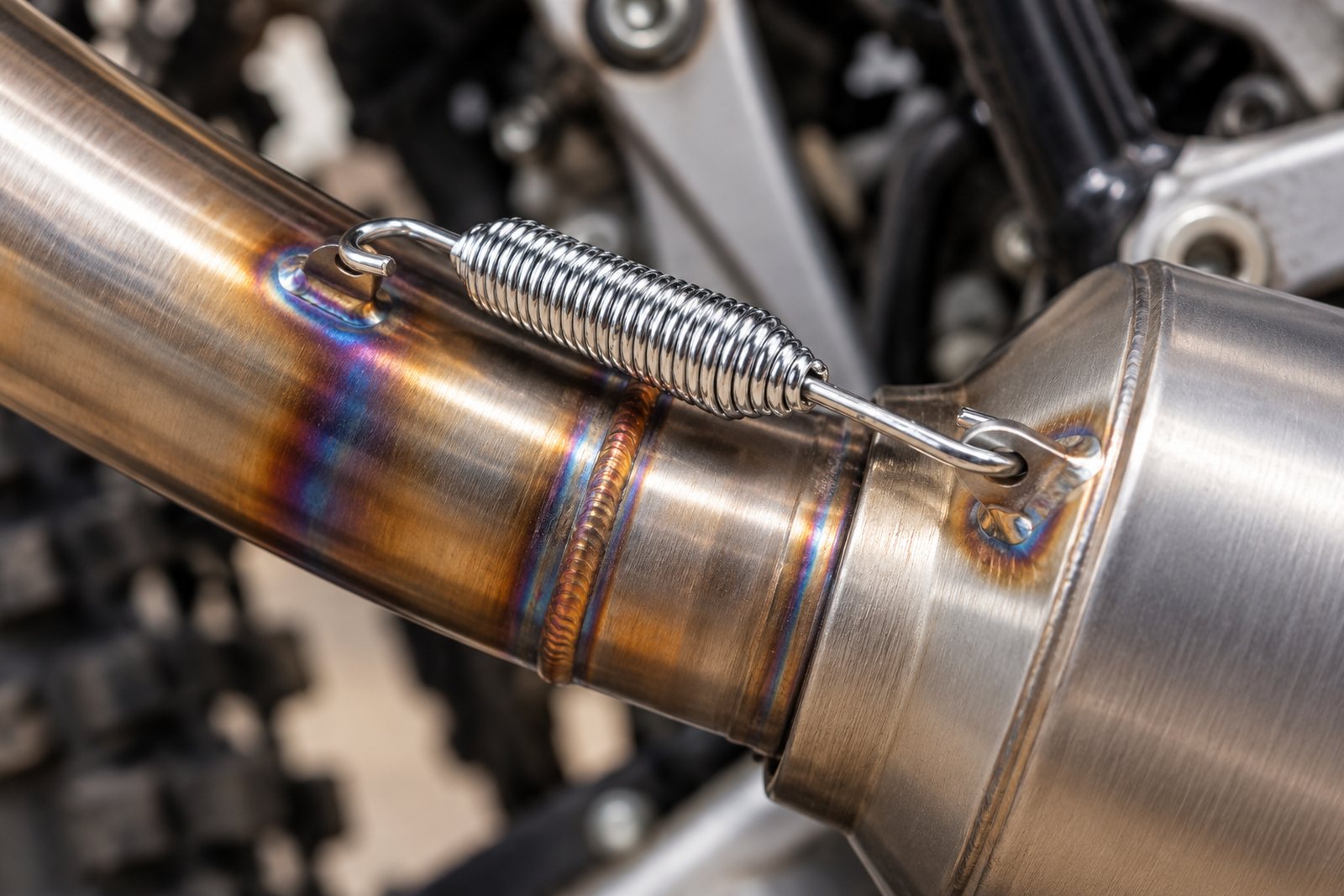
Cover image: an AI illustration based on a photograph of an exhaust pipe spring we make, placed in a new setting.
An exhaust spring is an extension spring that holds two parts of an exhaust system together while still letting them move. You find them across slip joints on motorcycle, ATV and snowmobile exhausts, between expansion chambers and silencers on two-stroke engines, and on the exhausts of generators and small engines. On cars, a related part, the compression spring on a flange “spring bolt”, clamps a ball joint between the manifold and the downpipe.
The job sounds simple, but the spring works in one of the hardest places on a vehicle: hot, vibrating, wet and full of road salt. Most exhaust spring failures trace back to three choices made early: the wire grade for the temperature at the spring, the hook shape, and how far the spring is stretched when someone fits it.
This guide is for engineers and buyers at exhaust system makers and aftermarket brands who need exhaust springs made to a drawing. It covers how the spring works, which material suits which temperature, a worked stress example, the usual failure modes and what to send for a quote. If you are new to extension springs, our extension spring guide covers the basics.
Key takeaways
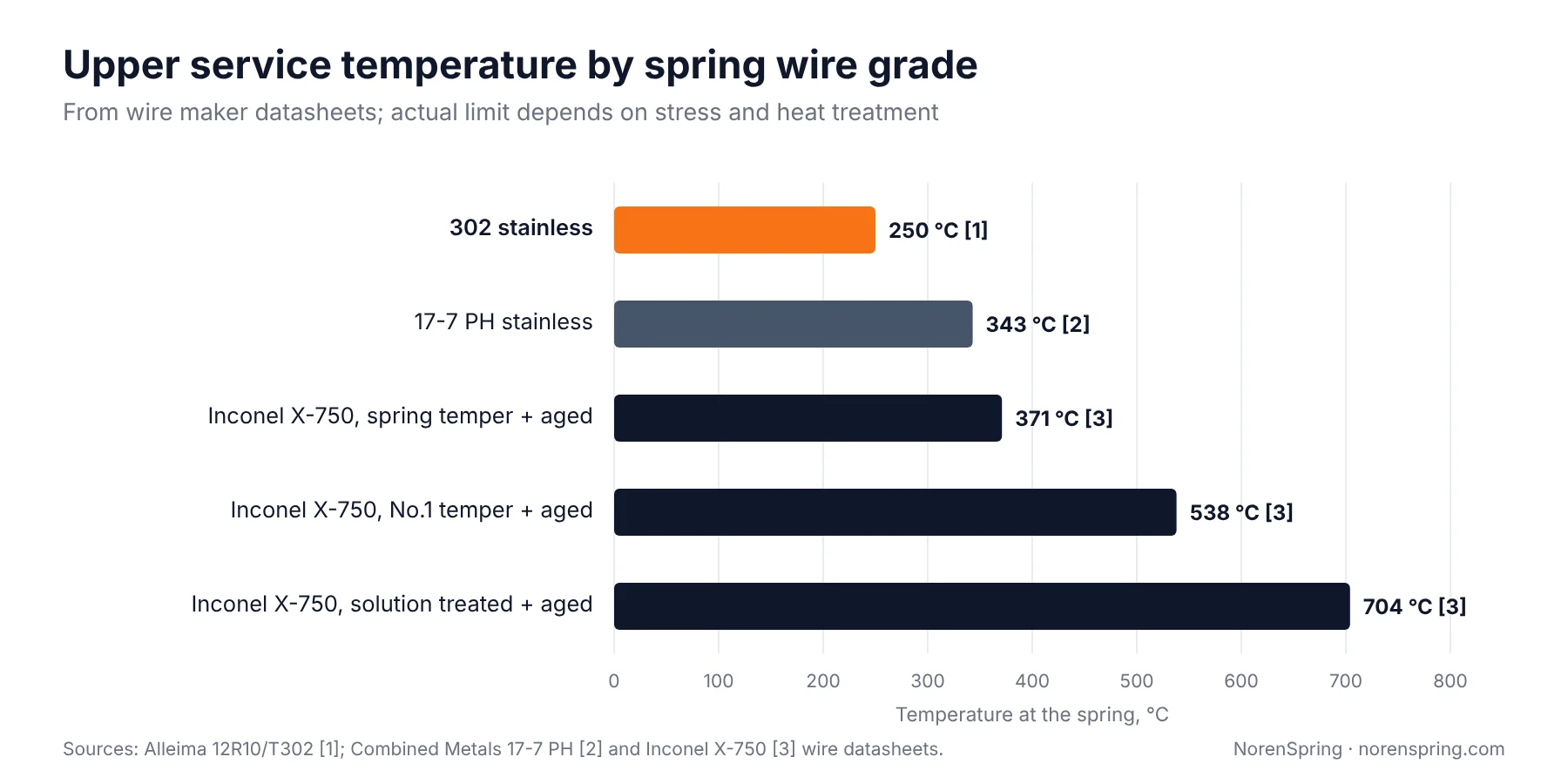
- Pick the wire by the temperature at the spring, not at the exhaust port. 302 stainless spring wire is rated for service up to about 250 °C, 17-7 PH up to about 343 °C, and Inconel X-750 up to 704 °C with the right heat treatment [1][2][3].
- Heat removes initial tension first. Extension springs keep their initial tension only if they are stress relieved at a low temperature, about 200 to 250 °C for 302 wire [1]. Run them hotter in service and the joint clamp drops.
- The hook is usually the weak point, and fitting is the worst moment. In our worked example, a full-diameter hook with a tight bend reaches 116% of its static limit when the spring is stretched 5 mm past its installed length to fit it. A tapered end with a gentler bend brings it to 55%.
- Stainless steel is less stiff than carbon steel. Its shear modulus is about 69 GPa against about 79 to 82 GPa for carbon spring steels such as music wire, so the same geometry gives a lower rate [4].
- Specify loads at two lengths, the temperature at the spring and the finish. “Exhaust spring, 75 mm” is not enough to make a part that fits and lasts.
How does an exhaust spring work?
An exhaust spring pulls two flanged or tabbed parts together so that a slip joint or ball joint stays sealed while the pipes grow with heat and shake with the engine. Bolts would hold the joint just as tightly when cold, but a rigid joint cannot slide when the pipe expands, and it cracks welds and brackets under vibration. A spring keeps a steady clamping force and lets the joint move a little.
Springs also make removal quick. A motorcycle silencer held by two springs comes off in moments with a spring puller, which matters for racing teams, dealers and riders who repack silencers.
There are two main designs.
Extension springs across a joint. One or more extension springs hook onto welded tabs or loops on each side of a slip joint or ball joint. The spring is stretched when fitted, so it always pulls the two parts together. This is the common design on motorcycles, ATVs, UTVs, snowmobiles and two-stroke expansion chambers, and it is the spring this guide is mainly about.
Compression springs on spring bolts. On many cars and light trucks, the joint between the exhaust manifold and the downpipe is a ball-and-socket joint clamped by two bolts. Each bolt carries a short compression spring under its head or nut. The spring lets the joint flex as the engine rocks on its mounts. The design questions are the same (temperature, relaxation, corrosion), but this part is a compression spring, not an extension spring.
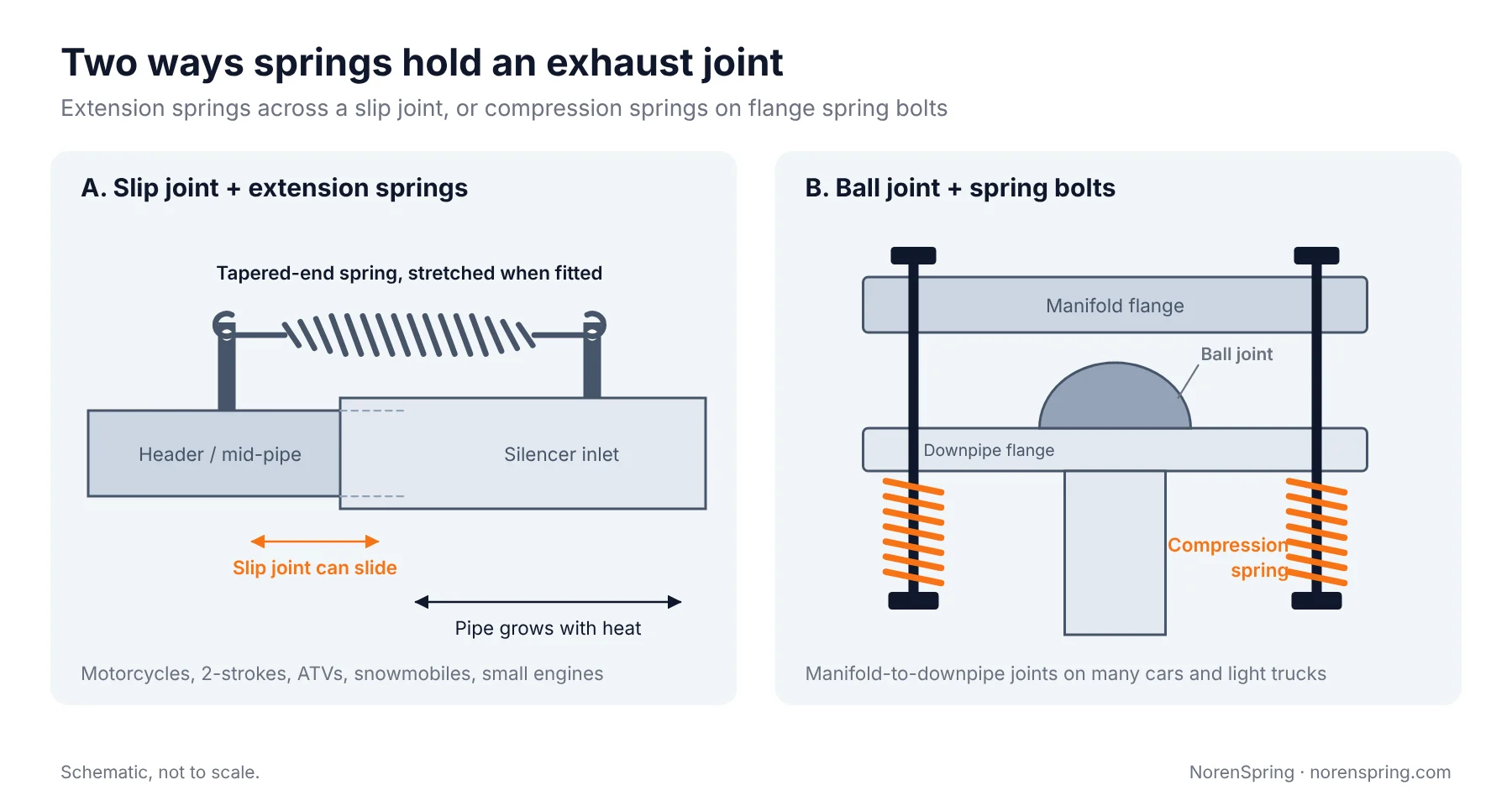
Where exhaust springs are used
- Motorcycle exhaust springs. Header to mid-pipe and mid-pipe to silencer slip joints, especially on off-road and aftermarket systems.
- 2-stroke exhaust springs. Expansion chamber to cylinder flange and chamber to silencer. The chamber also moves on rubber mounts, so the springs must allow movement in more than one direction.
- Snowmobile exhaust springs. Sleds use springs at the Y-pipe, expansion chamber and silencer joints. The springs often sit close to the hottest part of the pipe, then meet snow, meltwater and freezing temperatures as soon as the engine stops, so both the heat rating and corrosion resistance matter.
- ATV, UTV and small engine exhausts. Generators, pumps and garden machinery use springs at the manifold or silencer joint.
- Exhaust flange springs and exhaust manifold springs. The spring bolt design described above, mainly on cars and light trucks.
Which material should an exhaust spring be made of?
Choose the wire from the temperature the spring itself reaches, plus the corrosion it will see. The exhaust gas may be far hotter than the spring, because the spring sits outside the pipe, often on a tab away from the hottest section. But the spring can also sit right next to the header, where it gets much hotter than on a silencer joint. If you don’t know the temperature at the spring location, measure it on a running engine with a thermocouple or temperature crayon before choosing the grade. Our guide to high temperature springs lists the temperature limits of all common spring materials.
| Wire grade | Upper service temperature | Notes |
|---|---|---|
| 302 stainless (ASTM A313) | about 250 °C [1] | Standard choice; strength falls 3–4% per 100 °C |
| 17-7 PH stainless | about 343 °C [2] | Aged at about 482 °C after coiling |
| Inconel X-750, spring temper + aged | about 371 °C [3] | Low relaxation up to this temperature |
| Inconel X-750, No.1 temper + aged | about 538 °C [3] | For moderate or low stresses |
| Inconel X-750, spring temper + solution treated + aged | 538–704 °C [3] | Highest temperature, highest cost |
302 and 304 stainless steel. These austenitic grades are the usual choice for exhaust springs because they resist corrosion and need no plating. ASTM A313 covers stainless spring wire in both grades [5]. One wire maker rates its 302 spring wire for service from −200 °C to 250 °C, with tensile strength falling 3 to 4% for every 100 °C rise in temperature [1]. General spring material tables, including the one in our stainless steel springs guide, often give a higher figure of about 288 °C for 300-series springs. For an extension spring that must keep its initial tension, the lower figure is the safer basis. Our own exhaust pipe spring is made from 304 stainless wire. That guide also compares the other stainless grades.
17-7 PH stainless steel. This precipitation-hardening grade is coiled and then aged at about 482 °C (900 °F) for an hour to reach full strength [2]. Its maker lists spring service up to about 343 °C (650 °F) [2]. It is a step up from 302 for springs closer to the header, but in the aged condition its corrosion resistance is generally somewhat below 302 and 304, so check it for parts exposed to road salt.
Inconel X-750. This nickel alloy is the answer when the spring sits in real heat. Our Inconel springs guide shows how its temper and heat treatment set the limit. Its datasheet lists springs from cryogenic temperatures up to 704 °C (1,300 °F), but only with the right temper and heat treatment: spring temper plus aging for low relaxation up to about 371 °C, No.1 temper plus aging up to about 538 °C, and spring temper plus solution treatment and aging for 538 to 704 °C [3]. It costs far more than stainless steel, so use it only where the temperature demands it.
Carbon steel with zinc plating. Plated carbon steel springs are cheap and fine for cold parts of a machine, but zinc plating is not meant for exhaust heat. Use stainless steel or a nickel alloy for exhaust joints instead. Our spring finishes guide explains what each coating can and cannot do.
Why heat matters even below the rated limit
Two things happen to a hot extension spring.
First, initial tension relaxes. Initial tension is the force that holds the coils of an extension spring together before it starts to stretch. It is wound in during coiling and survives only a low-temperature stress relief. The 302 wire datasheet above recommends 200 °C for 0.5 to 3 hours, or about 250 °C for 3 to 20 minutes, for springs coiled with initial tension, and warns against the higher tempering temperatures used for compression springs [1]. If the spring runs hotter than this in service, expect initial tension to drop, and with it the clamping force at the joint.
Second, the wire gets weaker and the spring takes a set. With strength falling 3 to 4% per 100 °C [1], a spring that is close to its stress limit at room temperature has less margin when hot. A spring that has taken a set is longer when free and pulls less when fitted. That is how a joint that sealed on day one starts leaking months later. For more on how set and relaxation work, see why springs fail.
Passivation for stainless exhaust springs
Passivation is a chemical treatment that removes free iron and other surface contamination left on stainless steel by drawing and coiling, so the natural chromium oxide film can form evenly. ASTM A967 is the common specification for chemical passivation of stainless steel parts [6]. It does not change the dimensions or the load of the spring, and it does not add a coating. We passivate our 304 stainless exhaust springs.
Worked example: why the hook fails during fitting
In an extension spring the hook usually breaks before the coil body, and the most dangerous moment is often fitting, when the spring is stretched past its working length to get the hook over the tab. Here is a calculation for a typical stainless exhaust spring. It is an illustration, not a design for a specific exhaust.
Spring data (assumed): 302 stainless wire, d = 2.0 mm, mean coil diameter D = 12 mm (spring index C = D/d = 6), 20 body coils, initial tension stress 110 MPa. Installed, the spring is stretched 10 mm. To fit it, the installer pulls it a further 5 mm, to 15 mm.
Material values. Shear modulus G = 69.0 GPa and elastic modulus E = 193 GPa for A313 stainless wire [4]. Minimum tensile strength from Shigley’s constants for A313 wire, Sut = A/d^m with A = 1,867 MPa·mm^m and m = 0.146: Sut ≈ 1,687 MPa [4].
Static limits for austenitic stainless extension springs [4][7]: body torsion 35% of Sut (591 MPa), hook torsion 30% (506 MPa) and hook bending 55% (928 MPa).
Rate. Active coils Na = Nb + G/E = 20 + 0.36 = 20.36. Rate k = d⁴G / (8D³Na) = 3.92 N/mm.
Initial tension. For C = 6, Shigley’s preferred range is about 99 to 147 MPa [4], so 110 MPa is inside it. Initial tension force Fi = πd³τi / (8D) ≈ 28.8 N.
Forces. Installed: F = 28.8 + 3.92 × 10 ≈ 68 N. At fitting: F = 28.8 + 3.92 × 15 ≈ 88 N.
Body stress. With the Bergsträsser factor KB = (4C + 2)/(4C − 3) = 1.24, τ = KB × 8FD/(πd³) = 322 MPa installed (54% of the limit) and 414 MPa at fitting (70%). The coil body is comfortable.
Hook stresses. Shigley gives the bending stress at the top of the hook (point A) and the torsional stress at the bend where the hook meets the body (point B) [4]. Both rise with the hook radius, because the force acts at that radius, and point B rises sharply as the bend radius r2 gets tighter. Applying the same equations with the hook formed at the full 12 mm coil diameter, and with a tapered end that brings the hook down to 8 mm (for the tapered end we use the smaller hook radius as the moment arm, a simplification of Shigley’s model, which assumes the hook sits at the full coil diameter):
| Case at fitting stretch (88 N) | Hook bending at A | Hook torsion at B |
|---|---|---|
| Full-diameter hook, bend radius r2 = 2 mm (1d) | 792 MPa, 85% of limit | 586 MPa, 116% of limit |
| Full-diameter hook, r2 = 4 mm (2d) | 792 MPa, 85% | 418 MPa, 83% |
| Tapered end, hook at 8 mm, r2 = 2 mm | 577 MPa, 62% | 391 MPa, 77% |
| Tapered end, hook at 8 mm, r2 = 4 mm | 577 MPa, 62% | 279 MPa, 55% |
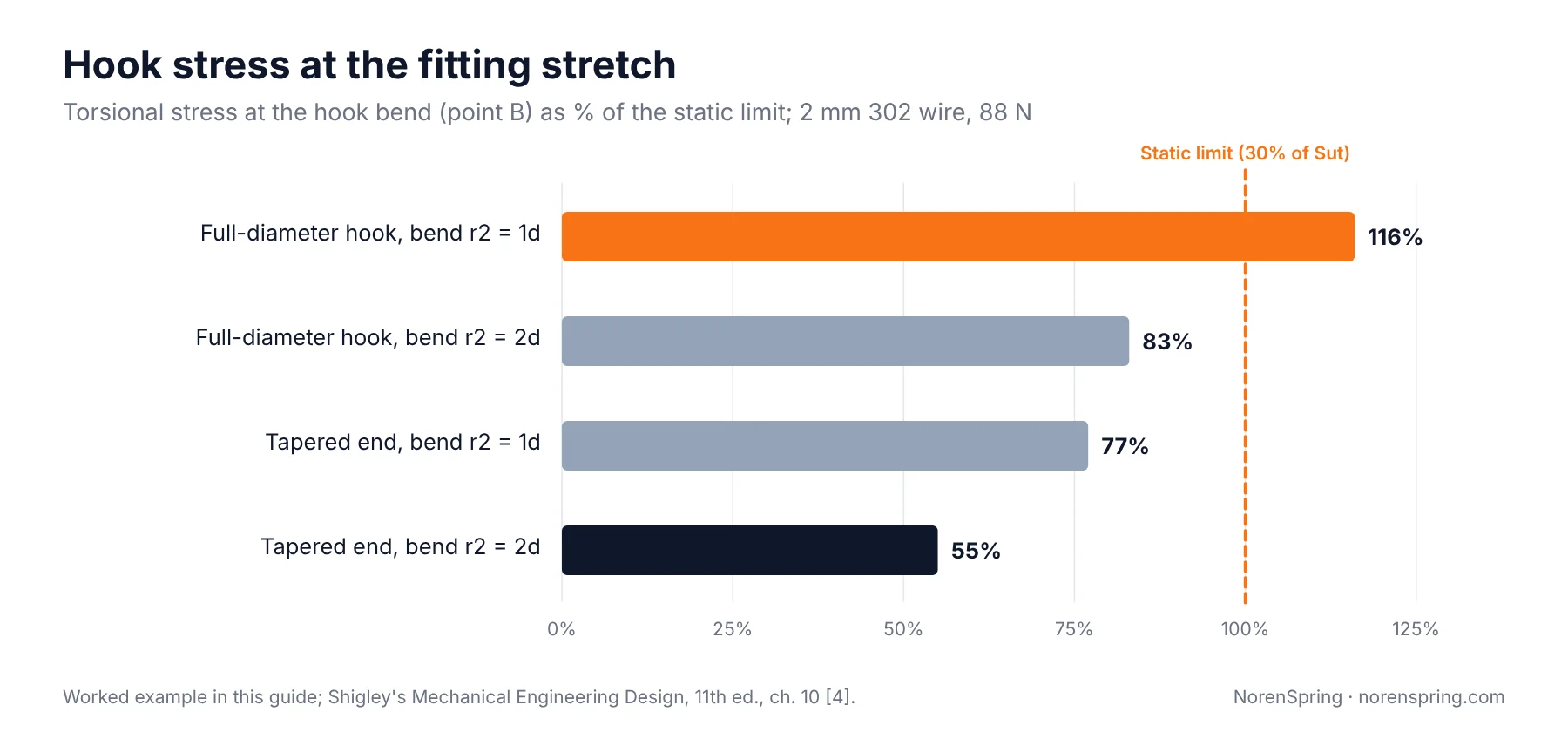
At the installed length, the worst case (full-diameter hook, tight bend) is at 90% of its limit. So the spring might pass a bench test at working length and still crack at the hook bend after a few fittings, or after a few months of heat that cuts the wire’s strength.
What this example shows:
- Check stresses at the fitting length, not just the working length. If fitters stretch the spring further than its installed length, put that length on the drawing as a maximum extension.
- Specify a minimum bend radius at the hook. Going from 1d to 2d in this example cut the torsional stress at point B by 29%.
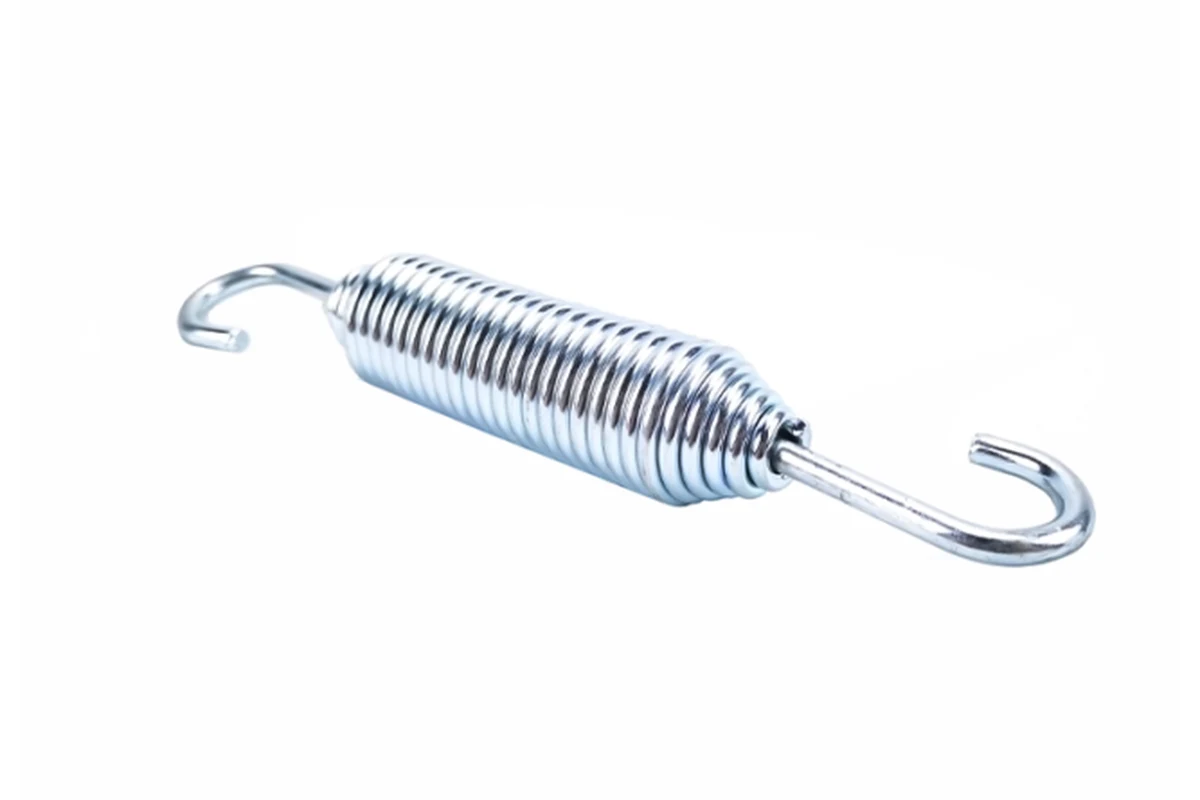
- Tapered ends are not just for looks. Coiling the last turns down to a smaller diameter puts the hook closer to the spring axis, so the same force makes less bending and torsion. This is why so many exhaust springs have conical ends and long extended hooks, like the one in our photo above.
- Add margin for heat. Fitting usually happens cold, but the spring then spends its life hot. At 200 °C, tensile strength is about 5 to 7% lower than at room temperature [1]. In this example that pushes the installed worst case (full-diameter hook, tight bend) from 90% to about 96% of its limit, which is too close. The tapered end with a 2d bend goes from 43% to about 46%.
How exhaust springs fail, and how to prevent it
Most exhaust spring failures fall into four groups. Each has a fix that belongs on the drawing.
- Hook fracture. Usually at the bend at point B, sometimes starting from a tool mark. Prevention: minimum bend radius, tapered ends where space allows, a maximum extension for fitting, and no nicks from forming tools.
- Loss of force (relaxation and set). The joint leaks or rattles after the exhaust has been hot for a while. Prevention: choose the grade for the actual temperature at the spring, keep stresses moderate, and if the application is hot, ask for a heat soak test on samples (load at a set length before and after a soak at the service temperature).
- Wear at the tab. The hook wears a notch into the welded tab or the tab wears the hook. Prevention: hook wire and tab shape that suit each other, and a hook that seats fully on the tab without rocking. Some aftermarket kits use springs with a heat-resistant silicone sleeve to protect paint and reduce rattle. If you want a sleeve, check its temperature rating and say so on the drawing.
- Corrosion. Road salt and water attack carbon steel quickly, and even stainless steel stains if the surface is contaminated. Prevention: stainless steel or nickel alloy wire, and passivation [6].
Vibration and fatigue
The stress checks above are static. On a running engine, vibration makes the spring and its hooks cycle around the installed load over and over, and the static limits do not cover that. In extension springs, fatigue cracks usually start at the hook bend or at a surface mark. Keep the installed stresses moderate, use generous hook bend radii and smooth forming, and make sure the spring’s own natural frequency is well away from the main engine vibration frequencies, or the coils can surge and the stress swing grows. Our spring natural frequency guide shows how to check it. If the application is demanding, ask for a fatigue test on samples at the real installed length.
What to send for an exhaust spring quote
A spring maker can quote and make a matching part quickly when the request includes the following. A drawing is best, but a sample with the loads written on it also works.
- Drawing or sample with free length inside hooks, outside diameter, wire diameter and coil count.
- Two loads at two lengths, usually the installed length and the maximum extension at fitting, with tolerances.
- Initial tension, or a load at a short extension, if the joint needs a minimum clamp before the spring starts to stretch.
- Hook details: type (machine loop, extended hook, offset hook), hook opening, hook orientation relative to each other, minimum bend radius, and whether the ends are tapered.
- Temperature at the spring location, not just at the engine, and how long it stays there.
- Material and finish, for example “302 or 304 stainless, ASTM A313, passivated per ASTM A967”, or “Inconel X-750, No.1 temper, aged”. Our spring wire material guide lists the common grades and equivalents.
- Tests you need, such as a two-point load test, a heat soak test or a salt spray test, and the sample quantity.
- Annual quantity and packing, for example bulk, pairs or kits with tabs.
If the exhaust is for a particular motorcycle, ATV or snowmobile, you can name the compatible model. We use model names only to identify the fit.
How we make exhaust springs
We make exhaust springs as custom extension springs to the customer’s drawing or sample. Our exhaust pipe spring is coiled from 304 stainless wire of 1 to 3 mm and passivated; the one in the photo above has tapered ends and extended hooks. It goes mainly to customers in the USA and Japan. Our engineers confirm manufacturability before quoting and can review the loads and hook stresses at both the working and the fitting length if you send both. Prototype samples are available for dimensional, load and fit approval before production. For other parts of the vehicle, see our automotive springs page.
Frequently asked questions
What is an exhaust spring?
An exhaust spring is an extension spring that clamps two exhaust parts together at a slip joint or ball joint, so the joint stays sealed while the pipes expand with heat and move with the engine. On cars, the spring on a manifold flange bolt is a compression spring that does the same job.
What size exhaust spring do I need?
It depends on the distance between the tabs, the clamp force the joint needs and the space around it. Measure the free length inside the hooks, the outside diameter and the wire diameter of the existing spring, and the distance between the tabs when the joint is assembled. A spring maker will also need the load at the installed length. Our guide on how to measure a spring shows how.
Are stainless steel exhaust springs better?
For most exhausts, yes. 302 and 304 stainless steel resist corrosion without plating, and one wire maker rates 302 spring wire for service up to about 250 °C, with strength falling 3 to 4% per 100 °C [1]. Stainless steel is less stiff than carbon steel, so a stainless spring of the same size pulls a little less, and the design has to account for that [4]. Above about 250 °C at the spring, use 17-7 PH or a nickel alloy such as Inconel X-750 [2][3].
Why do exhaust springs break at the hook?
Because the hook carries the highest stress, especially at the bend where it joins the coil body. Tight bend radii, full-diameter hooks and overstretching during fitting all raise it. A gentler bend and tapered ends lower it a lot, as the worked example above shows.
How long should motorcycle exhaust springs be?
There is no standard length. Measure the distance between the tabs with the joint assembled. The spring’s free length inside the hooks must be shorter than that, so it is stretched, and clamping, once fitted. Send both numbers to the spring maker with the wire diameter and outside diameter.
Why does my exhaust joint leak after the springs have been hot?
The springs have probably lost force. Heat relaxes initial tension and can make the spring take a set, so it pulls less at the same length [1]. Check the free length and the load at the installed length against a new spring. If the old spring is longer or weaker, replace it with one made from a grade suited to the temperature.
Do exhaust springs need preload?
Yes. An extension spring across a joint is always fitted stretched, so it clamps the joint from the moment it is installed. The force at the installed length is the spring’s preload; see our spring preload guide for how to set it.
About the authors
This guide was prepared by the NorenSpring engineering team, which designs and manufactures custom compression, extension and torsion springs and wire forms in Xuzhou, China. Technical review by Feng Yulin, General Manager and senior structural engineer, who has 15 years of spring R&D experience and more than 30 national patents. NorenSpring holds IATF 16949, ISO 9001, ISO 13485, ISO 14001 and ISO 45001 certifications. The product photo shows our own spring; the cover is an AI illustration based on that photo. The worked example is a calculation for illustration. Sources were last checked on October 27, 2026.
Need exhaust springs made to your drawing or sample? Send us the details with the loads, the temperature at the spring, the finish and the annual quantity. Our engineers give feedback within 24 hours and confirm the design with the quotation.
Sources
The numbers in square brackets in the text refer to this list.
- Alleima (formerly Sandvik), 12R10 / T302 spring wire datasheet (published by Zapp): service temperature −200 to 250 °C, strength loss 3–4% per 100 °C, heat treatment of tension springs with initial tension. Retrieved 2026-10-27.
- Combined Metals of Chicago, 17-7 PH wire datasheet: spring service up to 650 °F (343 °C), CH900 aging at 900 °F (482 °C) for 60 minutes. Retrieved 2026-10-27.
- Combined Metals of Chicago, Inconel X-750 wire datasheet: springs from cryogenic temperatures to 1,300 °F (704 °C); relaxation limits by temper and heat treatment. Retrieved 2026-10-27.
- Budynas, R. G. and Nisbett, J. K., Shigley’s Mechanical Engineering Design, 11th edition, McGraw-Hill, chapter 10 (Mechanical Springs): Table 10-4 tensile strength constants (A313 stainless), Table 10-5 elastic constants, extension spring rate, hook stresses at points A and B, preferred initial tension range and Table 10-7 static stress limits.
- ASTM International, ASTM A313/A313M, Standard Specification for Stainless Steel Spring Wire. Retrieved 2026-10-27.
- ASTM International, ASTM A967/A967M, Standard Specification for Chemical Passivation Treatments for Stainless Steel Parts. Retrieved 2026-10-27.
- Shigley, J. E. and Mischke, C. R., Standard Handbook of Machine Design, 2nd edition, McGraw-Hill, 1996, chapter 24 (Springs): allowable stresses for extension springs in static service.



