










In this article
- Key takeaways
- Where are small torsion springs used?
- Why a few microns of wire change the torque
- Torque per degree for small wire sizes
- Stainless steel torsion spring or music wire?
- Leg and arm styles for a miniature torsion spring
- Winding direction and arbor clearance at small sizes
- Tolerances that are realistic for small torsion springs
- Cycle life of small torsion springs
- How to inspect torque at small angles
- What to send for a quote
- Frequently asked questions
- About the authors
- Sources
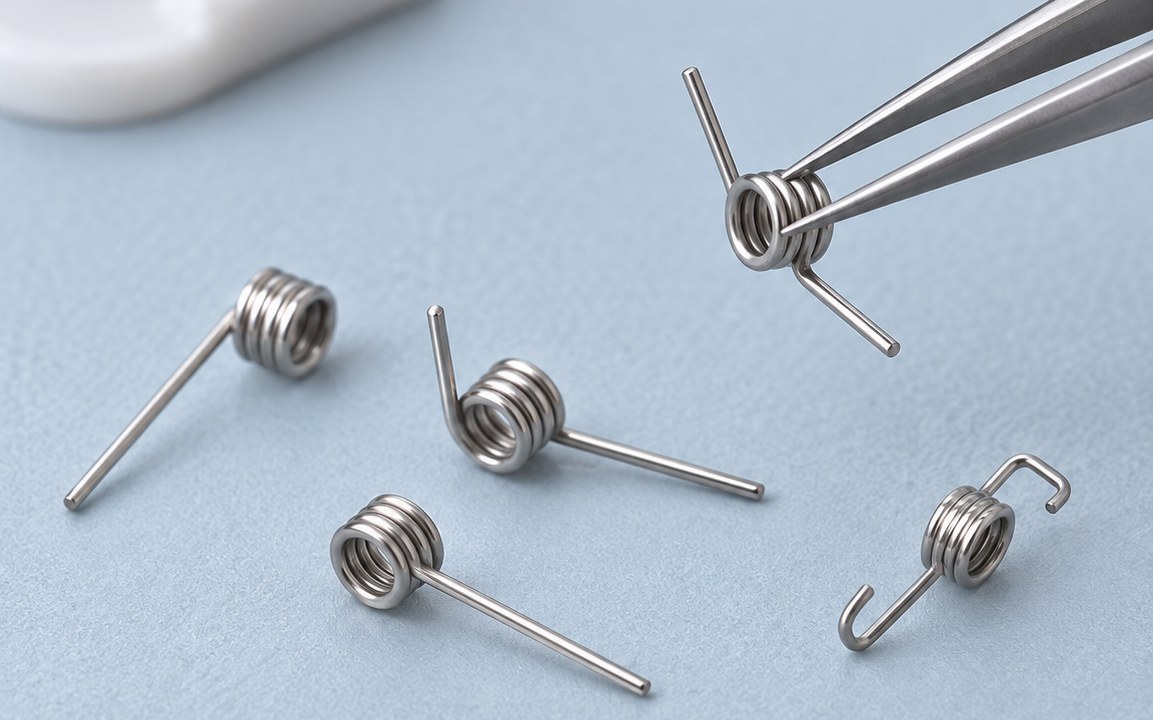
Cover image: an AI illustration based on a photograph of torsion springs we make, placed in a new setting.
Small torsion springs are helical torsion springs wound from fine wire, typically from about 0.1 mm up to about 2 mm in diameter, that return a hinge, lever, lid or latch to its rest position by applying torque through their legs. They work like any other torsion spring, and the difference is mainly one of scale: at these sizes, a change of 0.01 mm in wire diameter can move the torque by about 2% to 22% (Figure 1, calculated October 2026), and the clearance to the pin is a fraction of a millimetre.
This guide is for engineers and buyers who need a miniature torsion spring for a hinge, clip, sensor or small device. It covers where these springs are used, how torque scales with wire size, a table of torque per degree we calculated for wire from 0.2 to 1.2 mm, stainless steel versus music wire, leg styles, arbor clearance, tolerances, cycle life, torque inspection and what to send for a quote. For the full calculation method on any size of spring, use our torsion spring calculator.
Key takeaways
- Wire size dominates. Torque rate is proportional to d⁴. On 0.3 mm wire, 0.01 mm more wire raises the torque by 14%; on 2 mm wire, by only 2% (Figure 1, calculated October 2026).
- Stainless costs strength and angle. The static bending limit for austenitic stainless is about 0.61 × tensile strength, against 0.78 × for music wire (Shigley, 2020). In our table, a 302 stainless spring reaches its limit at about 80° to 98° of rotation, while the same music wire spring goes to 115° to 148°.
- Specify torque at an angle, not coil count. Let the maker adjust coils to hit the torque with the wire actually on the reel.
- Expect angle tolerances in degrees, not fractions. A common commercial guide is ±8° for up to 3 coils and ±10° for 3 to 10 coils (Shigley, 2020).
- Measure torque at two angles. The rate from two points avoids most zero-position error on a spring that only gives a few N·mm.
Where are small torsion springs used?
A miniature torsion spring is the smallest end of this range, usually with wire under about 0.5 mm and an outside diameter of a few millimetres. Small torsion springs sit wherever a part must rotate through a defined angle and return on its own within a very compact envelope. Typical applications include:
- Hinges and lids: battery covers, flip lids, small doors and access hatches. The larger springs inside self-closing door hinges are covered in our guide to hinge springs.
- Latches and catches: push-to-open catches, locking pawls and trigger returns.
- Clips and clamps: spring clips, cable clamps, small grippers and clothespin springs.
- Sensors and switches: lever-type switches, flaps in flow sensors and return arms on position sensors.
- Consumer and medical devices: dispensers, small hand tools and the return mechanisms in handheld devices.
- Electronics: connector latches, card ejectors and test-socket lids.
We make precision small springs from wire as fine as 0.1 mm, and our ISO 13485 certificate covers the design and manufacture of springs for medical devices. Our medical spring solutions page shows how we handle documentation for that sector. For these devices, we can review the space, the torque and the cleanliness needs before quoting.
Why a few microns of wire change the torque
The torque rate of a torsion spring is k = d⁴E / (10.8 · D · Na) per turn, where d is the wire diameter, E the modulus of elasticity, D the mean coil diameter and Na the active coils (Shigley, 2020). The constant 10.8 includes an allowance for friction between the coils and the arbor. The fourth power on d is what makes small springs sensitive.
However, a wire tolerance that looks tight in millimetres is large in percent on fine wire. We compiled the effect of one hundredth of a millimetre across common sizes:
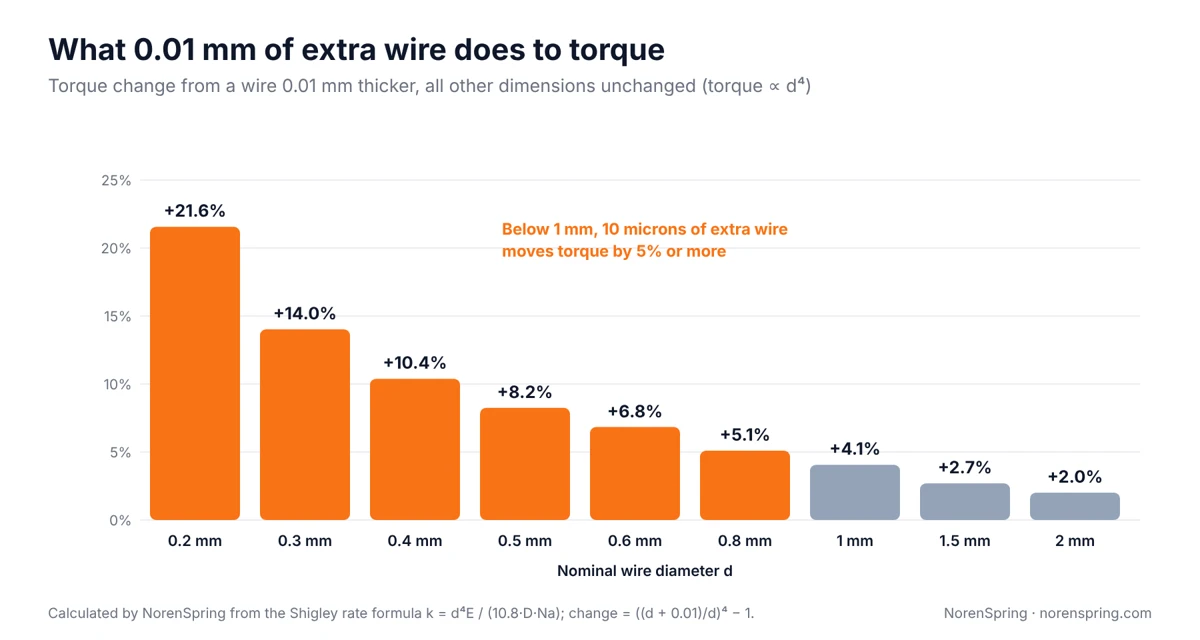
Two practical consequences follow. First, the torque on a miniature torsion spring cannot be controlled by the wire specification alone, so the manufacturer adjusts the coil count or the free angle for each wire lot to land on the target torque. Second, a drawing that fixes wire diameter, coil count and torque simultaneously over-constrains the part. Specify the torque and the available space, and allow the coil count to vary.
Torque per degree for small wire sizes
The table below is our own calculation. We ran the Shigley equations for eight wire sizes from 0.2 to 1.2 mm, using the minimum tensile strength that ASTM sets for each size. It shows what a simple small spring can do as the wire gets finer, and where it runs out of stress. It is a starting point for sizing, not a rated part.
Methodology: spring index C = D/d = 8, five body coils, short legs (leg bending ignored), load in the winding direction. E = 28.5 Mpsi (196.5 GPa) for music wire and 28.0 Mpsi (193.1 GPa) for 302 stainless [5]. Minimum tensile strength by size from ASTM A228 for music wire [2] and ASTM A313 Table 5 for 302 [3]. Static limit 0.78 × Sut (music wire) and 0.61 × Sut (stainless); 10⁶-cycle limit 0.50 × Sut, not shot-peened (Shigley, 2020).
| Wire d (mm) | OD (mm) | Rate, music wire (N·mm/°) | Rate, 302 (N·mm/°) | Max static torque, music wire (N·mm) | Max static torque, 302 (N·mm) | Torque for 10⁶ cycles, 302 (N·mm) |
|---|---|---|---|---|---|---|
| 0.2 | 1.8 | 0.0101 | 0.0099 | 1.50 | 0.97 | 0.80 |
| 0.3 | 2.7 | 0.0341 | 0.0335 | 4.88 | 3.20 | 2.62 |
| 0.4 | 3.6 | 0.0809 | 0.0795 | 11.1 | 7.39 | 6.05 |
| 0.5 | 4.5 | 0.158 | 0.155 | 20.8 | 14.1 | 11.5 |
| 0.6 | 5.4 | 0.273 | 0.268 | 35.3 | 23.6 | 19.4 |
| 0.8 | 7.2 | 0.647 | 0.636 | 80.0 | 54.1 | 44.3 |
| 1.0 | 9.0 | 1.26 | 1.24 | 149 | 103 | 84.4 |
| 1.2 | 10.8 | 2.18 | 2.15 | 252 | 173 | 142 |
Calculated by NorenSpring, October 2026. Formulas: rate from the Shigley equation above; stress σ = Ki · 32M / (πd³) with Ki = 1.103 at C = 8 (Shigley, 2020).
Three patterns stand out:
- Torque falls fast with size. At a fixed index, the rate and the torque limit scale with d³. Halving the wire from 1.0 to 0.5 mm cuts both by a factor of eight.
- Stainless gives less rotation. Divide the static torque by the rate. Music wire reaches its limit at 148° on 0.2 mm wire and 115° on 1.2 mm. 302 stainless reaches it at 98° and 81°. If a stainless steel torsion spring has to turn further, it needs more coils.
- Fine wire is slightly more forgiving. Smaller wire has a higher tensile strength, so the allowable angle rises a little as the wire gets finer.
Stainless steel torsion spring or music wire?
Choose the material by operating environment first, then confirm torque and angular deflection. A stainless steel torsion spring is a torsion spring wound from austenitic stainless wire such as 302, 304 or 316, chosen for corrosion resistance at some cost in strength. Music wire is the stronger choice for dry, indoor assemblies, whereas stainless wire is the usual choice where the spring meets moisture, cleaning agents or contact with skin.
| Factor | Music wire (ASTM A228) | 302 / 304 stainless (ASTM A313) | 316 stainless |
|---|---|---|---|
| Min. tensile strength, 0.20 mm | 2,700 MPa [2] | 2,240 MPa [3] | Lower than 302; see below |
| Min. tensile strength, 1.0 mm | 2,150 MPa | 1,895 MPa | Lower than 302 |
| Modulus E | 28.5 Mpsi | 28.0 Mpsi | 28.0 Mpsi [5] |
| Static bending limit | 0.78 × Sut | 0.61 × Sut | 0.61 × Sut (Shigley, 2020) |
| Corrosion | Needs a finish or oil | Good indoors and in moisture | Better in chlorides |
ASTM A228 describes music wire as intended for “springs subject to high stresses or requiring good fatigue properties” [2]. ASTM A313 covers the stainless spring wires, including 302, 304 and 316 [3]. In the international standard, ISO 6931-1 (EN 10270-3 in Europe), 316 (grade 4401) has a minimum of 1,575 MPa at 0.8 to 1.0 mm, against 1,850 MPa for 302 (grade 4325) [4]. Use 316 only where its extra corrosion resistance is needed, and expect a larger wire or more coils for the same torque.
In addition, watch the modulus. Autodesk’s metric table lists 175 GPa for drawn austenitic stainless wire, while its inch table gives 28.0 Mpsi, or about 193 GPa [5]. That spread alone moves a calculated torque by about a tenth. As a result, it is one more reason to specify the torque you need rather than a coil count. Our stainless steel springs guide and music wire springs guide compare the two wire families in more depth.
Leg and arm styles for a miniature torsion spring
The legs transfer the load into and out of the coil body, and most problems with small springs originate at the legs rather than in the coils. Five configurations cover most designs:
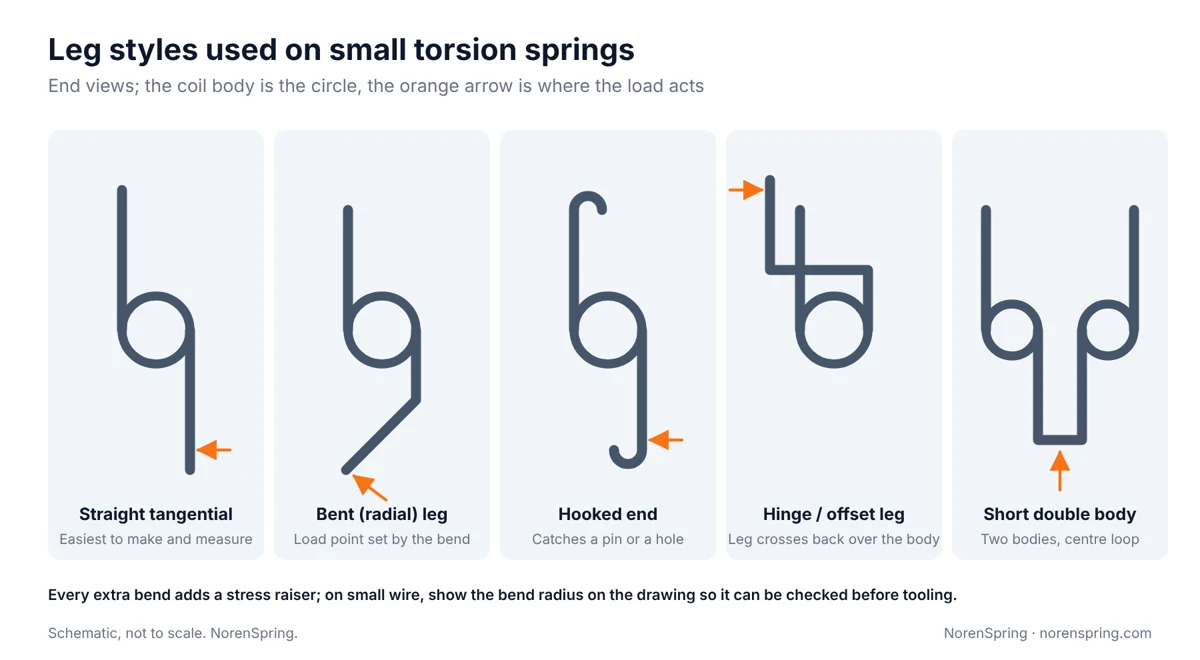
- Straight tangential legs are the simplest to make, to measure and to hold to an angle.
- Bent or radial legs move the load point. Each bend adds a stress raiser.
- Hooked ends catch a pin or a hole. On fine wire, the hook radius is often the weakest point.
- Hinge or offset legs cross back over the body. They need room, so check the axial space.
- Short double bodies balance the load across a wide part. Our double torsion spring guide explains how to size one.
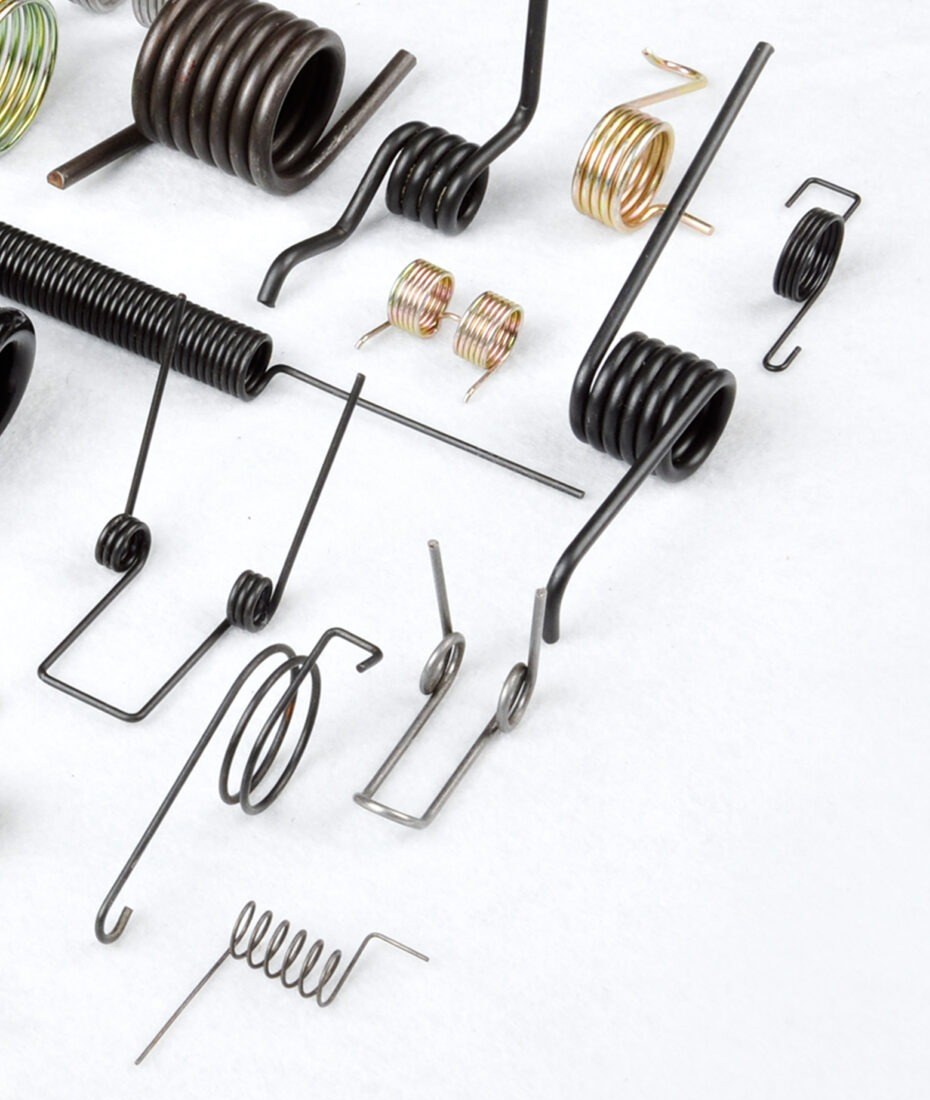
On wire under 1 mm, show the leg lengths from the coil centre, the bend angles and the bend radii on the drawing. Small radii are hard to see by eye, so a dimensioned radius lets us check it on a vision system before tooling is made. You can see the full range of forms on our custom torsion springs page.
Winding direction and arbor clearance at small sizes
Load the spring in the direction that closes the coils, so that the body diameter decreases as it winds up and the inside diameter (ID) gradually approaches the pin. Shigley gives the clearance at full rotation as Δ = Nb · D / (Nb + θc) − d − Dp, where Nb is the body coils, θc the body’s rotation in turns and Dp the pin diameter (Shigley, 2020).
On a small spring, the numbers are tiny. For example, in the scenario below, a 0.5 mm spring with a 3.5 mm ID closes to about 3.33 mm at 110°. A 3.0 mm pin leaves only 0.33 mm. Add the tolerance on the spring ID and the pin, plus any coating, and the margin shrinks again. Three habits help:
- Give the pin diameter and its tolerance, not just a nominal size.
- State the maximum rotation, so the closed ID can be checked.
- Mark LH or RH. A left-hand spring cannot be swapped for a right-hand one. Our guide on how to measure a spring shows how to read the hand on a sample.
Tolerances that are realistic for small torsion springs
Tolerance only what the assembly needs, usually the torque at one angle, the free angle and the ID. Typical commercial values are a useful guide:
| Characteristic | Typical commercial tolerance | Note |
|---|---|---|
| Relative end (leg) position, up to 3 coils | ±8° | For D/d up to 16 (Shigley, 2020) |
| Relative end position, over 3 to 10 coils | ±10° | Closer tolerances on request (Shigley, 2020) |
| Relative end position, over 10 to 20 coils | ±15° | (Shigley, 2020) |
| Torque at a stated angle | Agreed per part | Set by wire lot, free angle and coil count |
In particular, the angle tolerance grows with the coil count because each coil adds a little spring-back. In Germany, DIN 2194 sets quality grades for cold-coiled torsion springs. Its contents cover coil diameter, spring torque, relative end angle, free body length, leg lengths, bend radii, bend angles and torque testing [7]. The European calculation standard is EN 13906-3, for cylindrical helical torsion springs with a linear characteristic made from round wire [6].
On a miniature torsion spring, a torque tolerance must allow for the wire. Figure 1 shows why: on 0.3 mm wire, the normal variation in wire diameter alone can use up most of a tight torque band. In other words, holding a tight torque is possible, but the maker does it by adjusting coils or free angle, and the drawing must allow that.
Cycle life of small torsion springs
For springs that operate cyclically, keep the maximum bending stress well below the static limit. Shigley quotes a recommended maximum bending stress for torsion springs in cyclic service. For music wire and 302 stainless that are not shot-peened, it is 53% of Sut for 10⁵ cycles and 50% for 10⁶ cycles (Shigley, 2020). Leg bends, scratches and poor loading direction lower the real life, so test samples in the device.
Example scenario (an illustration, not a customer record). A small lid needs about 3 N·mm closed and 12 N·mm fully open, 110° of rotation from free. The lid sees moisture, so 302 stainless is chosen.
| Option A | Option B | |
|---|---|---|
| Wire, mean diameter | 0.50 mm, D = 4.0 mm | 0.55 mm, D = 4.0 mm |
| Body coils (5 mm legs) | 6.75 | 10 |
| Rate | 0.111 N·mm/° | 0.111 N·mm/° |
| Torque at 27.5° / 110° | 3.0 / 12.2 N·mm | 3.0 / 12.2 N·mm |
| Bending stress at 110° | about 1,093 MPa | about 830 MPa |
| Against 10⁶-cycle limit (0.50 × Sut) | 1,035 MPa: over | 1,020 MPa: under |
| ID at 110° | 3.50 → 3.33 mm | 3.45 → 3.33 mm |
| Body length, close-wound | 3.9 → 4.0 mm | 6.1 → 6.2 mm |
Both springs give the same torque. However, Option A is shorter but runs above the 10⁶-cycle stress, so it suits a part that opens rarely. Option B uses 0.05 mm more wire and more coils. It drops the stress by about a quarter but needs about 2 mm more axial space. This is the typical trade-off on a small spring: stress against space. Our custom torsion spring guide covers the same choices for larger parts.
How to inspect torque at small angles
A spring that delivers only 1 to 15 N·mm is easy to misread on general-purpose equipment. These checks keep the measurements consistent and comparable:
- Measure at two angles. Read the torque at, say, 30° and 90° from free. The rate is the difference in torque divided by 60°. This removes most of the error in finding the free position.
- Support the spring on a mandrel. Use one slightly smaller than the closed ID, and record its size. A spring tested with and without a mandrel can read differently because of friction.
- Load in the winding direction. Read torque while winding up, and note if the agreed value is taken on the way up or the way back.
- Match the tester to the torque. The tester range should suit the small torque, so the reading is not at the bottom of the scale.
- Check angles optically. On fine wire, free angle and leg position are easier to check on a vision system than with a protractor.
Our in-house testing laboratory checks torque against angle on torsion testers and checks dimensions on vision measuring systems. The records supplied, such as inspection reports, material certificates and dimensional records, are agreed at project setup.
What to send for a quote
Send whatever information you already have; if some items are missing, our engineers can work from a sample or from a photograph of the spring in its installed position.
| # | Item | Example |
|---|---|---|
| 1 | Torque at one or two angles from free | 3 N·mm at 27.5°, 12 N·mm at 110° |
| 2 | Free angle between the legs | 150° |
| 3 | Wind direction and which leg moves | RH, load closes the coils |
| 4 | Pin diameter and tolerance; axial space | Pin 3.0 −0.05 mm; 7 mm between walls |
| 5 | Leg lengths, end forms and bend radii | 5 mm straight, 5 mm with 90° hook |
| 6 | Material or environment | 302 stainless, humid, cleaned weekly |
| 7 | Cycle life | About 20 openings a day |
| 8 | Finish and cleanliness | Passivated, no oil |
| 9 | Quantity and records | Samples, then volume; material certificate |
Without a drawing, the wire diameter, outside diameter and leg lengths are enough to start. We accept DWG, DXF, STEP, PDF, JPG and PNG files, and we reply with engineering feedback or a quotation within 24 hours. There is no fixed minimum order quantity, so small prototype batches are fine. Send your drawing or sample through our contact page.
Frequently asked questions
What is the smallest torsion spring wire size you can make?
Our wire range starts at 0.1 mm. At that diameter, the available torque is a small fraction of a N·mm per degree, so the design normally begins from the required torque and the installation space rather than from a catalogue part.
Is a stainless steel torsion spring weaker than a music wire one?
Yes, for identical dimensions. 302 stainless has a lower minimum tensile strength at every diameter, and its static bending limit is approximately 0.61 × Sut compared with 0.78 × for music wire. In our table, that limits a stainless spring to about two-thirds of the music wire torque.
Why does my small torsion spring give a different torque from the calculation?
The usual causes are the actual wire diameter, the modulus value assumed in the calculation, friction on the mandrel and the method used to establish the free angle. On fine wire, a 0.01 mm difference alone can shift torque by about a fifth on 0.2 mm wire and by about a twentieth on 0.8 mm wire.
How tight can the leg angle tolerance be on a miniature torsion spring?
A common guide is ±8° to ±10° for springs with up to 10 coils. Closer tolerances can be agreed where the assembly needs them, but they cost more to hold.
About the authors
This guide was prepared by the NorenSpring engineering team, which designs and makes custom compression, extension and torsion springs, precision small springs and wire forms in Xuzhou, China. Reviewed by Feng Yulin, General Manager and senior structural engineer, with 15 years of spring R&D experience and more than 30 national patents. NorenSpring holds IATF 16949, ISO 9001, ISO 13485, ISO 14001 and ISO 45001 certifications. The calculations here show the method and are not rated parts. Sources were last checked on October 30, 2026. More about NorenSpring.
Sources
- R. G. Budynas and J. K. Nisbett, Shigley’s Mechanical Engineering Design, 11th ed., McGraw-Hill, 2020, chapter 10, cited in the text as (Shigley, 2020); chapter 10 lecture slides hosted by Philadelphia University: torsion spring rate with the 10.8 constant, bending stress, static limits (Eq. 10-57), end position tolerances (Table 10-9), cyclic bending stresses (Table 10-10) and pin clearance (Eq. 10-55). philadelphia.edu.jo. Retrieved 2026-10-30.
- ASTM A228/A228M-18, Standard Specification for Steel Wire, Music Spring Quality: scope and Table 1 tensile requirements. iTeh Standards. Retrieved 2026-10-30.
- ASTM A313/A313M-18, Standard Specification for Stainless Steel Spring Wire: scope, grades and Table 5 tensile requirements for 302 and 304. iTeh Standards. Retrieved 2026-10-30.
- ISO 6931-1:2016 / EN 10270-3, Stainless steels for springs, Part 1: Wire: scope and Table 2 tensile strength by diameter and grade. iTeh Standards. Retrieved 2026-10-30.
- Autodesk, Torsion Spring Materials, Inventor Help: modulus of elasticity for spring wires. help.autodesk.com. Retrieved 2026-10-30.
- CEN, EN 13906-3:2014, Cylindrical helical springs made from round wire and bar, Calculation and design, Part 3: Torsion springs: scope. Genorma. Retrieved 2026-10-30.
- DIN 2194:2002-08, Cold coiled torsion springs (leg springs), quality specifications: contents. NSAI Standards Store. Retrieved 2026-10-30.



