










In this article
- Key takeaways
- What is compression spring buckling?
- When can a compression spring buckle?
- How to calculate the critical buckling deflection
- Worked example: one spring on four kinds of seat
- How to prevent compression spring buckling
- What to send your spring maker
- Frequently asked questions
- About the authors
- Sources
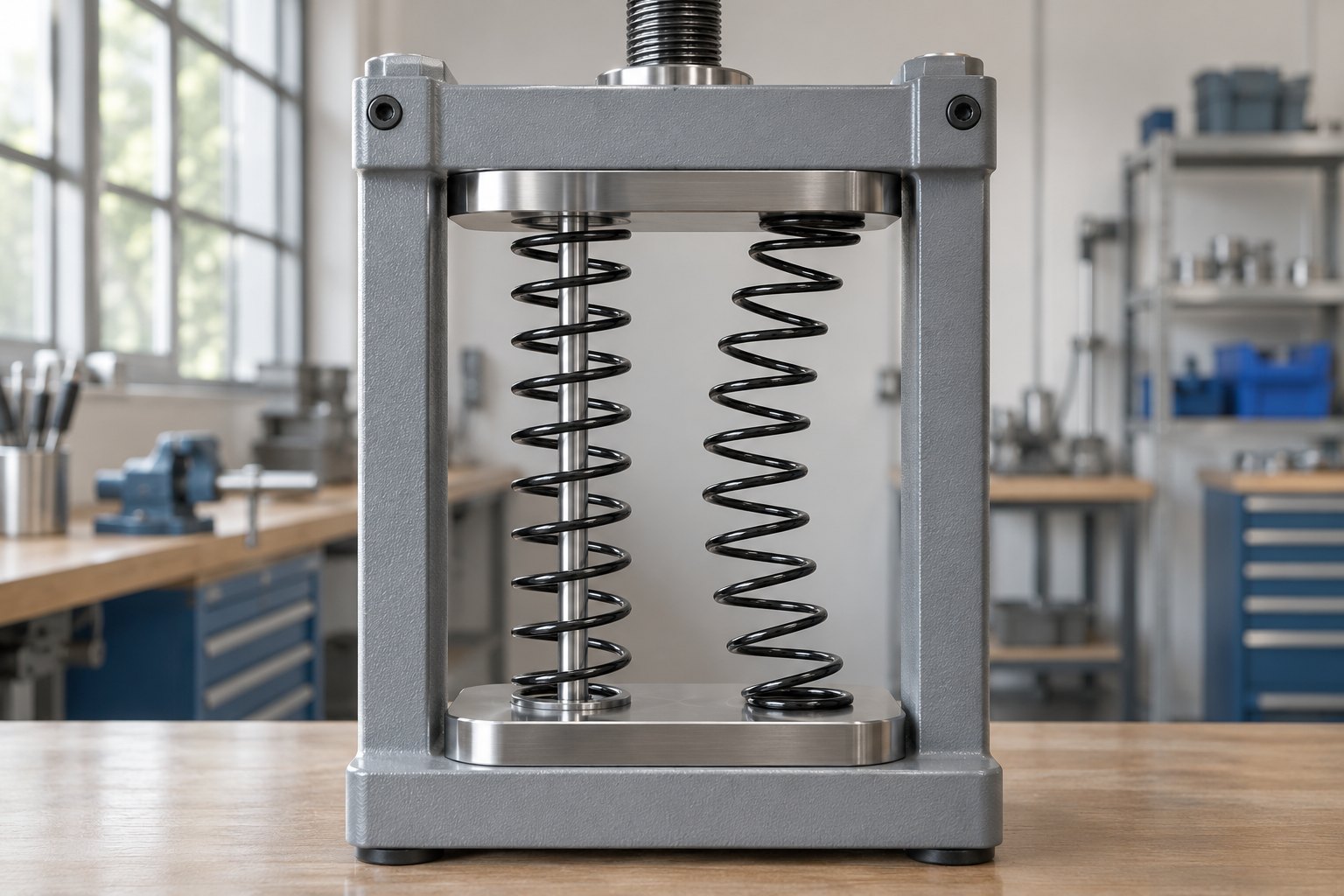
Cover image: an AI illustration based on a photograph of black coated compression springs we make, showing a guided and an unguided spring under load. It is not a photo of a specific order.
Spring buckling is the sideways bowing of a compression spring when it is compressed beyond a critical deflection. It happens when the free length is large compared with the mean coil diameter, and when the ends are free to tilt or pivot. A buckled spring rubs against surrounding components such as housings, guide rods and adjacent springs, loses force, wears rapidly and can even jump out of its seat.
Buckling is easy to predict at the design stage. This guide gives the rule for when a steel spring cannot buckle at all, the formula for the critical deflection when it can, a worked example, and the fixes that work in practice.
Key takeaways
- Slenderness decides buckling. Compare the free length L0 with the mean coil diameter D. Long, thin springs buckle; short, fat ones do not.
- End support matters as much as length. With both ends on flat, parallel, fixed seats, a steel spring cannot buckle while L0/D is below about 5.25. With both ends free to pivot, the limit falls to about 2.63.
- Above the limit, check the critical deflection. In our worked example, a 120 mm long spring with a 20 mm mean diameter can only compress 50.2 mm on fixed ends before it buckles, and only 9.8 mm on pivoting ends.
- Ground ends and a guide are the first fixes. Closed and ground ends on parallel seats, a guide rod or a bore, a larger coil diameter, or two shorter springs in series all prevent buckling.
- Give the seats and guides to your spring maker. The end support and guide dimensions are as important to the buckling check as the spring itself.
What is compression spring buckling?
A compression spring behaves like a column of coils. Like any slender column under axial load, it remains stable while short and becomes progressively less stable as its length increases relative to its diameter. Beyond a certain deflection the spring no longer shortens along its axis; instead, the middle section moves laterally and the spring bows into a curve, as the right-hand spring on the cover illustrates.
Buckling causes several problems at once:
- Friction and wear. The bowed coils rub against the bore, guide rod or nearby components, which wears both the spring and the mating part. For example, a valve or clutch spring rubbing inside a bore can leave visible polished bands on both surfaces.
- Load loss. A buckled spring no longer gives the force calculated from its rate at that length.
- Uneven stress. One side of the coils carries more stress than the other, which shortens fatigue life.
- Loss of position. In severe cases the spring jumps out of its seat or locks against the housing.
It is a different failure from coil clash or set. Our article on why springs fail covers the other modes.
When can a compression spring buckle?
Two numbers decide whether buckling is possible: the slenderness ratio L0/D and the end condition constant α. The AMES design notes give the stability condition for a steel spring as L0 < (πD/α)·√[2(E − G)/(2G + E)], where E and G are the elastic and shear moduli [1]. For spring steel with E = 207 GPa and G = 79.3 GPa, the square-root term works out to 0.836, so a spring is absolutely stable when αL0/D is below 2.63.
The end condition constant α describes how the two ends are held [1]:
| End support | α | Spring cannot buckle while L0/D is below | Example: max free length at D = 20 mm |
|---|---|---|---|
| Both ends on flat, parallel, fixed seats | 0.5 | 5.25 | 105 mm |
| One end fixed, the other pivoted | 0.707 | 3.71 | 74 mm |
| Both ends pivoted | 1 | 2.63 | 53 mm |
| One end clamped, the other free | 2 | 1.31 | 26 mm |
As a quick reference, we compiled the longest free length at which a steel spring of a given mean coil diameter is absolutely stable, rounded to the nearest millimetre:
| Mean coil diameter D | Both ends fixed (α 0.5) | Fixed and pivoted (α 0.707) | Both pivoted (α 1) | Fixed and free (α 2) |
|---|---|---|---|---|
| 8 mm | 42 mm | 30 mm | 21 mm | 11 mm |
| 10 mm | 53 mm | 37 mm | 26 mm | 13 mm |
| 15 mm | 79 mm | 56 mm | 39 mm | 20 mm |
| 20 mm | 105 mm | 74 mm | 53 mm | 26 mm |
| 25 mm | 131 mm | 93 mm | 66 mm | 33 mm |
| 30 mm | 158 mm | 111 mm | 79 mm | 39 mm |
| 40 mm | 210 mm | 149 mm | 105 mm | 53 mm |
| 50 mm | 263 mm | 186 mm | 131 mm | 66 mm |
A spring shorter than the value in its column cannot buckle at any deflection. A longer spring is not automatically a problem, but it needs the critical deflection check in the next section.
“Fixed” here means the end cannot tilt. In practice that requires closed and ground ends sitting on flat seats that remain parallel throughout the stroke. A seat that can rock, for instance a plate on a single central pin, or an unground end that bears on one point, behaves more like a pivot. Our guide to spring end types explains the difference between ground and unground ends.
How to calculate the critical buckling deflection
If the spring is longer than the stability limit, it can still work, as long as the working deflection stays below the critical deflection y_cr. The classic Shigley form, also used in the University of Idaho machine design notes, is [2]:
y_cr = L0 · C1′ · [1 − √(1 − C2′/λ²)], with λ = αL0/D
where C1′ = E / [2(E − G)] and C2′ = 2π²(E − G)/(2G + E). For steel with E = 207 GPa and G = 79.3 GPa, we calculated C1′ = 0.81 and C2′ = 6.89. When C2′/λ² is greater than 1, the square root has no real value and the spring is absolutely stable, which gives the same 2.63 limit as above [3].
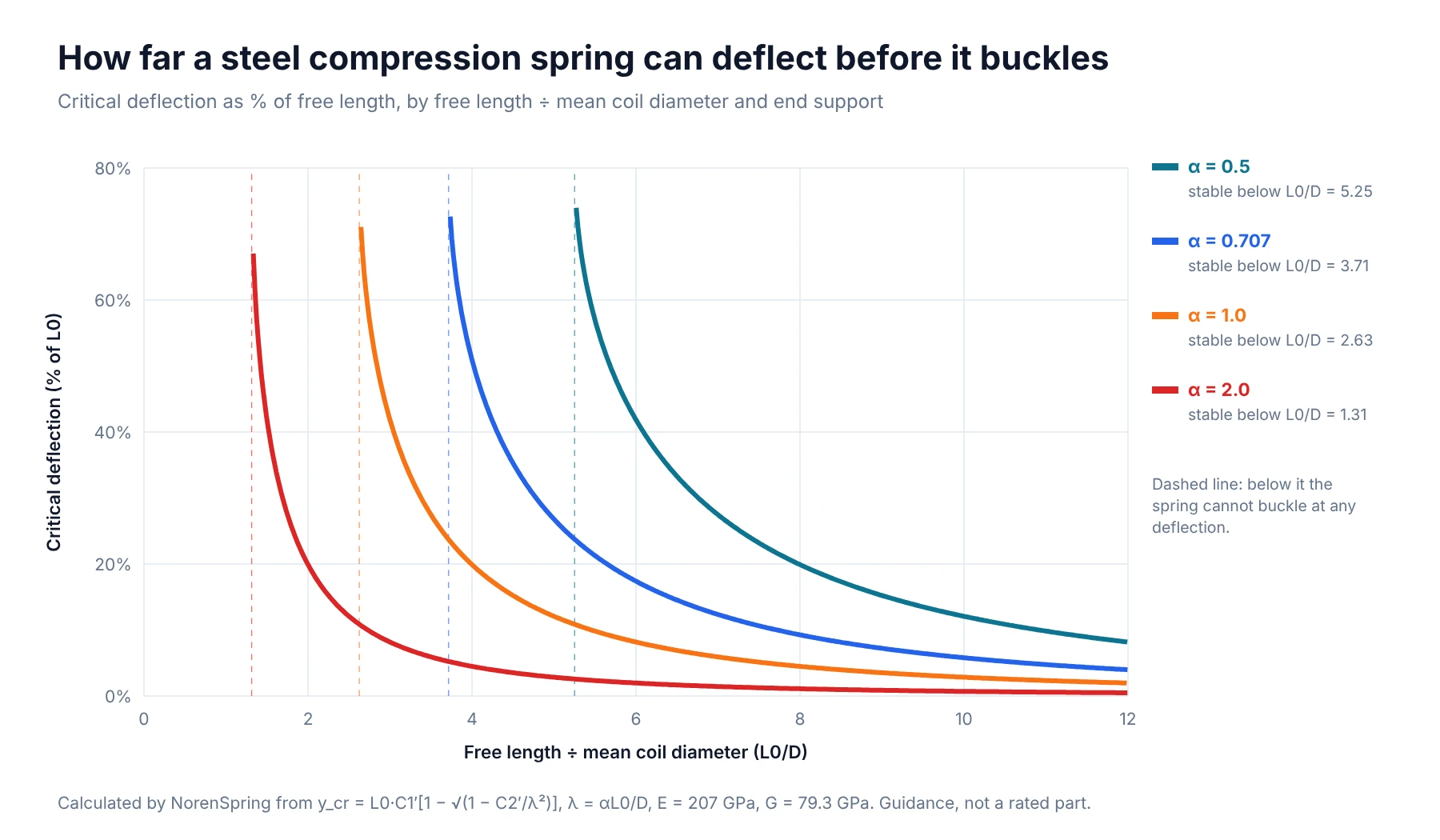
The chart shows how quickly the allowed deflection falls once a spring passes its limit. We compiled the same curves as a table:
| L0/D | Both ends fixed (α 0.5) | Fixed and pivoted (α 0.707) | Both pivoted (α 1) | Fixed and free (α 2) |
|---|---|---|---|---|
| 3 | stable | stable | 41.8% | 8.2% |
| 4 | stable | 51.0% | 19.9% | 4.5% |
| 5 | stable | 26.8% | 12.1% | 2.8% |
| 6 | 41.8% | 17.4% | 8.2% | 2.0% |
| 8 | 19.9% | 9.3% | 4.5% | 1.1% |
| 10 | 12.1% | 5.8% | 2.8% | 0.7% |
| 12 | 8.2% | 4.0% | 2.0% | 0.5% |
The values are percentages of the free length, so they apply to any steel spring with the same proportions, whether it is 30 mm or 300 mm long. A spring with L0/D = 8 on fixed ends can compress 19.9% of its free length before it buckles; the same spring on pivoting ends can only compress 4.5%.
Worked example: one spring on four kinds of seat
Example scenario (an illustration, not a customer record). A machine needs a steel compression spring with a free length of 120 mm and a mean coil diameter of 20 mm, compressed by 60 mm in service. So L0/D = 6, above every stability limit in the table.
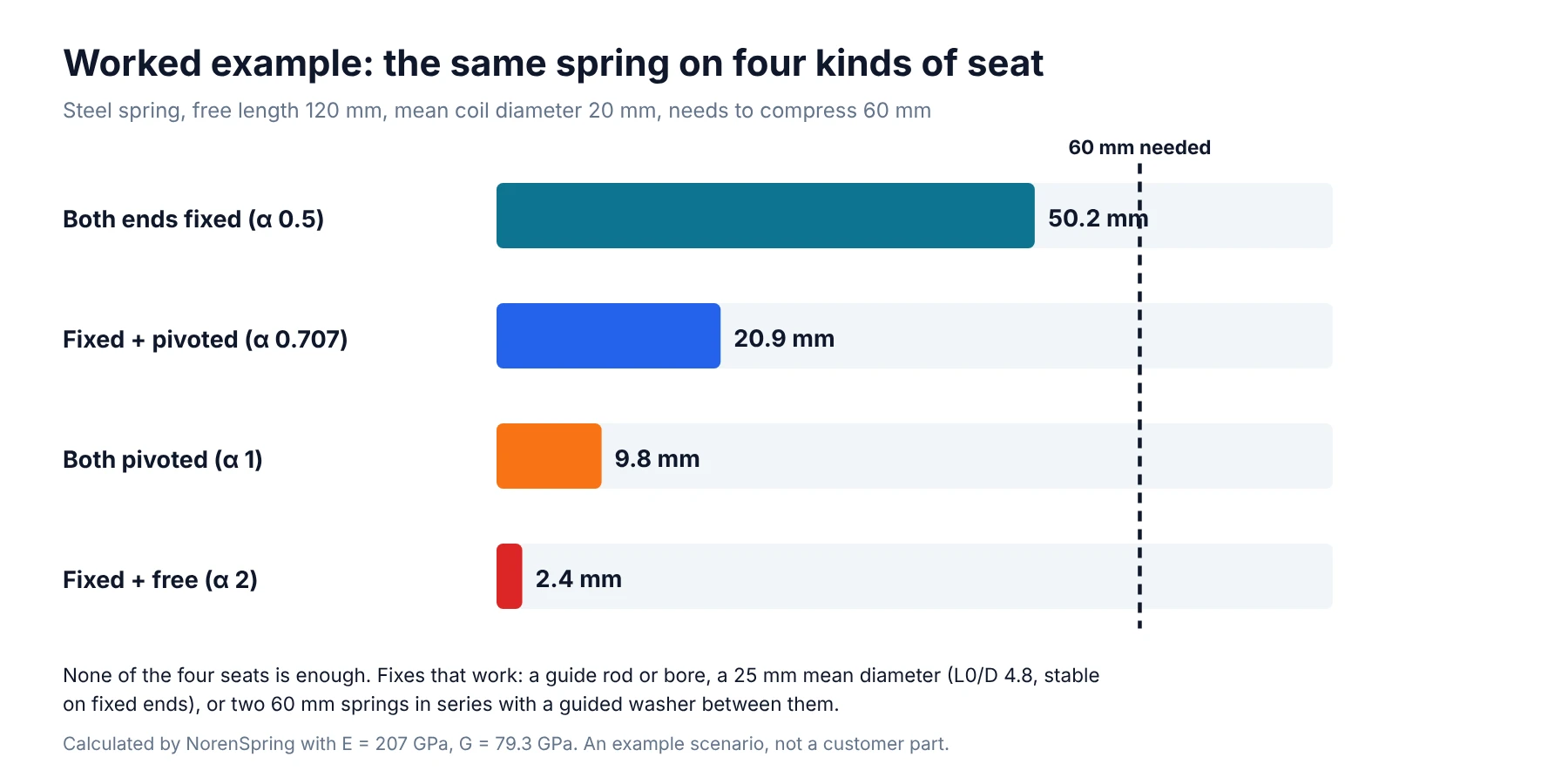
Even on fixed, ground ends the spring buckles at 50.2 mm, which is 41.8% of its free length and short of the 60 mm stroke. On pivoting ends it buckles after only 9.8 mm. Here are four ways to make the design work, with what each one costs:
| Fix | Result for the example | Trade-off |
|---|---|---|
| Guide rod inside the spring or bore around it | Lateral movement is limited by the guide | Friction and wear at the guide; needs diametral clearance |
| Increase mean diameter to 25 mm | L0/D = 4.8, stable on fixed ends | Rate drops to about 51% unless the wire size is increased |
| Two 60 mm springs in series with a guided washer between | Each spring has L0/D = 3, stable on fixed ends | Extra parts; the washer must be guided |
| Shorten the free length and the stroke | Below 105 mm free length, stable on fixed ends | Only possible if the machine allows it |
The rate figure for the larger diameter comes from the spring rate formula, where rate falls with the cube of the mean diameter: (20/25)³ = 0.51. Our spring rate guide shows the full formula.
How to prevent compression spring buckling
The solutions fall into two categories: the first makes the spring inherently stable, while the second provides external support for a spring that would otherwise buckle.
Make the spring stable:
- Use closed and ground ends on flat, parallel seats. This moves the spring from α = 1 towards α = 0.5 and doubles the length it can have before buckling is possible.
- Increase the mean coil diameter. A larger D lowers L0/D directly. Keep the spring index in a practical range, about 4 to 12, as our compression spring design guide explains.
- Split the spring. Two or more shorter springs in series, separated by guided washers, each have a lower L0/D. Our guide to springs in series and parallel shows how their rates combine.
- Shorten the stroke. If the travel can be reduced, a shorter spring can do the job.
Support the spring:
- Fit a guide rod or a bore. A rod inside the spring or a tube around it stops sideways movement. The outside diameter of a compression spring grows slightly as it is compressed, so the bore must allow for that. A rod must clear the inside diameter in the same way.
Guides are effective, but they introduce friction and wear, and a spring that would buckle without the guide will continuously press against it. Where possible, design the spring to be stable and use the guide as a back-up. For large springs, our article on heavy duty compression springs covers buckling, fatigue and hot coiling for large springs. At the other end of the scale, the spring in a click pen would buckle on its own but is guided by the refill tip running through it, as our article on pen springs explains.
What to send your spring maker
A buckling check needs information about the parts around the spring as well as the spring itself. Send:
- Free length, working length and minimum length in service, or the loads at two lengths.
- Seat design: flat and parallel, or able to tilt, and whether the ends will be ground.
- Guide: rod diameter or bore diameter, and its length.
- Space limits: maximum outside diameter and minimum inside diameter.
- Duty: static or cycled, and the cycles per minute, because a spring rubbing on a guide wears faster when it cycles.
We make compression springs to drawing with CNC coiling and end grinding, and check dimensions and load against the agreed control plan before shipment. Send your drawing or the data above through our contact page, and we will check buckling as part of the drawing review. See our custom compression springs page for the full range.
Frequently asked questions
What causes a compression spring to buckle?
A compression spring buckles when its free length is large compared with its mean coil diameter and it is compressed past its critical deflection. Ends that can tilt make it much more likely. For steel, a spring with both ends pivoting can buckle once L0/D passes about 2.63.
What is the slenderness ratio of a spring?
It is the free length divided by the mean coil diameter, L0/D; a 100 mm spring with a 20 mm mean diameter has a slenderness ratio of 5. Multiplying by the end condition constant α gives the effective slenderness λ = αL0/D. A steel spring with λ below about 2.63 cannot buckle.
Do squared and ground ends prevent buckling?
They help a lot, but they do not stop it alone. Closed and ground ends on flat, parallel seats bring α close to 0.5, which allows a free length up to about 5.25 times the mean diameter before buckling is possible. Longer springs still need a check or a guide.
Does a guide rod stop buckling?
Yes, a guide rod or bore limits the sideways movement, so the spring cannot bow far; in our example it is the only fix that keeps the original 120 mm by 20 mm spring and its 60 mm stroke unchanged. The cost is friction and wear between the coils and the guide. The guide needs enough clearance for the diameter change as the spring compresses.
Does buckling depend on the wire diameter?
Not directly. The stability limit and critical deflection depend on L0/D, the end support and the material moduli; a 120 mm spring with a 20 mm mean diameter buckles at 50.2 mm on fixed ends whether it is wound from 2 mm or 3 mm wire. A thicker wire changes the rate and stress, but it does not change whether a spring of a given length and mean diameter buckles.
About the authors
This guide was prepared by the NorenSpring engineering team, which designs and manufactures custom compression, extension and torsion springs and wire forms in Xuzhou, China, since 2001. Technical content reviewed by Feng Yulin, General Manager and senior structural engineer, who has 15 years of spring R&D experience and more than 30 national patents. Our certificates are shown on our about page. Sources were last checked on November 5, 2026.
Sources
- AMES, Compression Spring Formulas and Definitions, buckling stability condition and end condition constants. amesweb.info. Retrieved 2026-11-05.
- University of Idaho, Springs machine design poster (after Shigley and Mischke), critical deflection, λeff and C1, C2. uidaho.edu. Retrieved 2026-11-05.
- Istanbul Technical University, Mechanical Springs lecture slides (Shigley’s Mechanical Engineering Design, chapter 10), critical deflection for stability. itu.edu.tr. Retrieved 2026-11-05.



