










In this article
- Key takeaways
- How a spring hinge works
- The closing torque a door needs
- Worked example: a hinge spring for a three-hinge door
- Why the barrel limits the torque
- Relaxation: why spring hinges get weaker
- Materials, legs and wind direction
- What to send for a hinge spring quote
- Frequently asked questions
- References
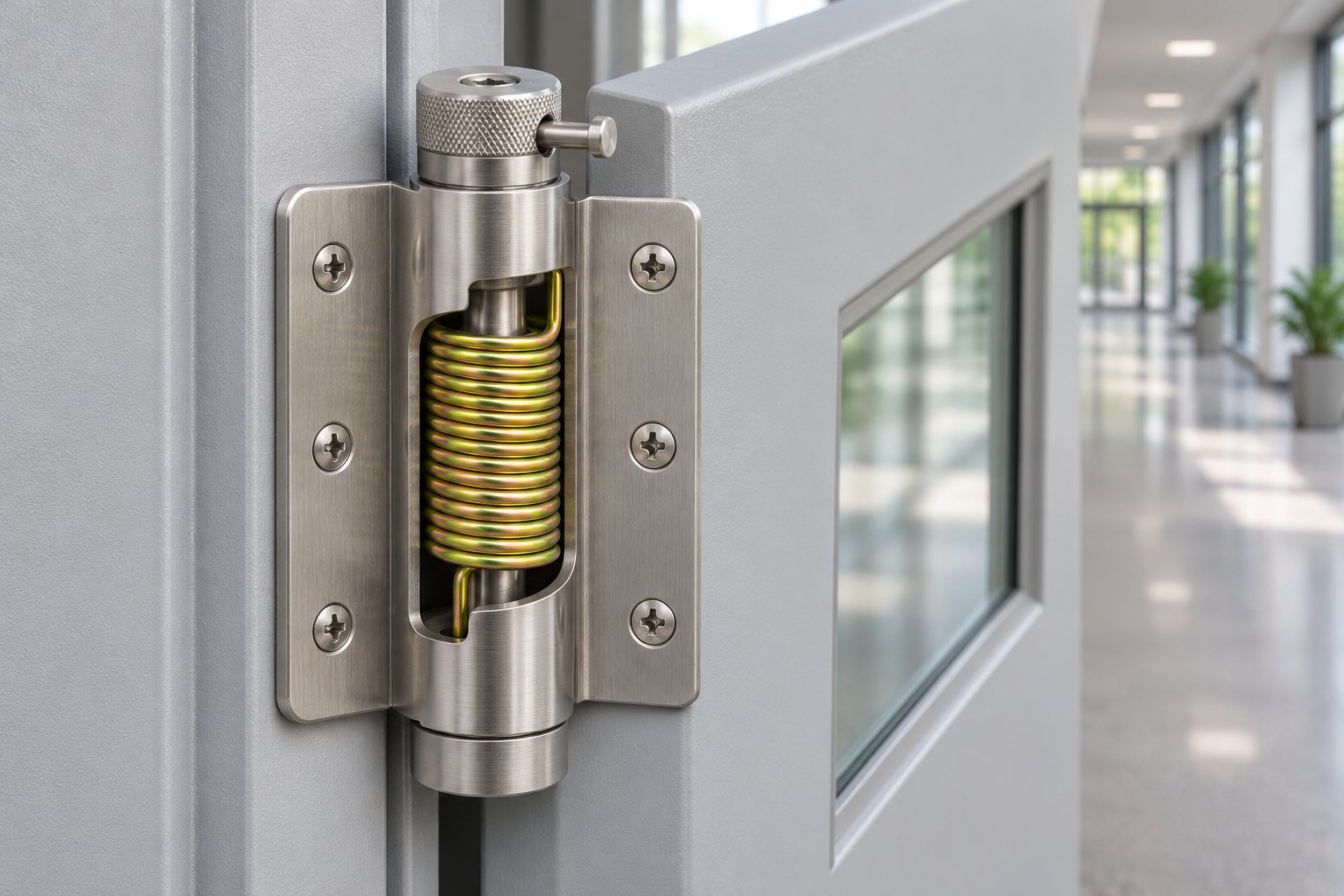
Cover image: an AI-generated illustration of a generic self-closing hinge with its barrel cut away, based on a photo of a torsion spring we make; it does not show a specific hinge product.
A hinge spring is the spring that makes a hinge close by itself. In a self-closing door hinge it is a helical torsion spring wound around the hinge pin inside the barrel. Opening the door winds the spring tighter, and the stored torque swings the door shut. A hinge maker explains that the spring inside a hinge barrel is a torsion spring, and that standard spring hinges set closing tension through a barrel rotation mechanism locked by a pin and notch [1]. The same idea, at a smaller size, closes gates, lids, cabinet flaps, screen doors and equipment covers. A spring door stop works differently: its coil spring bends sideways when the door strikes it, then springs back straight. Many screen and storm doors use a long extension spring between the jamb and the door instead of a spring hinge; our screen door springs guide works out its closing force and the best mounting position.
This guide is for hinge and door hardware makers, gate and enclosure builders and parts suppliers who buy hinge springs. It explains how the spring sets closing torque and closing speed, a worked hinge spring design for a three-hinge door, why preload and opening angle decide the stress and life, and what to put on the drawing. For general torsion spring drawings, see our torsion spring specification guide.
Key takeaways
- A hinge spring is a torsion spring with a fixed home. It works around the hinge pin, inside a barrel only a little larger than the spring. That small space limits how much torque it can store.
- Preload sets the closing torque; the spring rate sets how it grows. In our example, three hinges at 90° preload give 2.07 N·m with the door closed and 4.15 N·m at 90° open.
- More preload costs life. Raising the preload from 90° to 180° doubles the closed torque to 4.15 N·m, but the peak stress rises from 0.49 to 0.72 of the wire’s tensile strength.
- The opening angle matters as much as the preload. The same spring at 90° preload runs at 0.44 of tensile strength at 90° opening and 0.67 at 180°.
- Closing speed has a legal floor. The 2010 ADA Standards require a door on spring hinges to take at least 1.5 seconds to close from 70° [2]. In our frictionless model the example door takes 2.41 seconds.
How a spring hinge works
A spring hinge has two leaves and a barrel, like a plain butt hinge, but the barrel holds a spring. The Builders Hardware Manufacturers Association (BHMA) describes it as a hinge with leaves attached to the door and jamb, connected at the barrel, where springs provide energy to close a door from the open position [3]. Spring hinges are covered by ANSI/BHMA A156.17, Self Closing Hinges and Pivots [3].
Inside the barrel, one end of the spring is anchored to an adjustable tension cap on the frame side, while the other end is anchored to the knuckle on the door leaf. The hinge pin runs through the middle of the coils and functions as the spring’s arbor, which limits how far the coil diameter can shrink during winding. A clothespin spring uses the same torsion principle at a much smaller scale, with its coil acting as the pivot and its legs closing the jaws.
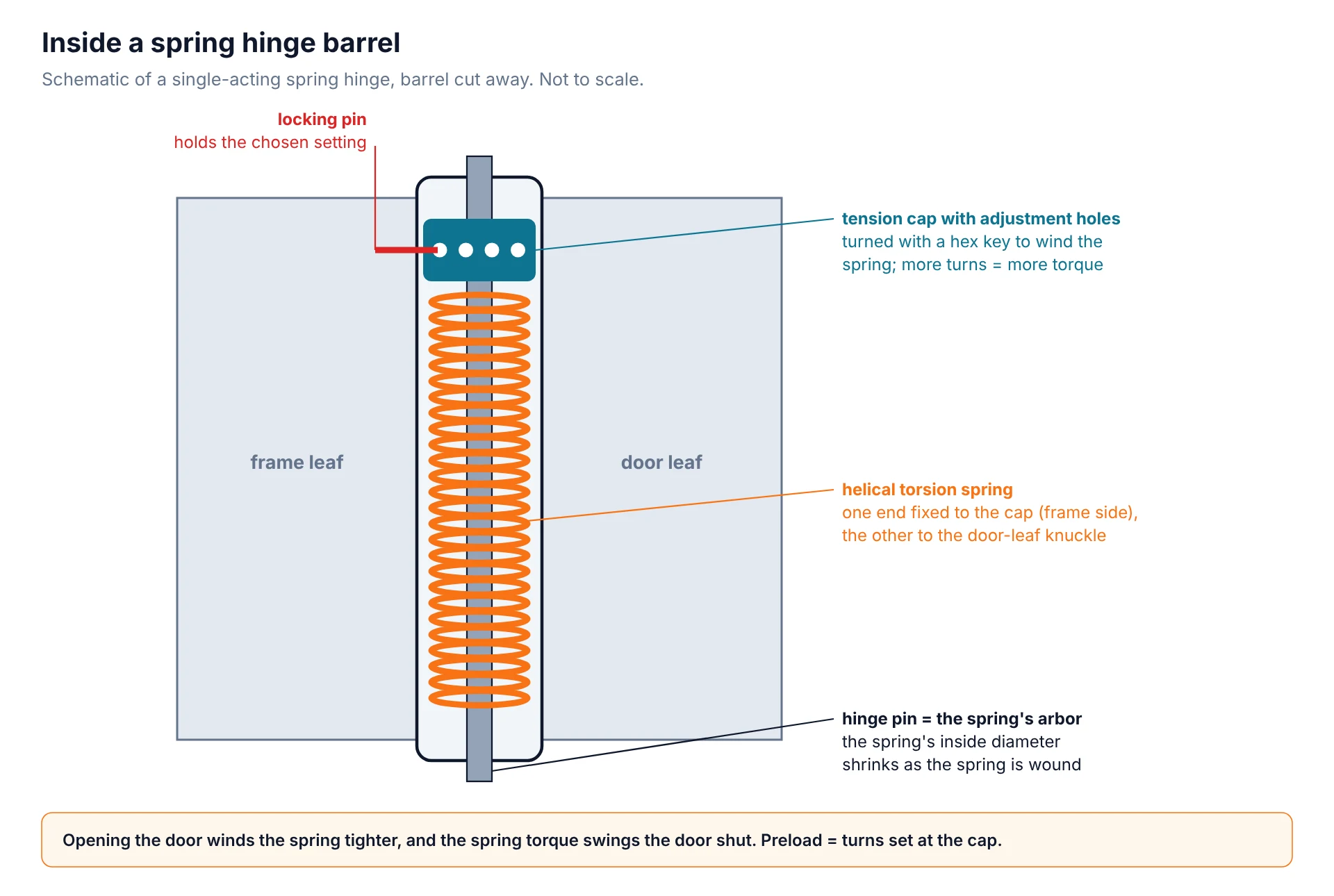
The installer sets the closing force by rotating the cap with a hex key and locking it with a pin in the next available hole, so each additional step winds the spring further before the door is ever opened. That initial deflection is the preload. Once the door opens, the spring deflects further, and the torque increases linearly with the opening angle according to the spring rate.
A helical torsion spring is loaded in bending, not in torsion, even though it resists a twist [4]. That matters for design: the stress is a bending stress, and it is highest at the inside of the coil.
| Hinge type | Typical spring | What the spring does |
|---|---|---|
| Single-acting spring door hinge | Helical torsion spring in the barrel, adjustable cap | Closes the door from one side |
| Double-acting (saloon) spring hinge | Two torsion springs, one per barrel | Returns the door to centre from both sides |
| Self-closing gate hinge | Torsion spring, often in an exposed barrel | Closes a gate; usually needs a corrosion-resistant finish |
| Screen door and cabinet hinges | Small torsion spring or wire spring | Closes a light door or holds it shut |
| Lid, flap and cover hinges | Torsion spring, sometimes double torsion | Lifts or holds a lid; often a counterbalance, not a closer |
The closing torque a door needs
A correctly hung door does not swing shut on its own, so the spring has to overcome hinge friction, air pressure differences, compression of any weatherseal and the resistance of the latch. The force a person needs to open the door is the other side of the same balance, which is why accessibility regulations limit it. For interior hinged doors, the 2010 ADA Standards set a maximum opening force of 5 pounds (22.2 N), not counting the force needed to retract latch bolts [5]. Fire doors are treated separately: their minimum opening force is set by the local authority [5].
A hinge spring therefore operates between two limits: it must be powerful enough to close and latch the door reliably, yet moderate enough that people, including wheelchair users, can still open it comfortably. A spring hinge also has no hydraulic damping to regulate the closing motion. One hardware writer points out that the spring controls the closing force, not the speed, and that spring hinges do not offer the same level of door control as a door closer [6]. A dishwasher door has the opposite task: its extension springs hold the door up as it opens downward, which our dishwasher door springs guide explains.
| Requirement | Value | Source |
|---|---|---|
| Spring hinge closing time from 70° | 1.5 seconds minimum | 2010 ADA 404.2.8.2 [2] |
| Door closer closing time, 90° to 12° | 5 seconds minimum | 2010 ADA 404.2.8.1 [2] |
| Interior door opening force | 22.2 N (5 lbf) maximum | 2010 ADA 404.2.9 [5] |
| Grade 1 spring hinge cycle test | 1,000,000 cycles | BHMA A156.17 summary [7] |
For fire doors, NFPA 80 Annex A recommends adjusting spring hinges to achieve positive latching when the door closes freely from 30° open [6]. BHMA notes that single acting spring hinges are often listed for use on fire doors [3]. For the spring, that means closing torque near the closed position, after many cycles, is the number that counts.
Worked example: a hinge spring for a three-hinge door
We analyzed a hinge spring for a 30 kg door, 900 mm wide, hung on three spring hinges and stopped at 110°. The dimensions are our own example, not copied from a specific hinge. We used the standard torsion spring equations: rate k = E·d⁴ / (64·D·N) per radian, and bending stress σ = KB·32·M / (π·d³), with the curvature factor KB = (4C + 2) / (4C − 3). For music wire we used E = 196.5 GPa and the minimum tensile strength from Shigley’s strength equation [8].
| Parameter | Value |
|---|---|
| Wire | 2.8 mm music wire (ASTM A228) |
| Mean coil diameter | 13.0 mm (spring index C = 4.64) |
| Outside / inside diameter | 15.8 mm / 10.2 mm |
| Active coils | 33, close-wound body about 95 mm long |
| Hinge pin (arbor) | 8.0 mm |
| Spring rate per hinge | 7.68 N·mm per degree |
| Preload | 90° (wound a quarter turn at the cap) |
| Torque per hinge, door closed | 0.69 N·m |
| Torque per hinge, door at 90° | 1.38 N·m |
| Peak stress at 110° (200° total wind) | 941 MPa, 0.49 of tensile strength (1,904 MPa) |
We deliberately limited the peak stress to approximately half of the minimum tensile strength, which is a conservative engineering choice for a component that a Grade 1 qualification test operates a million times [7]. The spring is small, but its stress is not: 941 MPa is higher than in most springs that only carry a static load.
What preload does
The following table compares the identical spring at four cap settings, with three hinges installed on the door. The force at the latch equals the closing torque divided by the 0.83 m horizontal distance from the hinge axis to the latch.
| Preload | Door torque, closed | Door torque at 90° | Force at latch, closed | Peak stress at 110° | Closing time from 70° |
|---|---|---|---|---|---|
| 45° | 1.04 N·m | 3.11 N·m | 1.25 N | 0.38 of tensile strength | 2.90 s |
| 90° (example) | 2.07 N·m | 4.15 N·m | 2.50 N | 0.49 | 2.41 s |
| 135° | 3.11 N·m | 5.18 N·m | 3.75 N | 0.61 | 2.11 s |
| 180° | 4.15 N·m | 6.22 N·m | 5.00 N | 0.72 | 1.90 s |
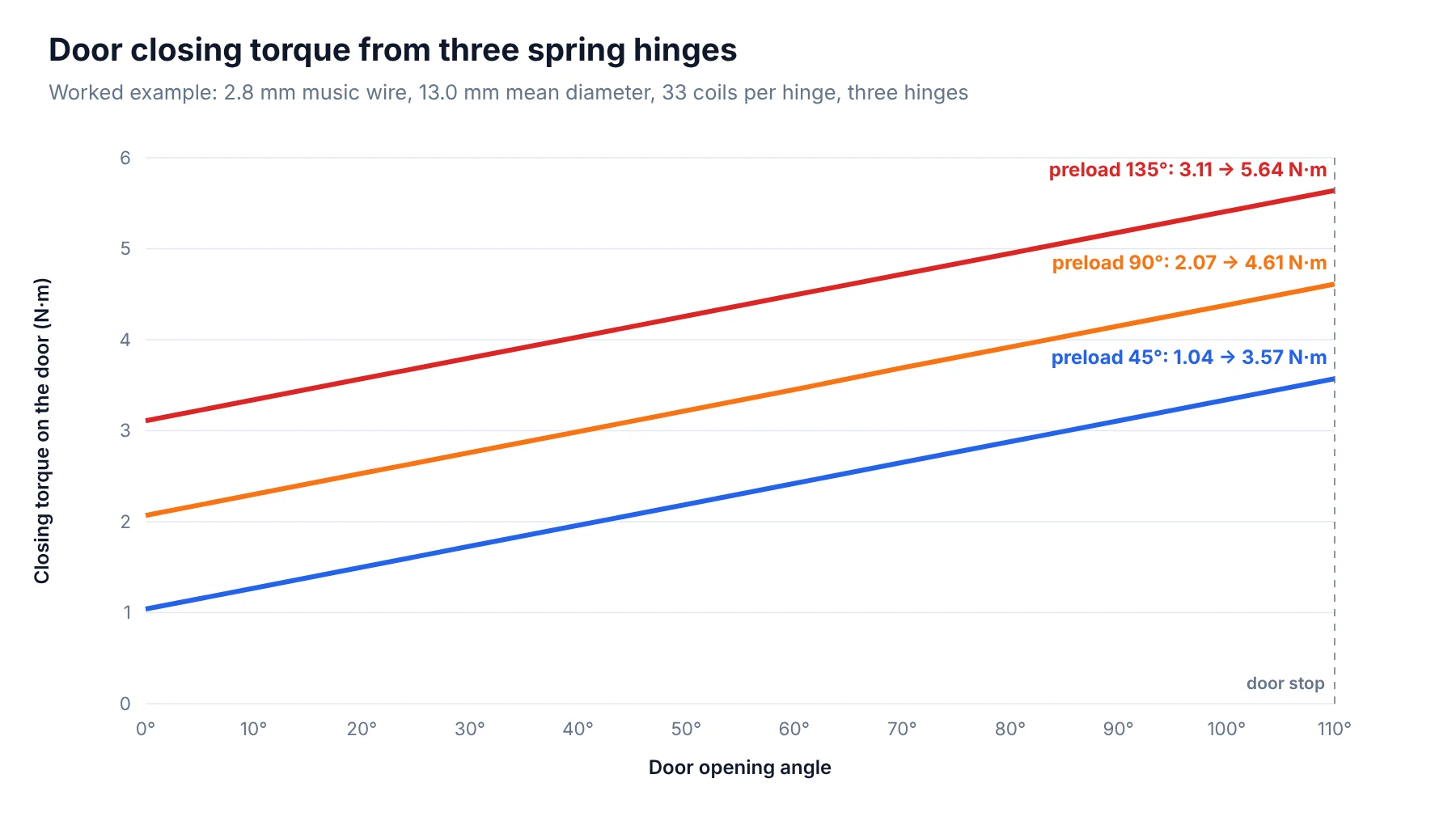
Data behind the chart (closing torque on the door, N·m):
| Opening angle | 45° preload | 90° preload | 135° preload |
|---|---|---|---|
| 0° | 1.04 | 2.07 | 3.11 |
| 30° | 1.73 | 2.76 | 3.80 |
| 60° | 2.42 | 3.45 | 4.49 |
| 90° | 3.11 | 4.15 | 5.18 |
| 110° | 3.57 | 4.61 | 5.64 |
The comparison illustrates the essential trade-off: increasing the cap setting from 90° to 180° doubles the latching force, from 2.5 N to 5.0 N, but the peak stress increases by almost half. A door that apparently “needs more spring” is frequently better served by an additional fourth hinge or a heavier specification than by extra turns on the cap. The push the door needs at the strike also depends on the latch bolt spring, which our door latch springs guide works out for 35, 45 and 55 degree bevels.
Closing speed
The closing time comes from treating the door as a rotating panel (moment of inertia m·w²/3 = 8.1 kg·m²) driven by the spring torque, with no friction. Friction only slows the door, so the real time is longer. For example, at 90° preload:
| Door mass | Closing time from 70° | Latch-edge speed at closing |
|---|---|---|
| 20 kg | 1.97 s | 0.95 m/s |
| 30 kg (example) | 2.41 s | 0.77 m/s |
| 40 kg | 2.78 s | 0.67 m/s |
| 60 kg | 3.41 s | 0.55 m/s |
Lighter doors close fastest because they have less rotational inertia. If a lightweight door fitted with powerful springs closes in less than 1.5 seconds, reduce the preload or specify a spring with a lower rate.
How many hinges
| Spring hinges on the door | Door torque, closed | Door torque at 90° | Closing time from 70° |
|---|---|---|---|
| 2 | 1.38 N·m | 2.76 N·m | 2.95 s |
| 3 (example) | 2.07 N·m | 4.15 N·m | 2.41 s |
| 4 | 2.76 N·m | 5.53 N·m | 2.09 s |
A hinge manufacturer notes that A156.17 testing is performed with three hinges on doors up to 7 ft [1]. Every additional hinge contributes its own spring, so the total torque increases while each individual spring keeps the same operating stress.
Why the barrel limits the torque
The spring has to fit around the pin and inside the barrel, and the barrel is only a few millimetres larger than the pin. The space fixes the coil diameter and the body length. Within that space, the peak stress depends on the total wind angle, preload plus opening, and on how many coils share it.
For the example spring, here is the most closing torque per hinge we could get at 90° preload without passing a given stress limit:
| Peak stress limit | Door stops at 90° | Door stops at 110° | Door opens to 180° |
|---|---|---|---|
| 0.50 of tensile strength | 0.78 N·m | 0.70 N·m | 0.52 N·m |
| 0.60 of tensile strength | 0.93 N·m | 0.84 N·m | 0.62 N·m |
| 0.78 of tensile strength | 1.21 N·m | 1.09 N·m | 0.81 N·m |
A door that swings to 180° can have only about three quarters of the closing torque of one that stops at 110°, if the springs are to last as long. When a hinge must open wide and still close firmly, the designer needs a longer barrel, a larger barrel or more hinges, not just a stronger spring.
Winding also changes the coil dimensions. The inside diameter decreases as the spring is wound, in our example from 10.2 mm free to 9.98 mm at full opening, while the body length increases from 95.2 mm to 96.8 mm, so both the pin diameter and the barrel length need corresponding clearance. Our torsion spring calculator shows the same diameter and length change for any spring.
Relaxation: why spring hinges get weaker
A hinge spring remains at its preload stress continuously and cycles above it every time the door opens. Over time, spring wire gradually loses some torque through stress relaxation, particularly when the working stress is high or the operating temperature is elevated. Waterson notes that the A156.17 standard does not require manufacturers to measure or report the residual closing torque after cycling [1]. That gap is why doors on spring hinges are often found not latching after a few years.
For a spring buyer, the useful steps are:
- Specify torque at two angles, for example at the closed position and at 90°, so both the preload and the rate are controlled.
- Ask for the torque after a cycling test, or after a set number of cycles, if your product depends on latching.
- Keep the peak stress moderate. In our example, a 0.49 ratio leaves margin; a 0.72 ratio at 180° preload is more likely to relax.
- Choose a finish that suits the door. Exterior gates and wet rooms need a corrosion-resistant spring or finish. Our spring finishes guide compares the options, and our stainless steel springs guide explains the strength you give up with stainless wire.
Materials, legs and wind direction
- Music wire gives the highest strength for small hinge springs and is the usual choice inside a sealed barrel. Our music wire springs guide lists its strength range.
- Stainless steel spring wire (302/304) suits exterior gates, food areas and coastal sites. It is weaker than music wire, so the same space gives less torque at the same stress.
- Legs and tangs lock the spring ends into the cap and the door-leaf knuckle. They are usually short radial or axial bends, and they are a common failure point if the bend is tight.
- Wind direction must be chosen so that opening the door winds the coils tighter, which loads the spring in its stronger direction and reduces the inside diameter. Left-hand and right-hand doors may need opposite-wound springs.
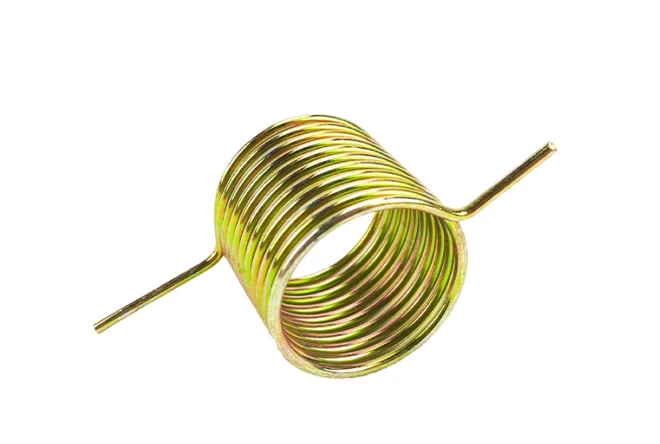
The photo shows a torsion spring we make. We make torsion springs in music wire, stainless and carbon steel, and our torsion spring application cases show parts we have supplied. Brand names in this article identify the companies whose public pages we quote; NorenSpring is not affiliated with them.
What to send for a hinge spring quote
| Item | Example |
|---|---|
| Drawing or sample | Drawing preferred; a spring from a used hinge may have relaxed |
| Wire diameter and material | 2.8 mm music wire, or stainless 302 for outdoor use |
| Outside or inside diameter | 15.8 mm OD, 10.2 mm ID, for an 8.0 mm pin |
| Active coils and body length | 33 coils, about 95 mm close-wound |
| End forms | Leg or tang shape at each end, with lengths and bend radius |
| Wind direction | Left-hand or right-hand |
| Torque at two angles | 0.69 N·m at 90° wind and 1.38 N·m at 180° wind, ± 10 % |
| Maximum wind angle | 200° (90° preload plus 110° opening) |
| Finish | Zinc plate with baking, oil, or as specified |
| Cycle life target | For example 1,000,000 cycles for a Grade 1 hinge |
| Quantity and packing | Per hinge build or per service kit |
The two torque values at two angles are the core of a hinge spring drawing, because they fix both the preload and the rate. Send your drawing or sample through our contact page, and our engineers will review it and reply within 24 hours. You can read more about our company and its certifications. This guide was compiled by our editorial team with our spring engineers.
Frequently asked questions
What kind of spring is in a spring hinge?
It contains a helical torsion spring wound around the hinge pin inside the barrel. One end is anchored to the adjustable cap and the other to the door leaf, so opening the door winds the spring and the stored energy closes it again.
How do you adjust the tension on a spring hinge?
Most spring hinges have an adjustment cap at the top of the barrel with holes around its circumference. The cap is rotated with a hex key to wind the spring, and a locking pin is inserted into the next hole. Additional turns produce more closing torque. Always follow the hinge manufacturer’s instructions, because the wound spring stores considerable energy.
How long should a door take to close on spring hinges?
Under the 2010 ADA Standards, a door or gate operated by spring hinges must take a minimum of 1.5 seconds to close from an opening position of 70° [2]. A longer time is acceptable.
Why does my spring hinge door no longer latch?
Usually the spring has lost torque through relaxation, or the tension was originally adjusted too low. Re-tensioning helps temporarily, but a spring operating at high stress will continue relaxing. A hinge or spring with lower working stress, or an extra hinge, gives a longer-lasting result.
Can I replace the spring in a spring hinge?
Some hinges allow it, but the spring has to match the barrel, the pin, the wind direction and the end forms exactly. For a product line, it is better to specify the spring on a drawing so every replacement has the same torque.
References
- Waterson, “Spring hinge closing force”. https://watersonusa.com/solutions/spring-hinge-closing-force
- 2010 ADA Standards for Accessible Design, 404.2.8 Closing speed (Corada pocket guide). https://www.corada.com/documents/2010ADAStandards/404-2-8
- Builders Hardware Manufacturers Association, “Spring Hinges or Pivots”. https://buildershardware.com/Resources/Guide-to-Builders-Hardware-Terminology/Spring-Hinges-or-Pivots
- Wikipedia, “Torsion spring”. https://en.wikipedia.org/wiki/Torsion_spring
- 2010 ADA Standards for Accessible Design, 404.2.9 Door and gate opening force (Corada pocket guide). https://www.corada.com/documents/2010ADAStandards/404-2-9
- iDigHardware, “Decoded: Door and gate closing speed”. https://idighardware.com/2024/06/decoded-door-and-gate-closing-speed/
- Builders Hardware Manufacturers Association, “A156.17 Self Closing Hinges and Pivots”. https://buildershardware.com/ANSI-BHMA-Standards/Hardware-Highlights/A15617-2019-Self-Closing-Hinges-Pivots
- Shigley’s Mechanical Engineering Design, Chapter 10 Mechanical Springs, lecture slides, Istanbul Technical University. https://web.itu.edu.tr/~halit/Makel/Ch_10_slides_m.pdf



