










In this article
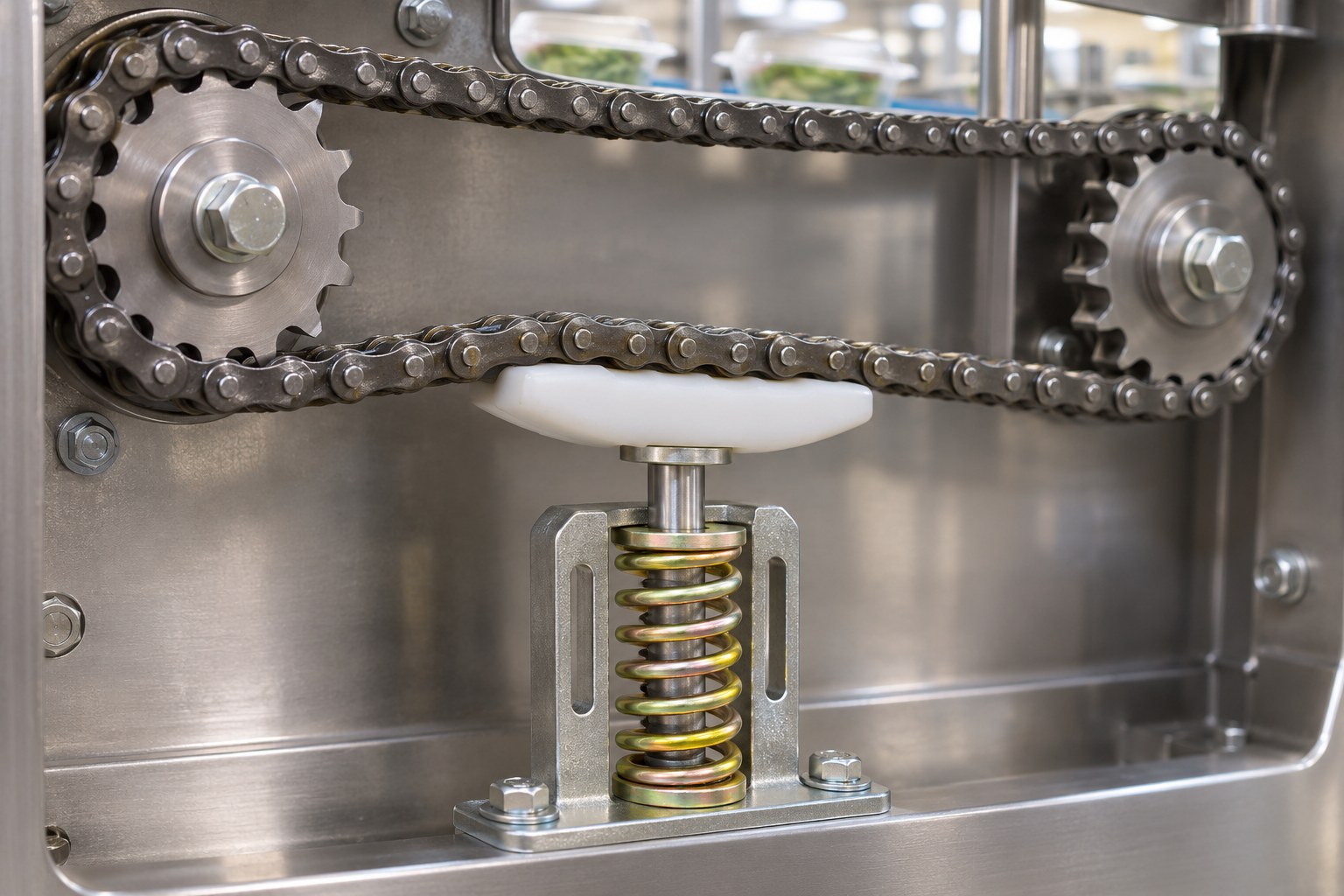
Cover image: an AI-generated illustration of a generic spring-loaded chain tensioner, based on a photo of compression springs we make; it does not show a specific product.
A chain tensioner spring is the spring inside a spring-loaded chain tensioner. It pushes a shoe, roller or idler sprocket against the slack strand of a roller chain, so the drive keeps running with the right amount of slack as the chain wears and stretches. In a linear tensioner the spring is usually a compression spring around a plunger. In a rotary tensioner it is often a torsion spring acting through an arm.
As Machine Design puts it, the simplest automatic tensioners employ a spring-actuated idler that maintains tension by taking up slack [1]. This guide is for machine builders, conveyor makers and tensioner manufacturers who buy these springs. It explains the force geometry, a worked tensioner spring design, why the tension falls as the chain wears, and what to put on a drawing. For compression spring drawings in general, see our compression spring design guide.
Key takeaways
- The spring sets the slack-side tension, through geometry. The chain tension is the spring force divided by twice the sine of the strand angle at the shoe.
- Tension falls as the chain wears, for two reasons. The spring extends and loses force, and the strand angle grows. In our example a stiff 4 N/mm spring drops from 150 N to 42 N of chain tension by 0.5 % chain elongation.
- A deeper starting deflection helps. Pushing the strand 100 mm instead of 50 mm cut the geometric loss at 1 % elongation from 44 % to 19 %.
- Long preload, short stroke. A spring that is compressed a long way before it starts working loses a smaller share of its force over the same travel.
- Never use a spring tensioner on a reversing drive. When the drive reverses, the slack side becomes the tight side [1].
How much slack should a roller chain have?
A roller chain must run with some slack in the slack strand, but not too much. Chain makers give their rules as a percentage of the span:
| Source | Recommendation |
|---|---|
| Diamond Chain installation guide | 4–6 % mid-span movement in horizontal drives, 2–3 % in vertical drives [2] |
| Murtfeldt chain drive basics | Sag of 1–3 % of the centre distance: 3 % for simple drives, 2 % for high-performance drives, 1 % for synchronised motion [3] |
| Machine Design (Fenner Drives) | Slack under normal conditions should not exceed 4 % of the span, and less than 2 % for heavy loads or frequent starts and stops [1] |
The same Machine Design article notes that a span longer than 50 chain pitches will typically require a tensioner [1]. Murtfeldt adds that running-in and wear cause continuous elongation and increasing sag, and that if re-tensioning is neglected, the sag grows and accelerates the wear [3]. A spring-loaded tensioner takes up that growing slack automatically, between maintenance checks.
How a spring-loaded chain tensioner works
A linear tensioner presses a shoe or idler sideways into the slack strand, near the middle of the span. The chain then runs in two straight pieces with a bend at the shoe. Each piece carries the slack-side tension T. The shoe must push back with a force equal to the sum of the two side components:
F = 2 × T × sin θ, where θ is the angle between each piece of chain and the original straight line.
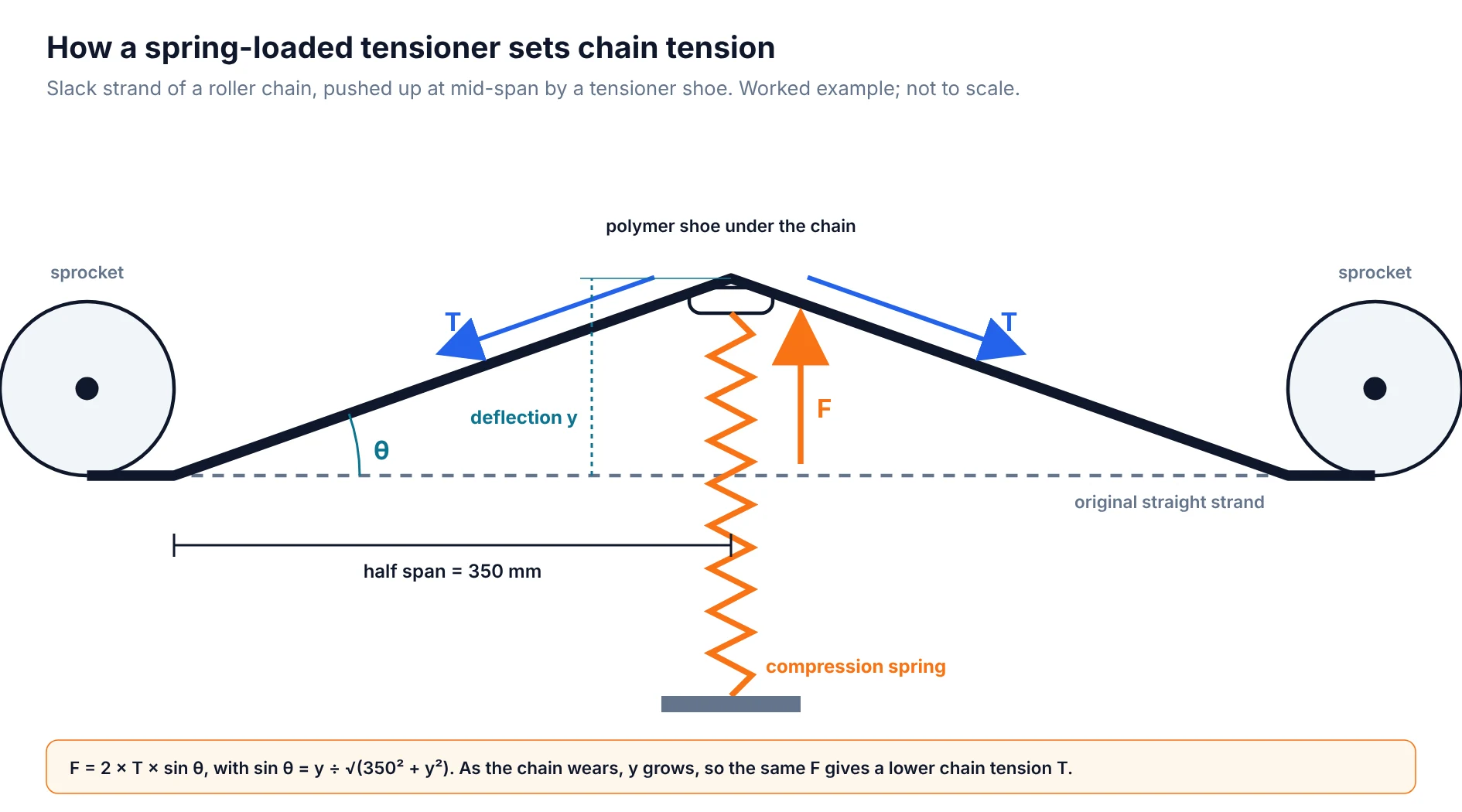
Two things follow from that equation. A small angle needs only a small spring force for a given chain tension, so tensioner springs are often light compared with the chain loads. And as the chain wears, the shoe has to move further out, the angle grows, and the same spring force gives less chain tension.
Rotary tensioners work the same way, with a torsion spring and an arm. Machine Design notes that rotary tensioners are found mainly on belt drives, while linear tensioners are more often found on chain drives, especially ones with a polymer wear surface in place of an idler sprocket [1]. If you do use an idler sprocket, place it outside the chain on the slack side, equally distant from both sprockets, with at least three teeth in engagement [1].
Worked example: a linear chain tensioner spring
We modelled a simple conveyor drive: two equal sprockets on 700 mm centres, an ANSI 40 roller chain (12.7 mm pitch) of 130 pitches, or 1,651 mm, and a linear tensioner with a polymer shoe at the middle of the slack strand. The example target is 150 N of slack-side tension when the chain is new. That target is our own design assumption for a light conveyor, not a figure from a standard. We used the standard compression spring equations with G = 79.3 GPa and Shigley’s minimum tensile strengths [4].
Where you set the shoe matters more than the spring
As the chain elongates, the extra length has to go into the bend at the shoe. The table compares two installed deflections, 50 mm and 100 mm, with a spring of constant force. Only the geometry changes the tension here.
| Chain elongation | Extra chain length | Shoe travel (start 50 mm) | Tension (start 50 mm) | Shoe travel (start 100 mm) | Tension (start 100 mm) |
|---|---|---|---|---|---|
| 0 % (new) | 0 mm | 0 mm | 150 N | 0 mm | 150 N |
| 0.25 % | 4.1 mm | 13.0 mm | 120 N | 7.3 mm | 141 N |
| 0.5 % | 8.3 mm | 23.7 mm | 103 N | 14.1 mm | 133 N |
| 1.0 % | 16.5 mm | 41.7 mm | 84 N | 26.8 mm | 121 N |
| 2.0 % | 33.0 mm | 70.2 mm | 65 N | 49.3 mm | 105 N |
With the shallow 50 mm starting deflection, the chain tension falls by 44 % at 1 % elongation, even with a perfect constant-force spring. With 100 mm, it falls by only 19 %, and the shoe needs 36 % less travel. The deeper bend needs a few more chain links, but it gives the spring an easier job.
Choosing the spring rate
At 100 mm starting deflection, the shoe needs 82.4 N of spring force to give 150 N of chain tension. Here is how three springs with that same installed force behave as the chain wears:
| Chain elongation | 4.0 N/mm spring (21 mm preload) | 1.2 N/mm spring (69 mm preload) | 0.5 N/mm spring (165 mm preload) |
|---|---|---|---|
| 0 % | 150 N | 150 N | 150 N |
| 0.25 % | 91 N | 126 N | 134 N |
| 0.5 % | 42 N | 106 N | 122 N |
| 0.75 % | 0 N | 89 N | 111 N |
| 1.0 % | 0 N | 74 N | 101 N |
| 1.5 % | 0 N | 49 N | 86 N |
| 2.0 % | 0 N | 30 N | 74 N |
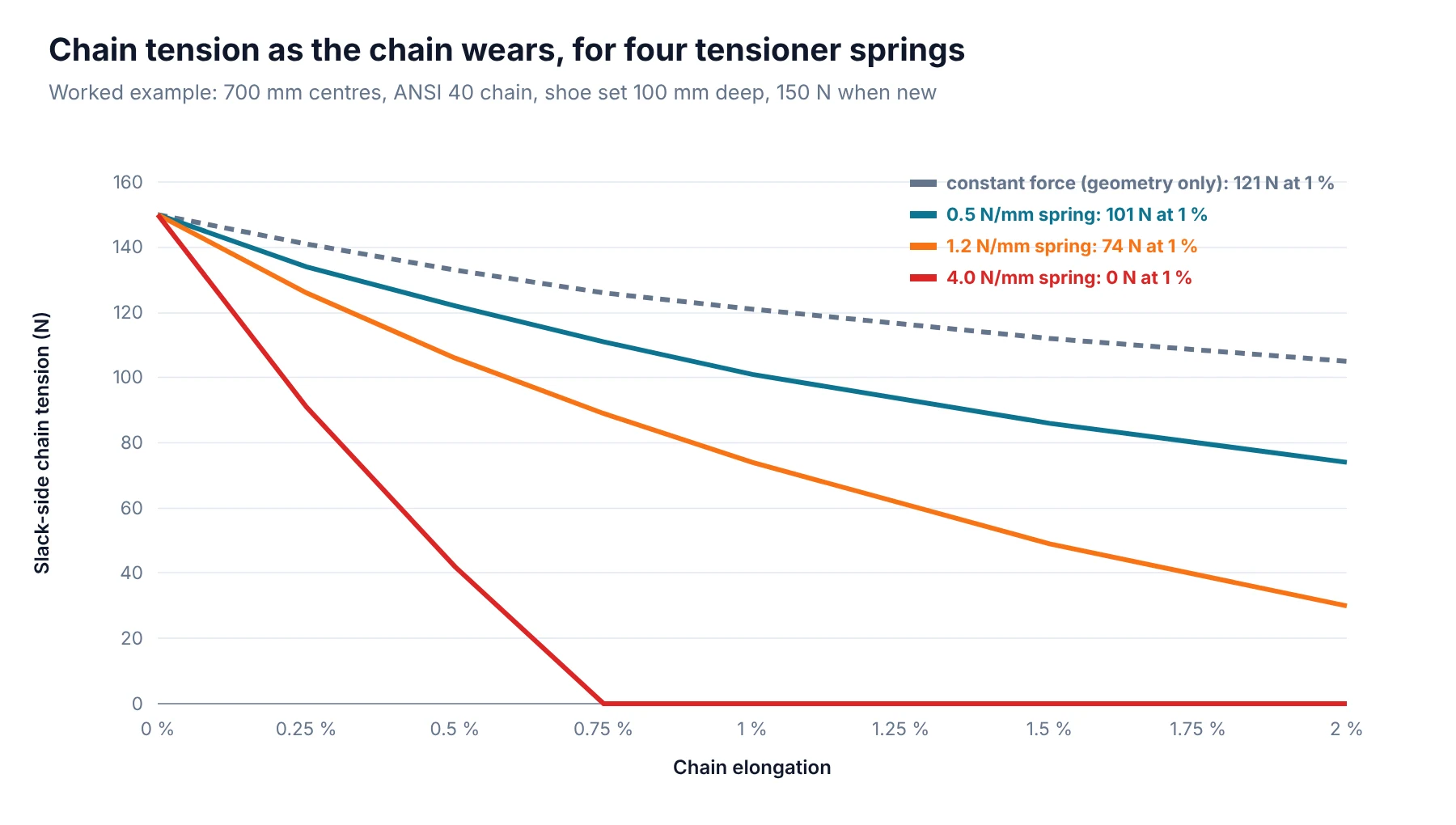
The stiff 4 N/mm spring is short and cheap, but it gives only 42 N by 0.5 % elongation and nothing at 0.75 %. The soft 0.5 N/mm spring holds tension best, but it must be compressed 165 mm before it starts work, which needs a free length of well over 200 mm. Few tensioner bodies have room for that.
So why do so many tensioners use a stiff spring anyway? Because a short body is easy to fit, and the chain is re-tensioned at service. Three lessons follow from the table:
- The useful stroke is short. Decide how much tension loss you accept, then size the stroke to that, not to the full chain life.
- Preload deflection is what counts. The share of force a spring loses over its stroke is roughly the stroke divided by the preload deflection. A spring compressed 69 mm loses about 20 % over 14 mm; one compressed 21 mm loses 68 %.
- Levers and torsion springs help. A torsion spring can be wound up 180° or more before it starts work, so a rotary arm tensioner can keep a long preload in a small space. See our torsion spring specification guide for the windup terms.
The spring we would specify
For this drive we chose the 1.2 N/mm spring and a rule to re-set the tensioner when the shoe has moved 14 mm, which matches about 0.5 % chain elongation. At that point the chain tension is still 106 N, 71 % of the starting value.
| Parameter | Value |
|---|---|
| Wire | 2.0 mm music wire (ASTM A228), or 302 stainless (ASTM A313) for washdown areas |
| Mean coil diameter | 20.0 mm (spring index C = 10); outside diameter 22.0 mm |
| Active coils | 16.5, closed and ground ends, total 18.5 |
| Spring rate | 1.20 N/mm |
| Free length | 121.6 mm |
| Installed length (new chain) | 53.0 mm at 82.4 N |
| Fitting length (shoe pushed back to fit chain) | 43.0 mm at 94.4 N |
| Solid length | 37.0 mm |
| Shear stress at fitting length | 0.34 of tensile strength (music wire), 0.41 (302 stainless) |
| Free length / outside diameter | 5.5, so the spring needs a guide rod |
Shigley’s stress limits for compression springs are well clear here, so this spring is controlled by its force loss, not its strength [4]. The long free length compared with its diameter means it will buckle unless it runs on a rod or in a bore. Our article on compression spring buckling shows how to check that.
What goes wrong with chain tensioner springs
Most tensioner spring problems show up as chain noise, chain whip or jumped teeth, not as a broken spring. The usual causes are:
- The spring has reached the end of its stroke. It still pushes, but with too little force. The fix is to re-set the tensioner or shorten the chain, not to fit a stiffer spring.
- A stiffer spring was fitted to cure noise. Over-tensioning loads the shaft bearings and wears pins and bushings faster. Machine Design notes that automatic tensioners reduce the risk of over-tensioning in the first place [1].
- The drive reverses. A spring tensioner on a reversing drive ends up on the tight side, where its force may be inadequate [1]. Use a fixed idler there.
- Corrosion or dirt in the plunger. A spring that rusts in its bore can stick, so the shoe stops following the chain. Our stainless steel springs guide covers wire choices for wet and washdown areas.
- Buckling or rubbing. A long spring without a guide bows sideways and rubs, which wastes force and wears the coils.
USA Roller Chain sums up the trade-off: fixed models are simple and reliable, while spring-loaded designs automatically adjust to chain stretch and shock loads [5].
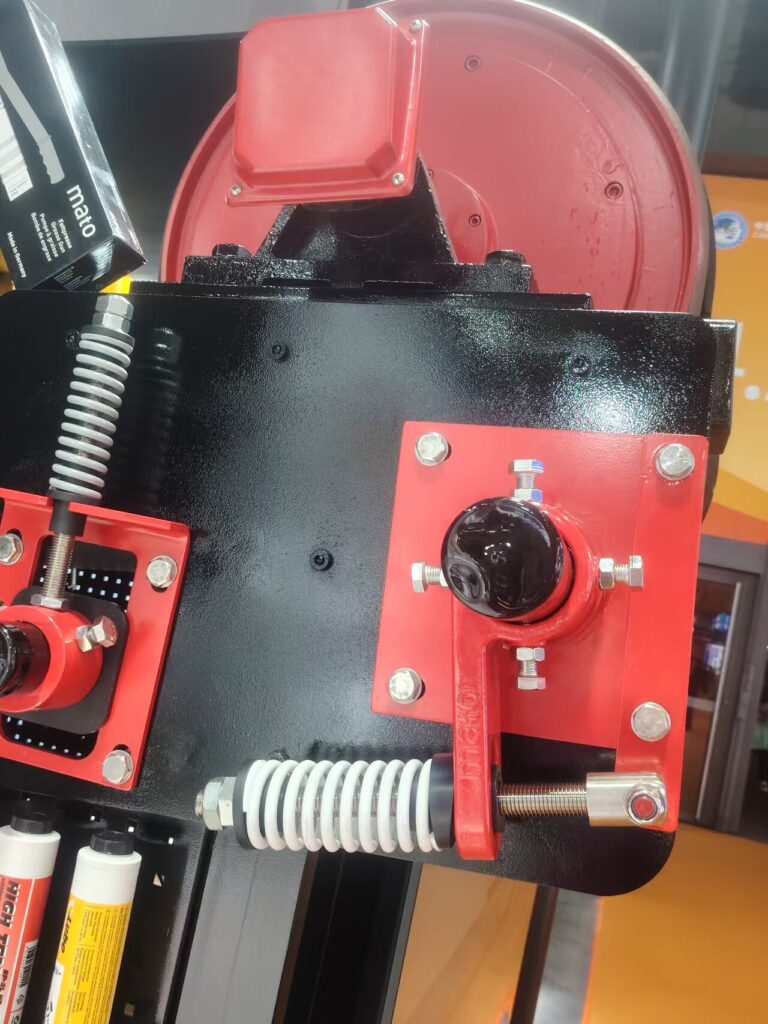
The photo above was taken on our visit to CIIE 2026 and shows how compact these springs usually are. We make compression springs and torsion springs for this kind of mechanism. Belt drives on lawn equipment use the same idea with an extension spring; see our article on mower deck belt tension springs.
What to send for a chain tensioner spring quote
| Item | Example |
|---|---|
| Spring type | Compression spring on a plunger, or torsion spring on an arm |
| Drawing or sample | Drawing preferred; a used spring may have taken a set |
| Wire and material | 2.0 mm music wire, or 302 stainless for washdown |
| Outside diameter and bore or rod | 22.0 mm OD; 24 mm bore or 15 mm rod |
| Free length | 121.6 mm, with tolerance |
| Force at two lengths | 82.4 N at 53.0 mm and 65.5 N at 67.1 mm, ± 10 % |
| Solid length | 37.0 mm maximum |
| Ends | Closed and ground, or closed and not ground |
| Finish | Oiled, zinc plated with baking, or passivated stainless |
| Duty | Drive speed, reversing or not, wet or dusty environment |
Two forces at two lengths are the most important lines on the drawing. They fix both the new-chain tension and the tension at the re-set point. If you are unsure how preload and travel interact, our spring preload guide explains the terms. Send your drawing or sample through our contact page, and our engineers will review it and reply within 24 hours. You can read more about our company and its certifications. This guide was compiled by our editorial team with our spring engineers.
Frequently asked questions
What does a chain tensioner spring do?
It pushes the tensioner’s shoe, roller or idler sprocket into the slack strand of the chain. The spring force, together with the angle of the chain at the shoe, sets the slack-side tension and takes up slack as the chain wears.
How tight should a spring-loaded chain tensioner be?
Tight enough to keep the slack within the chain maker’s limits, such as 4–6 % mid-span movement on a horizontal drive [2], and no tighter. More spring force does not make the drive better; it loads the bearings and wears the chain faster.
Why does my chain still go slack with a spring tensioner?
Usually the spring has reached the end of its useful stroke. As the chain wears, the shoe moves out, the spring extends and the chain angle grows, so the tension falls. In our example, a 1.2 N/mm spring has lost half its tension at about 1 % elongation. Re-set the tensioner or shorten the chain.
Can I use a stronger spring in my chain tensioner?
You can, but a stiffer spring loses force faster over its stroke and raises the starting tension. In our example, a 4 N/mm spring had no useful tension left after 0.75 % chain elongation, while a 1.2 N/mm spring still gave 89 N. A longer, softer spring with the same installed force is usually the better change.
References
- Warren Palmer (Fenner Drives), “Belt and chain tensioners”, Machine Design, January 2005. https://www.machinedesign.com/archive/belt-and-chain-tensioners
- Diamond Chain, “Roller chain installation” (PDF). https://www.ibtinc.com/wp-content/uploads/2016/03/Diamond-Chain-Roller-Chain-Installation.pdf
- Murtfeldt, “Basics of a chain drive”. https://murtfeldt.de/en-GB/Products-Applications/Tensioning/Chain-drive/
- Shigley’s Mechanical Engineering Design, Chapter 10 Mechanical Springs, lecture slides, Istanbul Technical University. https://web.itu.edu.tr/~halit/Makel/Ch_10_slides_m.pdf
- USA Roller Chain, “Chain tensioners: types, applications and selection guidelines”. https://usarollerchain.com/blogs/news/chain-tensioners-roller-chain-systems



