










In this article
- Key takeaways
- How does a snow plow trip spring work?
- What does a typical trip spring pull?
- What does the business-card rule mean in pounds?
- Where is a trip spring most highly stressed?
- Why do trip springs break, and how do the brackets fail?
- How do replacement trip springs differ between plows?
- What to specify for a snow plow trip spring
- Frequently asked questions
- References
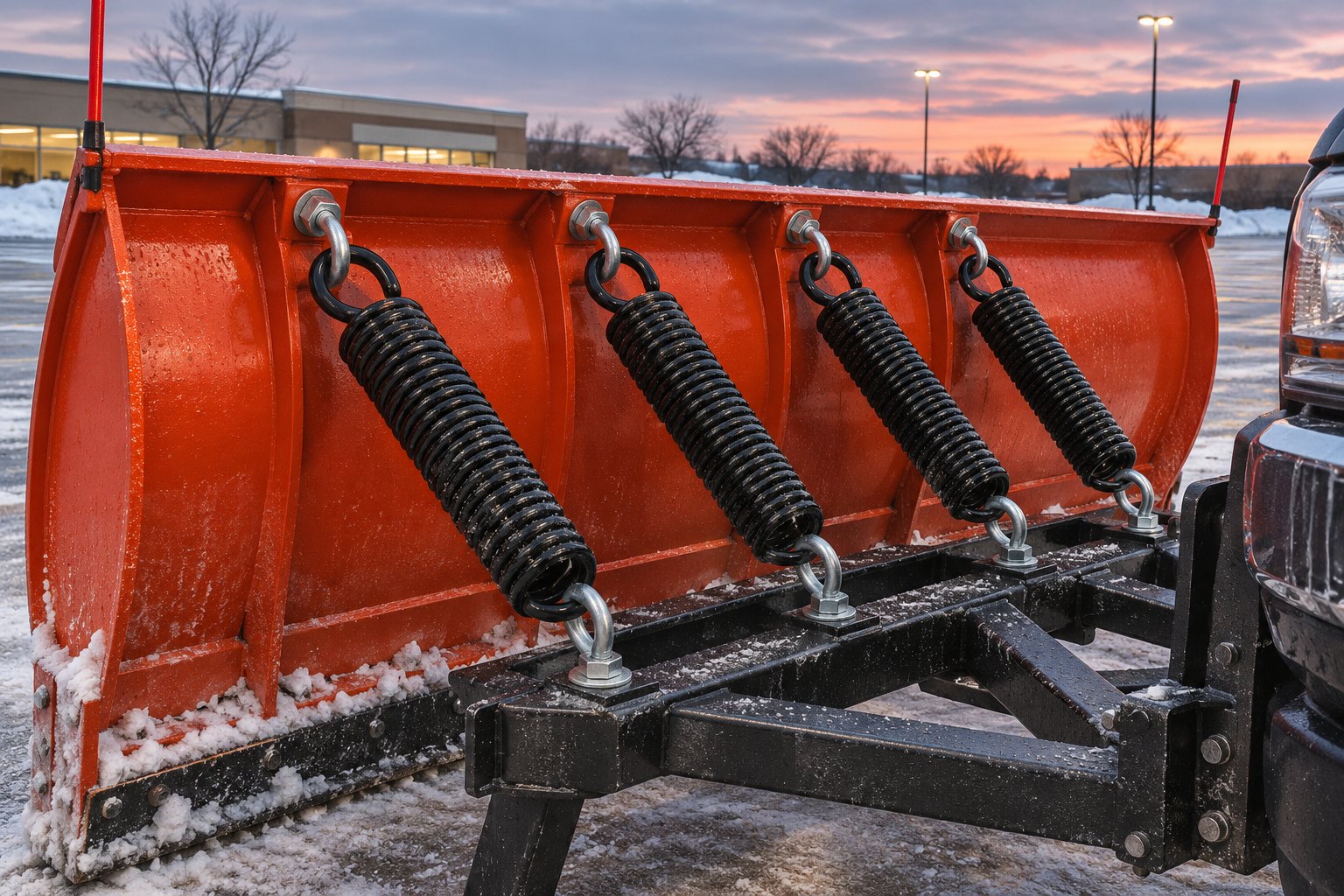
Cover image: an AI-generated illustration of a generic straight-blade snow plow, based on a photo of a heavy extension spring we make; it does not show a specific plow brand.
Snow plow trip springs are the heavy close-wound extension springs that hold a plow blade upright and let it fold forward over a hidden curb, manhole cover or speed bump, then pull it back into place. On a typical straight blade, two to four of them run from the top of the moldboard down to the push frame. One plow maker puts it plainly: trip springs let the blade “absorb the impact instead of transferring the force to the plow or truck” [1].
This guide is written for snow plow manufacturers, aftermarket parts brands and fleet maintenance buyers who source these springs in volume. It works through the loads in a published replacement spring, translates the business-card tension rule into pounds, shows where the spring is most highly stressed and explains why springs that are pulled too far go soft. For extension spring drawings in general, see our extension spring specification guide.
Key takeaways
- The preload does most of the work. A published 15 in replacement spring is wound with 340 lb of initial tension, so the blade cannot start to trip until each spring is pulled harder than that.
- The business-card gap is about 16 % above initial tension. Opening every coil by a 0.3 mm card adds about 8 mm of stretch, or roughly 56 lb, on the spring in our example.
- One nut turn is about 14 lb. With a 1/2-13 eye bolt, each full turn changes the pull by about 61 N, so four springs set “by feel” can easily differ by 10 % or more.
- Over-stretch, not wear, makes springs go soft. In our estimate the hook passes its static stress limit at about 3 in of stretch, well short of the 5 in maximum listed for the spring.
- Specify the force, not just the size. A drawing should state initial tension, rate, the stretch at which the force is checked and the hook stress basis.
How does a snow plow trip spring work?
A trip mechanism is the hinge-and-spring arrangement that lets part of the plow fold forward when the cutting edge hits something solid. On a full-moldboard trip plow, the whole blade pivots at hinges near its bottom edge, and the trip springs, hooked between the top of the moldboard and the push frame, hold it upright. When the cutting edge strikes a curb, the blade rotates about the hinges, the springs stretch and, once the obstacle is passed, they pull the blade back. On a trip-edge plow, only the cutting edge pivots, and the springs sit between the edge and the moldboard.
| Trip design | What folds | Spring type | Example from published sources |
|---|---|---|---|
| Full moldboard trip, straight blade | Whole moldboard | Two to four extension springs behind the moldboard | BOSS lists 2, 3 or 4 springs by straight-blade model [1] |
| V-plow | Each wing or the center section | Extension springs between center section and push frame | BOSS XT and DXT use four springs [1] |
| Trip edge | Cutting edge only | Torsion springs or spring-and-rod assemblies | BOSS trip-edge models use torsion springs [1]; Fisher fits 4 or 6 spring assemblies by blade width [2] |
| Small UTV and ATV plows | Moldboard | One or two shorter extension springs | A common 12 in replacement has 1-3/4 in coils [3] |
The trip force at the cutting edge depends on the plow geometry. As a rule, it equals the number of springs times the force in each spring times the ratio of the spring’s lever arm to the cutting edge’s lever arm about the hinge. Because that ratio is fixed by the plow design, the spring force is the only part an operator or a spring supplier can change, and that is why the preload matters so much.
Initial tension is the force wound into a close-wound extension spring during coiling; the spring does not stretch at all until the pull exceeds it. On a trip spring, initial tension is what keeps the blade from rocking under the normal push of snow. Our article on spring preload explains how preload and initial tension are set and measured.
What does a typical trip spring pull?
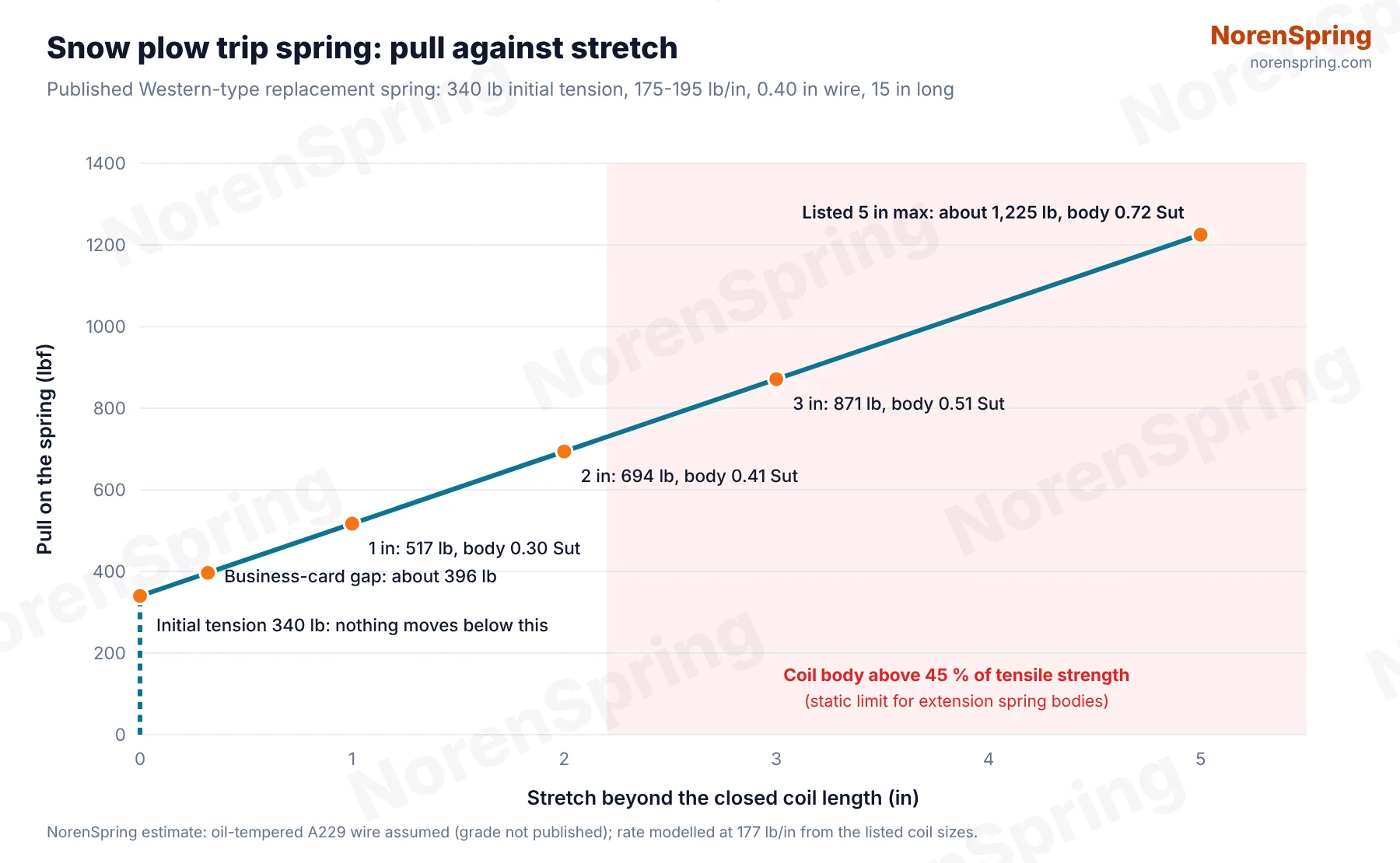
We modelled a published replacement trip spring sold for Western plows, using the specification answers a parts retailer gives for it. The first answer lists a rate of 175-195 lb/in, 27.75 to 28.25 coils and a largest coil of 2.38 in that tapers to 1.88 in over three coils at each end. It also gives 340 lb of initial tension (±10 %), a black paint finish and a maximum operating extension of 5 in [4]. A second answer for the same part gives a 15 in overall length, an 11.5 in coil length and a 0.40 in wire figure, and says it replaces Western 23039 [5]. We calculated the rate and stresses with the standard extension spring equations [6], so they are our estimates, not published figures.
| Parameter | Published | NorenSpring check |
|---|---|---|
| Wire diameter | 0.40 in | 10.16 mm |
| Outside diameter | 2.38 in, ends tapered to 1.88 in | Mean coil diameter 50.3 mm; spring index C = 4.95 |
| Coils | 27.75 to 28.25 | 28 coils × 0.40 in ≈ 11.6 in closed length, matching the listed 11.5 in |
| Rate | 175-195 lb/in | 177 lb/in (31.0 N/mm), counting the stiffer tapered end coils |
| Initial tension | 340 lb ±10 % | 1,512 N; uncorrected stress 185 MPa |
| Maximum operating extension | 5 in | About 1,225 lb pull at 5 in |
The published numbers agree with each other, which is not always the case: a close-wound spring of 28 coils of 0.40 in wire should be about 11.6 in long, and our modelled rate lands inside the listed range. Consequently, a buyer can use this spring as a sound reference design.
The initial tension is high for the wire size, which matters for quality control. The preferred range in Shigley’s design text for an index of 4.95 works out to about 112 to 163 MPa of initial tension stress [6], while 340 lb in this spring gives about 185 MPa. That is achievable but sits above the easy range, so the ±10 % tolerance on initial tension deserves a test at goods-in, not just a dimensional check.
What does the business-card rule mean in pounds?
BOSS’s instruction for setting trip springs is to tighten each spring evenly “until a standard business card fits snugly between the coils” [1]. The rule works because it pulls every spring just past its initial tension, by the same small amount, without any gauge.
For the spring in our example, a standard business card of about 0.30 mm opened between each of 27 coil gaps adds 8.1 mm of stretch. At 31.0 N/mm, that raises the pull from 1,512 N to about 1,763 N (396 lb), 16.6 % above initial tension. A thicker 0.36 mm card gives about 1,814 N, 20 % above. Either way, the rule sets each spring a little above its built-in preload, which is enough to stop the blade from nodding on every bump but still lets it trip at a predictable load.
| Adjustment from the card setting | Change in pull per spring | Change from card setting |
|---|---|---|
| One full turn of a 1/2-13 nut | About 61 N (13.6 lb) | 3.4 % |
| One full turn of a 5/8-11 nut | About 72 N (16.1 lb) | 4.1 % |
| Card gap reached (about 4 turns past coil contact, 1/2-13) | +251 N (+56 lb) | Card setting |
| Two cards per gap instead of one | +251 N (+56 lb) | 14 % stiffer trip |
The nut sizes come from BOSS’s instructions, which use 1/2 in nylon lock nuts on straight blades and 5/8 in top lock nuts on XT and DXT plows [1]; the thread pitches are our assumption. In practice, this means one spring turned two extra times carries about 7 % more than its neighbours, which twists the moldboard slightly and makes one end trip later than the other. The card check between coils is therefore a better guide than counting turns.
Where is a trip spring most highly stressed?
An extension spring has three places to check: torsion in the coil body, bending at the base of the hook (point A) and torsion where the hook bends away from the body (point B). Shigley’s text gives static limits of about 45 % of tensile strength for the body, 75 % for hook bending and 40 % for hook torsion for carbon spring steel [6].
We assumed oil-tempered ASTM A229 wire, because the listing does not name the grade, and a hook formed from the 1.88 in tapered end coil with an inside bend radius of twice the wire diameter. Tensile strength for 10.16 mm A229 wire works out to about 1,202 MPa.
| Stretch | Pull | Coil body | Hook bend, A | Hook torsion, B |
|---|---|---|---|---|
| 0 (initial tension) | 340 lb | 0.20 | 0.30 | 0.14 |
| 1 in | 517 lb | 0.30 | 0.46 | 0.22 |
| 2 in | 694 lb | 0.41 | 0.62 | 0.29 |
| 3 in | 871 lb | 0.51 | 0.78 | 0.37 |
| 4 in | 1,048 lb | 0.61 | 0.93 | 0.44 |
| 5 in (listed maximum) | 1,225 lb | 0.72 | 1.09 | 0.52 |
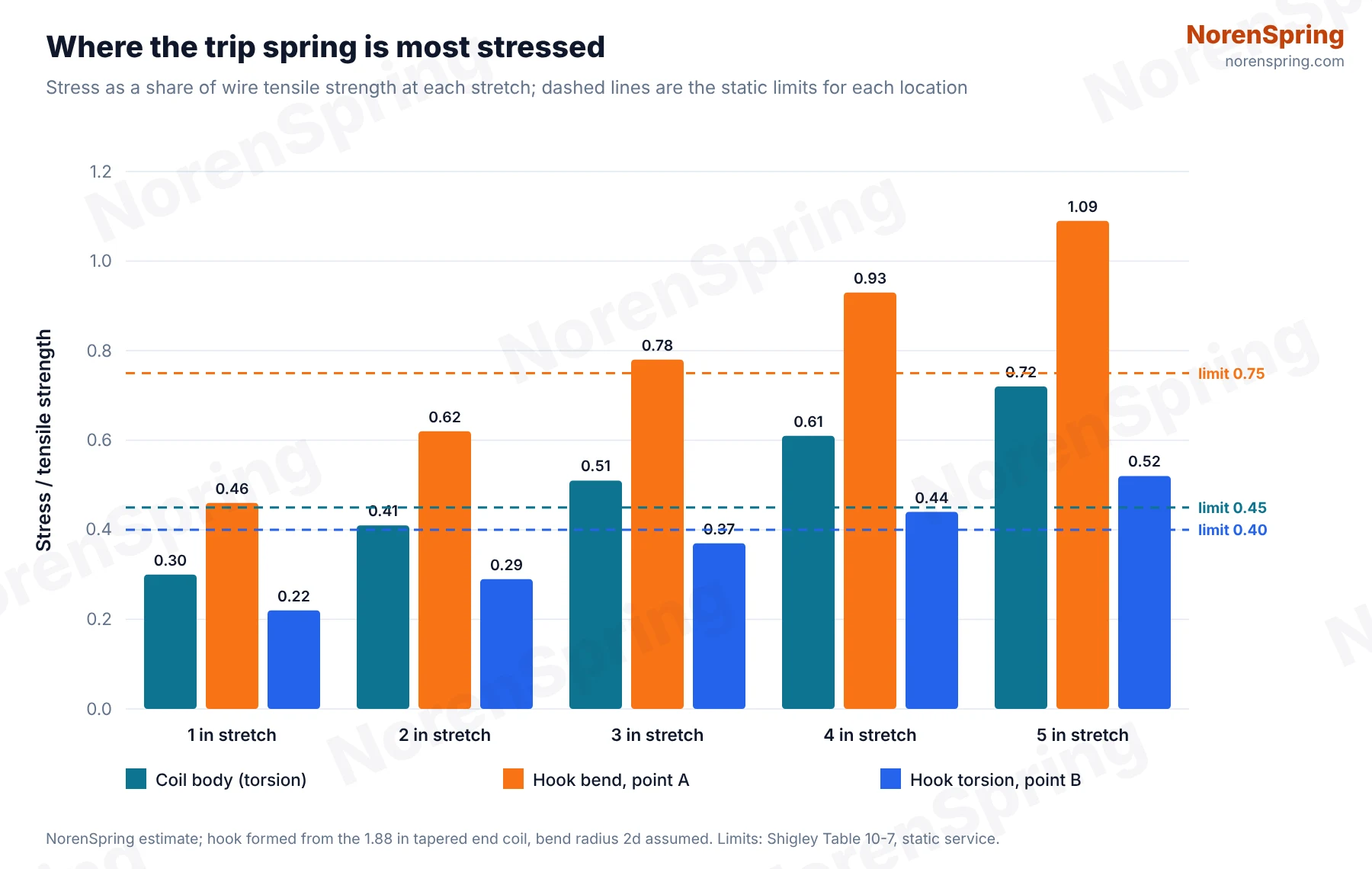
Up to about 2 in of stretch, every location stays inside its limit. Beyond about 2.2 in, the coil body passes 45 %, and by 3 in the hook bend passes 75 %. At the listed 5 in, our estimate puts the hook above the wire’s tensile strength. A real spring could only survive that with stronger wire, a larger bend radius, set removal or a different end design. As a result, the listed 5 in is best read as a stop-before-damage figure rather than a working stroke.
This also explains why trip springs “go soft” during a season of heavy use: each hard hit that pulls a spring past about 2 to 3 in yields the hooks or coils slightly. Set is that permanent loss of shape, and it builds up hit by hit. The spring then sits longer, its coils no longer close tight, and the blade trips too easily, which is the first symptom on BOSS’s replacement list, alongside sagging, stretched or uneven springs [1]. Our article on why springs fail covers set and relaxation in more detail.
Why do trip springs break, and how do the brackets fail?
Trip springs live in road salt, slush and freezing temperatures, and they cycle every time the blade nods, so three failure modes are common.
- Fatigue at the hook. The hook carries the highest stress, so fatigue cracks usually start at the base of the hook. A larger bend radius and a smooth, undamaged surface help most; our guide to spring end types compares hook designs.
- Corrosion pits. Paint chips where the hook bears on the eye bolt, and salt water starts pits that become fatigue cracks. Coating choice and touch-up matter; our spring finishes guide compares paint, powder coat and plating.
- Overload of the mounting. The spring load has to go somewhere, and the brackets can crack before the springs do. Fisher issued a repair procedure for top anchors, the brackets where trip springs attach to the moldboard, using welded gussets and replacement spring assemblies. The same document warns that servicing trip springs without special tools and knowledge could cause injury [2].
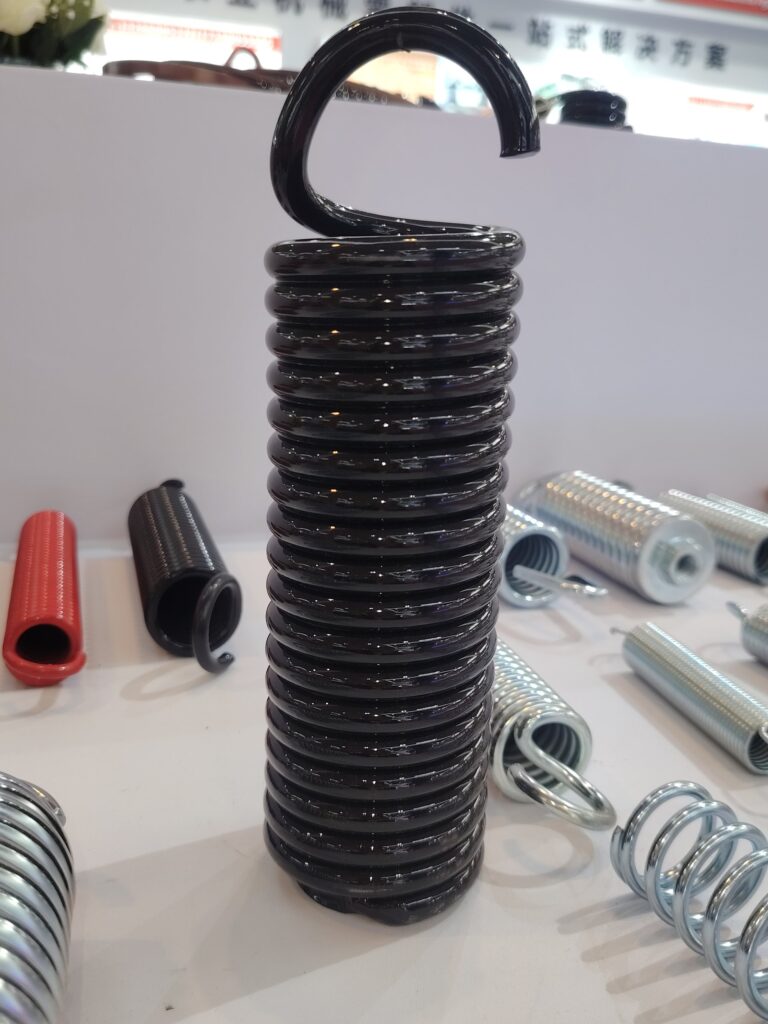
Safety is a real issue in the field, because the springs are never relaxed. At the card setting, each spring in our example already holds about 396 lb, and the energy stored in a trip spring stretched to 5 in is about 440 J. Release it without a removal tool, and the hook or eye bolt can fly. Replacement guides therefore tell installers to lower the plow, support the frame and swap springs one at a time [1].
How do replacement trip springs differ between plows?
Trip springs look alike but are not interchangeable, because published replacement springs in the 15 in class vary in diameter and wire size. One Meyer-type spring is listed at 15 in long with an 11 in coil length, 2-1/2 in diameter and 3/8 in material [7], while another seller lists a Meyer-type replacement at 14-3/4 in and 2-1/4 in [8]. With the same coil diameter and coil count, 0.375 in wire gives about 23 % less rate than 0.40 in wire, so a blade fitted with the lighter spring trips noticeably earlier.
Replace springs as a set whenever possible. If one spring has failed, BOSS advises inspecting the rest and notes that replacing the complete set gives more consistent tension [1]. A new spring next to three that have taken set will carry more than its share of every trip.
Brand names in this article are used only to identify products and published sources; NorenSpring is not affiliated with these plow manufacturers, and replacement springs should be described as compatible with a plow, not as original parts.
What to specify for a snow plow trip spring
| Item | Example |
|---|---|
| Application | Full-moldboard trip, four springs per blade, blade width and plow model stated |
| Wire | 10.16 mm (0.40 in) oil-tempered or chrome-silicon spring wire, grade stated |
| Coil form | 60.5 mm (2.38 in) OD body, ends tapered to 47.8 mm (1.88 in) over three coils |
| Closed coil length | 292 mm (11.5 in) ± 3 mm |
| Initial tension | 1,512 N (340 lb) ± 10 %, tested |
| Rate | 30.6 to 34.1 N/mm (175 to 195 lb/in) |
| Load check | Force at a stated stretch, for example 3,087 N (694 lb) at 50.8 mm (2 in) |
| Maximum stretch | Working stroke and maximum stretch stated separately |
| Hooks | Hook form, opening, orientation and minimum inside bend radius |
| Finish | Black paint or powder coat over phosphate, or zinc with embrittlement relief |
| Testing | Initial tension and load at two lengths on samples from every lot; hold at maximum stretch, then recheck free length for set |
Send your drawing, a sample spring or the plow’s load case through our contact page, and our engineers will review it and reply within 24 hours. Our extension springs page shows the end types and finishes we make, and you can read more about our company and its certifications. For other heavy extension springs with the same hook questions, see our guides to trailer ramp springs and drawbar springs. This guide was compiled by our editorial team with our spring engineers.
Frequently asked questions
How tight should snow plow trip springs be?
Tighten each spring evenly until a business card fits snugly between the coils, as plow makers instruct [1]. On the spring in our example, that is about 16 % above the 340 lb initial tension, or about 396 lb per spring.
Why does my snow plow trip too easily?
The usual causes are springs that have taken set after hard hits, a broken spring or springs adjusted too loose. A spring that has taken set is longer than a new one and its coils no longer close tightly, so it starts to stretch at a lower load; replace the whole set rather than a single spring.
Can I use stronger trip springs?
You can, but the blade will then transfer more of each impact to the A-frame, mounts and truck before it trips, and stronger springs also load the moldboard top anchors harder. Raise the spring force only within the plow maker’s guidance for that model.
How many trip springs does a snow plow have?
It depends on the plow design and the blade width. Published examples range from two to four on straight blades and four on some V-plows [1], and four or six spring assemblies on some trip-edge blades [2]. As a practical rule, count the spring mounting holes on the moldboard and fit one spring in each.
References
- BOSS Snowplow, “How to Replace Snowplow Trip Springs: Signs, Steps, and Proper Adjustment”, updated 28 September 2026. https://info.bossplow.com/blog/how-to-replace-snowplow-trip-springs
- Fisher Engineering, “Top Anchor Repair Procedures”, literature number 26624, December 2000. https://res.cloudinary.com/douglas-dynamics/image/upload/v1689776457/Literature/26624.pdf
- etrailer.com, “What Size Trip Spring and How Many Do I Need for My Snow Plow?” https://www.etrailer.com/question-563168.html
- etrailer.com, “Spring Rate and Other Specs for Western Snow Plow Trip Spring 3371302205”. https://www.etrailer.com/question-722120.html
- etrailer.com, “Specs on Replacement Trip Spring for Western Snow Plow, 15 in Long, 3371302205”. https://www.etrailer.com/question-532455.html
- Shigley’s Mechanical Engineering Design, Chapter 10 Mechanical Springs, lecture slides, Istanbul Technical University. https://web.itu.edu.tr/~halit/Makel/Ch_10_slides_m.pdf
- etrailer.com, “Dimensions of Replacement Trip Spring 3371302010”. https://www.etrailer.com/question-345681.html
- Reliable Aftermarket Parts, snow plow trip spring for Meyer plows (replaces 07017, 1302010). https://www.reliableaftermarketparts.com/products/one-snow-plow-trip-spring-fits-meyer-snow-plow-07017



