In this article
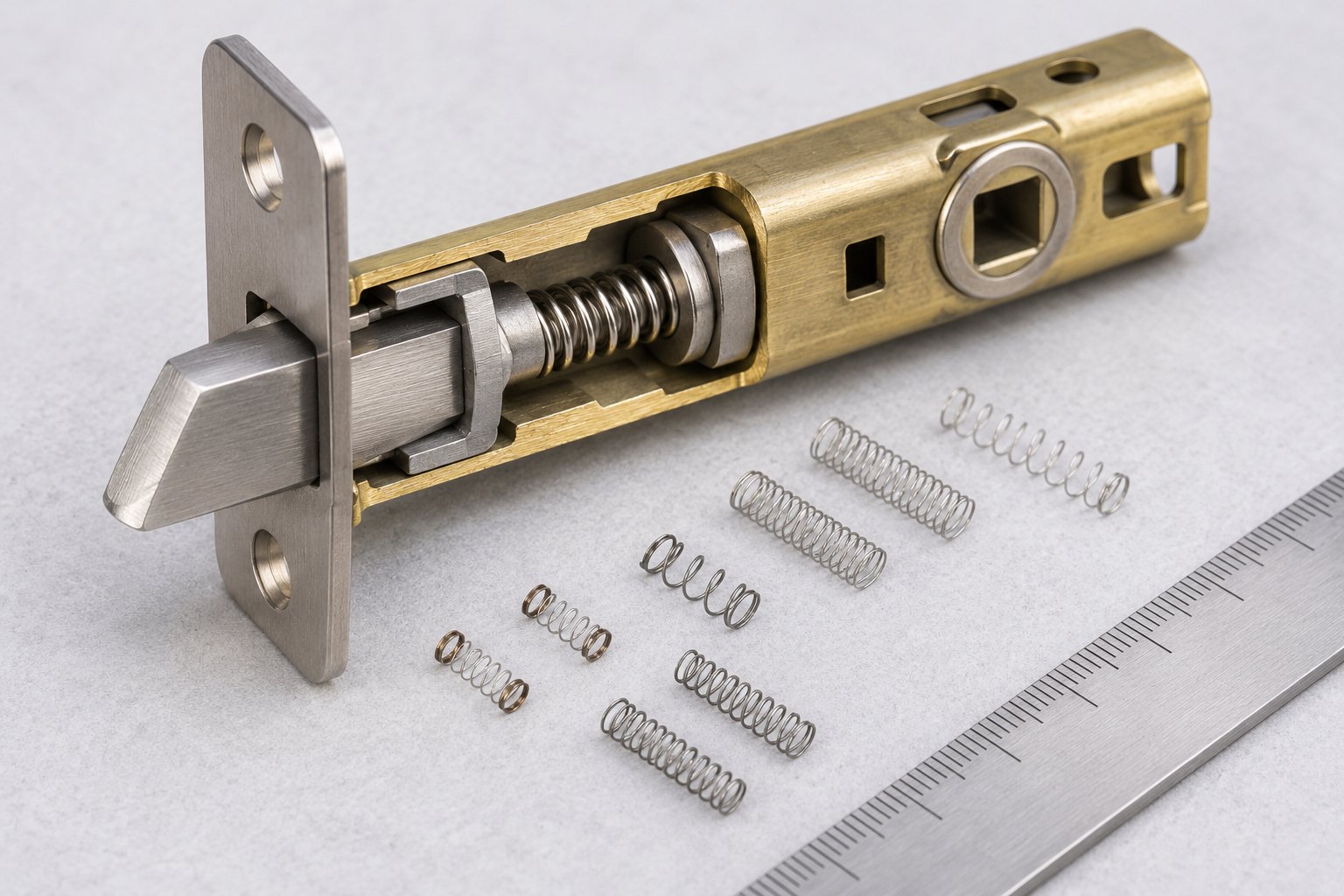
Cover image: an AI-generated illustration of a generic engine hose, based on a photo of a wire form we make; it does not show a specific vehicle or clamp brand.
Spring hose clamps are one-piece clamps made of spring wire or spring steel strip that squeeze a hose onto its fitting with their own spring force. There is no screw to tighten. The clamp is opened with pliers, slid over the hose end and released, and because it is a spring, it keeps pressing as the hose heats up, cools down and slowly settles. Rotor Clip, a maker of these clamps, calls them self-compensating: such a clamp “expands and contracts with the hose in response to temperature changes and, as a result, cannot be over- or under-tightened” [1].
This guide is for engineers and buyers who specify hose clamps for engines, pumps and appliances. Single wire and double wire clamps are wire forms, so our wire forms design guide covers the bending rules behind them in more depth.
Key takeaways
- The clamp’s spring force does the clamping. Würth sums up the benefit: “Once the spring band clamp is attached, there is no need to retighten it” [4].
- Three common types. Rotor Clip ranks them by clamping force: single wire highest, constant tension band in the middle, double wire lowest [1].
- Each clamp suits a narrow range of hose sizes. In the DIN 3021 table, the 32 mm band clamp is delivered at 29.5 mm and opens to 34.5 mm at most [5].
- Opening a clamp too far ruins it. In our model, a 2.0 mm wire clamp opened 2 mm past its fitting diameter goes from the stress limit to above the wire’s tensile strength, so it takes a set and grips less.
- Thicker wire is not always better. It grips a large hose harder, but in our model the 2.5 and 3.0 mm clamps sit loose on the smallest hose in the range.
How do spring hose clamps work?
A hose seals on its fitting when the rubber is pressed against the spigot or barb. Rubber hose walls creep under that pressure and change size with temperature, so a clamp that is simply tightened once, like a screw clamp, can lose its squeeze over time. A spring clamp is made smaller than the hose. Fitted on the hose, it is held open by the hose itself and keeps pushing inward; if the hose wall thins or shrinks, the clamp closes with it.
Rotor Clip’s FAQ describes the result: “A self-compensating hose clamp never needs to be manually adjusted” [1]. Westfield Fasteners, describing DIN 3021 band clamps, says the shape of the clamp lets it keep applying “an even and consistent radial clamping force” within “a temperature range of -40°C to +120°C” [5].
Spring clamps are for low-pressure joints. Wikipedia’s hose clamp article notes that spring clamps “are rarely used for high pressures or large hoses” and that they are common on automotive cooling hoses [8]. Rotor Clip lists uses “from securing radiator and heater hoses in automobiles to facilitating the flow of beverages in vending machines and attaching hoses to water jets in spas”, and calls them “a low cost alternative to the screw clamp in low-pressure applications” [1]. Würth gives an upper figure for its band clamps: depending on the hose and nozzle, “connections of up to a maximum of 11 bar can be fastened” [4].
Types of spring hose clamps
| Type | What it is made of | Clamping force | Typical finish (one maker’s standard) |
|---|---|---|---|
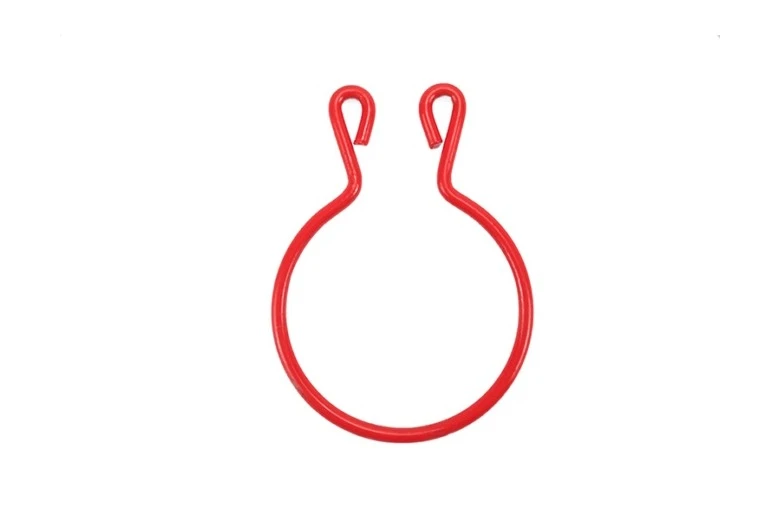
| Single wire | A ring of round spring wire, ends crossed into two ears | Highest of the three; Rotor Clip: “the most effective holding force and clamping strength” | Peen-plated zinc, “up to 240 hours of salt spray” [1] |
| Double wire | Two turns of thinner wire side by side | Lower than single wire; “spreads out the clamping force around the hose” | Peen-plated zinc [1] |
| Constant tension band | A strip of spring steel rolled into a ring, with intermeshing tabs | Between the two wire types [2] | Magni 511, “480 hours of salt spray protection” [1] |
Rotor Clip explains the choice of the double wire type: it is used “when a lower clamping force than offered by single wire clamps is sufficient and aesthetics are important” [1]. Its band clamps have “a smooth, 15-millimeter wide construction to provide a sturdy, uniform grip and prevent against damage to the hose” [2].
Materials
| Maker and type | Material | Heat treatment |
|---|---|---|
| Rotor Clip single and double wire | “specially processed premium grade spring wire” | “hardened and austempered” [1] |
| Rotor Clip band clamps | “SAE 1060-1090 steel” | Austempered [1] |
| Rotor Clip, all types | Carbon spring steel or chrome vanadium steel | Austempered in “well-regulated furnaces” [3] |
| Würth DIN 3021 band clamps | “High-strength, alloyed spring steel 51CrV4” | Not stated; coating rated for “720h salt spray resistance according to DIN EN ISO 9227” [4] |
For the wire grades themselves, see our guides to chrome vanadium springs and oil tempered vs hard drawn spring wire.
Spring hose clamp standards: DIN 3021 and SAE J1508
DIN 3021 covers spring band clamps. Part 1 covers dimensions, marking, materials and types; its 2016 edition added requirements for what DIN calls the “3-channel clamping force” [6]. Westfield’s summary of the standard covers sizes “from 13mm to 90mm in diameter” and explains that “The diameter given (nominal diameter) is the optimum hose outside diameter” [5]. For each size, the specification gives three diameters, the band thickness and a minimum clamping force measured at three points 120° apart:
| DIN 3021 size | Delivery diameter | Nominal (hose outside) diameter | Fully open diameter, max | Band thickness | Minimum 3-point clamping force |
|---|---|---|---|---|---|
| 13 | 12 mm | 13 mm | 14.2 mm | 0.8 mm | 100 N |
| 16 | 14.9 mm | 16 mm | 17.5 mm | 0.8 mm | 160 N |
| 20 | 18.4 mm | 20 mm | 21.6 mm | 1.3 mm | 200 N |
| 25 | 23.5 mm | 25 mm | 26.8 mm | 1.3 mm | 250 N |
| 32 | 29.5 mm | 32 mm | 34.5 mm | 1.7 mm | 300 N |
| 40 | 35.5 mm | 40 mm | 42.5 mm | 1.7 mm | 300 N |
| 50 | 43.5 mm | 50 mm | 53 mm | 2.1 mm | 410 N |
| 60 | 51.5 mm | 60 mm | 63 mm | 2.6 mm | 430 N |
| 70 | 61.5 mm | 70 mm | 73 mm | 2.6 mm | 370 N |
| 80 | 70 mm | 80 mm | 83 mm | 2.6 mm | 300 N |
| 90 | 79 mm | 90 mm | 93 mm | 2.6 mm | 300 N |
The values are from Tables 1 and 2 of the Westfield specification, for Form A clamps with a 12 mm wide band [5]. The minimum force rises with size to 430 N for sizes 54 to 60, then falls to 300 N for sizes 80 to 90. A spring clamp is chosen for one hose outside diameter.
SAE J1508 is the American hose clamp specification. SAE describes it as covering “32 types of clamps most commonly and suitably being used on OEM coolant, fuel, oil, vacuum, and emission systems”; the current edition is J1508_202301 [7]. Wikipedia notes that its designs include “screw, spring, and t-bolt styles” [8].
Worked example: sizing a single wire spring hose clamp
A wire clamp has to do two things that pull against each other. It must still grip on the smallest hose it will see, and it must survive being opened wide enough to pass over the hose end. We modelled a single wire clamp for a hose of 32 mm nominal outside diameter. Our assumptions, not data from any clamp maker:
- The hose diameter under the clamp can be anywhere from 31 to 33 mm, allowing for hose tolerance and the wall settling over time.
- The clamp is opened to 34.5 mm inside diameter to fit it, the fully open diameter DIN 3021 gives for the 32 mm band clamp [5].
- The wire is oil-tempered spring wire (ASTM A229), as a stand-in for the hardened wire clamp makers use. Tensile strength comes from Shigley’s Table 10-4. As a static bending limit we use 75 % of it, the value Table 10-7 gives for bending at the hook end of hardened and tempered carbon steel springs [10].
- The ring bends evenly all the way round. A real clamp bends most at the point opposite its ears, so this model shows trends; it does not give exact forces.
For each wire size, we set the clamp’s free inside diameter so that opening it to 34.5 mm takes the wire exactly to its bending limit. Then we calculated the spring-back moment left in the ring on hoses from 31 to 33 mm. That moment is what presses the ring onto the hose.
| Wire diameter | Tensile strength | Free inside diameter | Moment on a 31 mm hose | Moment on a 33 mm hose |
|---|---|---|---|---|
| 1.6 mm | 1,699 MPa | 29.9 mm | 136 N·mm | 361 N·mm |
| 2.0 mm (our choice) | 1,629 MPa | 30.8 mm | 63 N·mm | 597 N·mm |
| 2.5 mm | 1,563 MPa | 31.5 mm | 0 (loose) | 938 N·mm |
| 3.0 mm | 1,511 MPa | 32.0 mm | 0 (loose) | 1,267 N·mm |
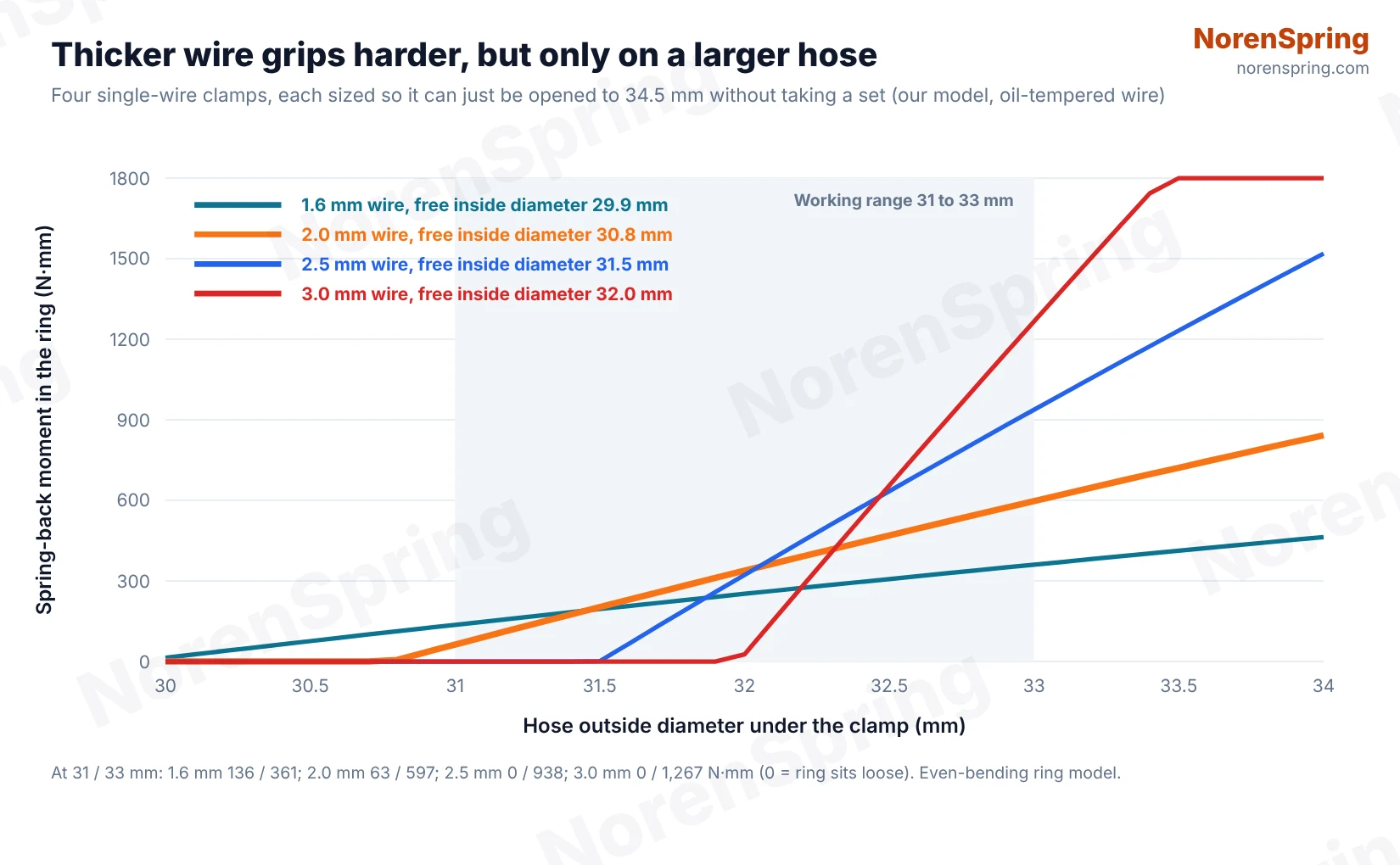
Thicker wire stores more moment for the same change in curvature, but its outer fibres are further from the centre, so it reaches its stress limit with less opening. To survive the trip to 34.5 mm, a thick wire clamp has to be made with a larger free diameter, and then it no longer closes onto a small hose. In our model the 3.0 mm clamp is loose on any hose under 32.0 mm; the 1.6 mm clamp still grips at 30 mm, but on a 33 mm hose it gives just over a quarter of the 3.0 mm clamp’s moment.
We chose 2.0 mm wire with a free inside diameter of 30.8 mm. It grips across the whole 31 to 33 mm range and gives 338 N·mm on the nominal 32 mm hose. On a 31 mm hose its moment falls to 63 N·mm, so a drawing for this clamp should hold the hose outside diameter close to nominal. A TMC session reported by FleetOwner made the same point about constant tension clamps in general: “this clamp has little tolerance for hose-wall variation”, and an SAE precise-tolerance hose was introduced for use with it [9].
Why a spring hose clamp must not be over-opened
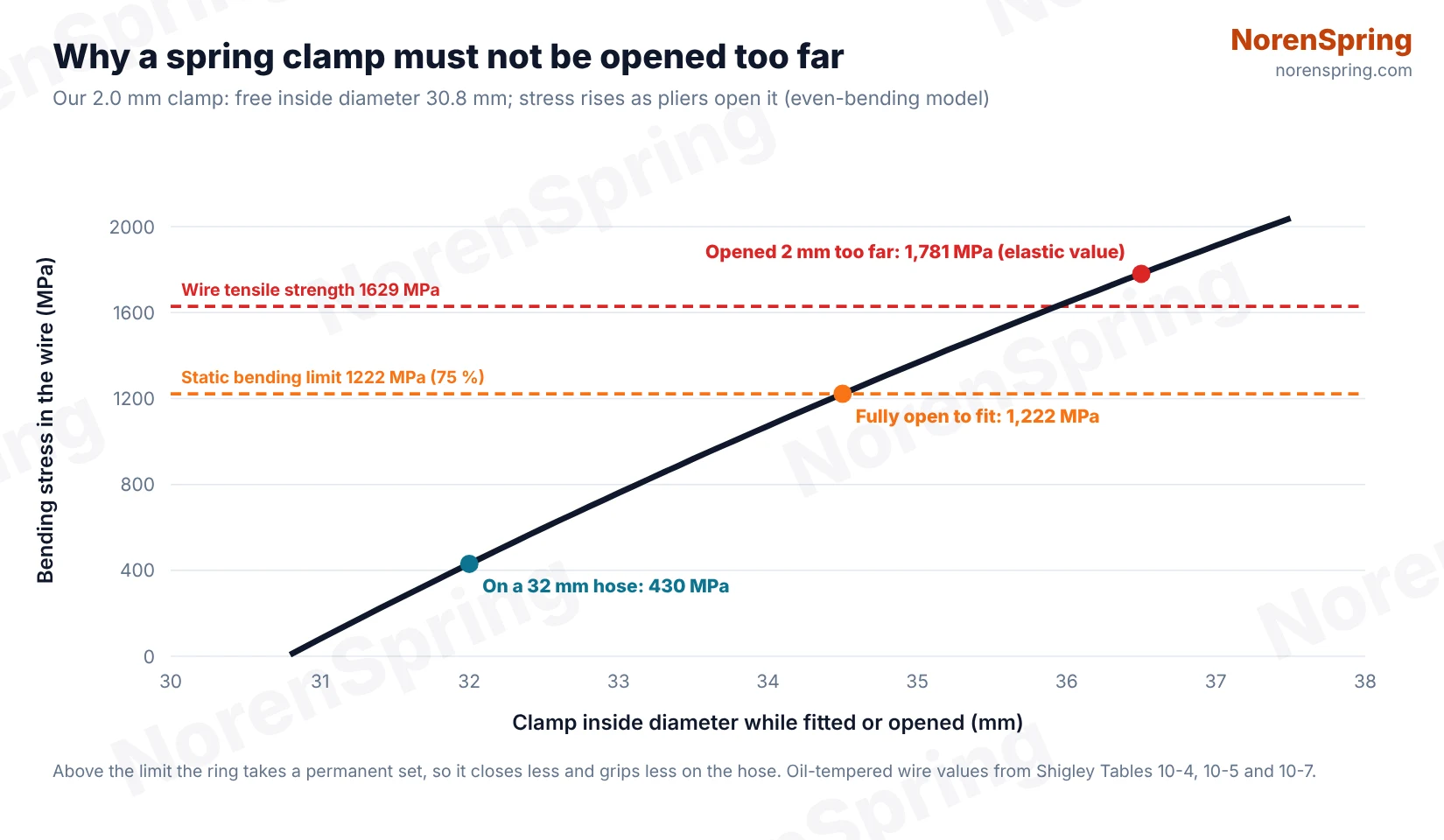
The same model shows why installers need the right pliers. On a 32 mm hose our 2.0 mm clamp carries 430 MPa of bending stress. Opened to 34.5 mm to fit it, the stress rises to its 1,222 MPa limit. Opened 2 mm further, the elastic calculation gives 1,781 MPa, above the wire’s 1,629 MPa tensile strength. Long before that, the ring yields and takes a permanent set: it comes back with a larger free diameter and presses less on the hose.
Rotor Clip gives the same warning in plain terms: “Care should be taken to ensure that the clamp is not expanded beyond the intended operating diameter as this will diminish the force that the clamp can apply when properly installed” [1]. Our wire forms design guide covers the bend radius rules that apply where the wire turns into the ears.
Can spring hose clamps be reused?
Würth lists “High reusability, since spring force is not lost” among the advantages of its band clamps [4]. That holds when the clamp has only been opened to its design diameter. A clamp that was pried open further, is visibly larger when free than a new one of the same size, or shows rust pits should be replaced, for the reasons in the worked example above. Our guide to why springs fail shows what corrosion and overload look like on spring steel.
What to specify when ordering spring hose clamps
For an engine, pump or appliance maker, a spring hose clamp drawing should state:
- Hose outside diameter under the clamp, with its tolerance, and the spigot or barb diameter. This sets the clamp size more than anything else.
- Free inside diameter of the clamp, with a tolerance.
- Maximum opening diameter in assembly, and the tool used, so the clamp is not over-opened.
- Clamping requirement, such as a minimum moment or a clamping force at nominal diameter. DIN 3021-1 sets requirements for the “3-channel clamping force” of band clamps [6]; the Westfield table asks for at least 300 N at size 32 [5].
- Type and size: single wire, double wire or band; wire diameter or band width and thickness.
- Material and heat treatment, for example hardened spring wire or 51CrV4 strip, with hardness range.
- Ear geometry: height, angle and spacing, to suit the pliers or automatic assembly tools and the space around the hose.
- Finish and corrosion test, such as zinc plating with a stated salt spray duration. Our spring finishes guide compares the options.
- Operating temperature and pressure of the hose joint.
For the 2.0 mm clamp above, the key lines of the drawing would look like this. The tolerances are our example values, to agree with the user of the clamp.
| Drawing item | Example value |
|---|---|
| Type | Single wire spring hose clamp, two ears |
| Wire | 2.0 mm hardened spring wire (oil-tempered, ASTM A229 or equal), zinc plated |
| Free inside diameter | 30.8 mm ± 0.3 mm |
| Hose outside diameter under clamp | 32.0 mm ± 0.5 mm |
| Maximum opening in assembly | 34.5 mm inside diameter |
| Check after opening | Opened to 34.5 mm three times, free diameter grows no more than 0.2 mm |
Send your hose size, spigot drawing and assembly method through our contact page, and our engineers will review the clamp geometry and wire size. Our wire forms page shows the bent wire parts we make, and you can read more about our company and its certifications. This guide was compiled by our editorial team with our spring engineers.
FAQ
What is a spring hose clamp?
A one-piece hose clamp made of spring wire or spring steel strip. It is opened with pliers, placed over the hose on its fitting and released, and its own spring force holds the hose. There is no screw to tighten.
Are spring hose clamps better than worm drive clamps?
They suit different jobs. Spring clamps keep their squeeze as the hose heats, cools and settles, and need no retightening, which is why they are common on cooling hoses. Screw clamps are the choice for higher pressures and large hoses, where spring clamps are rarely used.
What is the difference between single wire and double wire hose clamps?
A single wire clamp uses one ring of thicker wire and gives the higher clamping force. A double wire clamp uses two turns of thinner wire, spreads its force around the hose and clamps less firmly; Rotor Clip recommends it where lower force is enough and appearance matters [1].
How do I size a spring hose clamp?
Measure the outside diameter of the hose where it sits on the fitting, and choose the clamp whose nominal size matches it. In DIN 3021, the nominal diameter is “the optimum hose outside diameter” [5].
Why does a spring hose clamp lose its grip?
It loses grip if it was opened too far during fitting and took a set, if the hose is smaller than the clamp’s working range, or if corrosion has eaten into the wire or band.
Sources
- Rotor Clip, “Hose Clamp FAQs”. rotorclip.com
- Rotor Clip, “Constant Tension Band Hose Clamps”. rotorclip.com
- Rotor Clip, “Hose Clamp Production”. rotorclip.com
- Würth Industrie Service, “Spring band clamps for hose-nozzle connections”. wuerth-industrie.com
- Westfield Fasteners, “DIN 3021 Spring band clamp” product specification. westfieldfasteners.co.uk
- DIN, DIN 3021-1 “Hose clamps, spring band clamp, Part 1”. din.de
- SAE International, J1508_202301 “Hose Clamp Specifications”. saemobilus.sae.org
- Wikipedia, “Hose clamp”. en.wikipedia.org
- FleetOwner, “For want of a clamp” (TMC cooling system session). fleetowner.com
- Shigley’s Mechanical Engineering Design, chapter 10 lecture slides (mechanical springs), Istanbul Technical University. web.itu.edu.tr