











In this article
- Key takeaways
- Which springs does a cultivator or harrow use?
- Spring tine harrows and weeders: round-wire coil tines
- S-tine cultivators and spring tooth harrows
- Trip and cushion springs on cultivator shanks
- Materials and finishes for soil work
- Why cultivator springs fail
- How to measure a worn tine or trip spring for a replacement
- Replacement springs for your machine
- Cultivator spring RFQ checklist
- Frequently asked questions
- About the authors
- Sources
Cover image: an AI illustration based on a photograph of a pair of our spring tines, placed in a field setting.
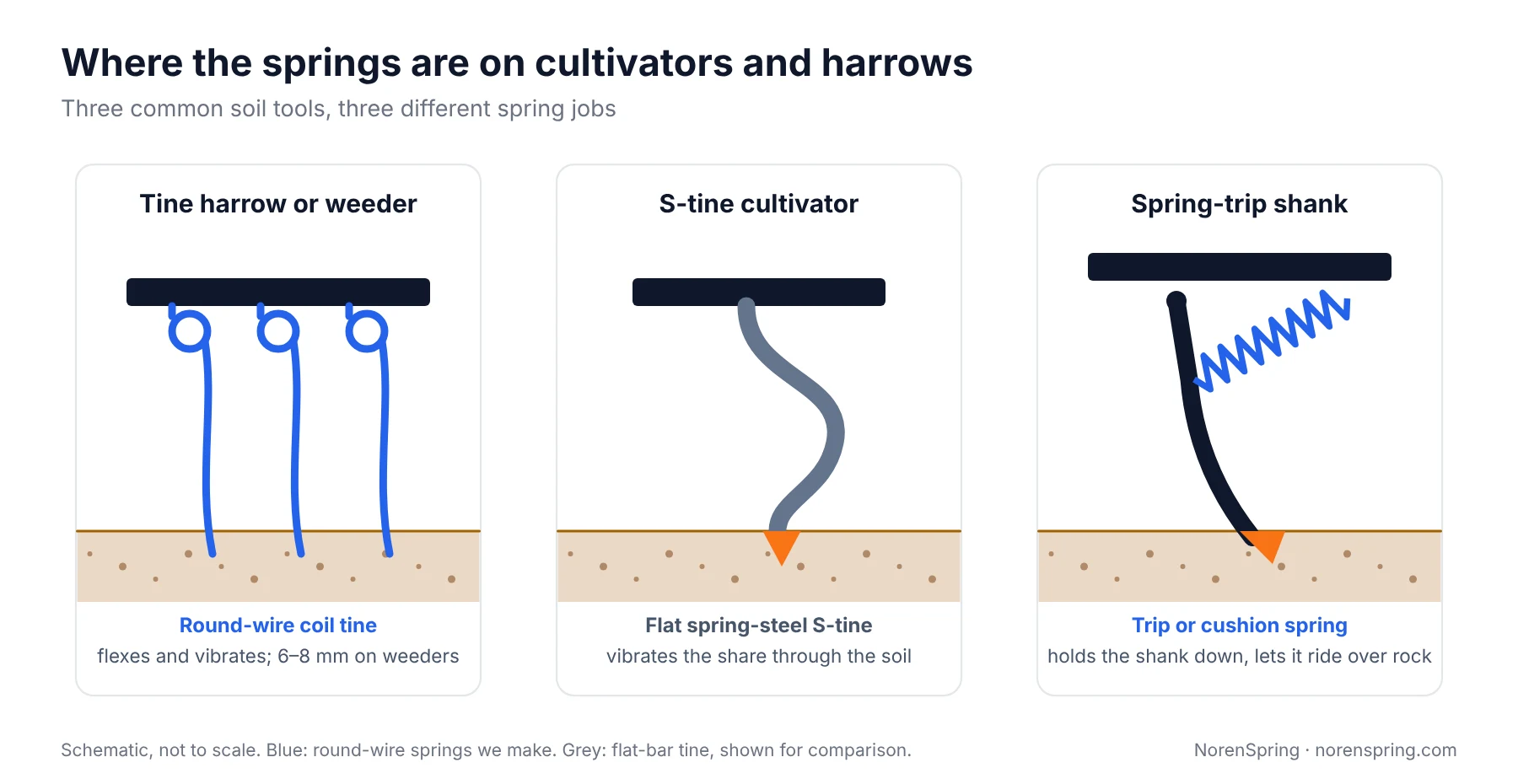
Cultivator springs do one of three jobs. Round-wire coil tines on tine harrows and weeders flex and vibrate to stir the top few centimetres of soil. Flat spring-steel S-tines on field cultivators vibrate a share through the seedbed. Trip and cushion springs on heavier shanks hold the tool in work and let it ride over a rock, then pull it back down. Each one fails differently and each needs different numbers on a replacement order.
This guide explains where the springs sit on cultivators and harrows, how each type works, which steels and finishes suit soil work, why they break, and what to measure when you need replacements made. It is written for farm equipment makers, dealers and parts buyers. Baler, rake and tedder tines are covered separately in our spring tines guide.
Key takeaways
- Three spring jobs: coil tines that flex (harrows, weeders), flat S-tines that vibrate (field cultivators) and trip or cushion springs that protect a shank.
- Weeder tines are light: flex-tine weeders use round tines of about 6 to 8 mm, up to 25 per foot of toolbar [1]. Heavier harrow tines use thicker wire.
- Trip springs work on force thresholds: in one published design the spring holds about 385 lb (1.7 kN) at the point, lets the shank trip at about 880 lb (3.9 kN) and resets it afterwards [2].
- Wear and fatigue are different problems: soil shortens a tine; cyclic bending breaks it at the coil or a bend. A replacement has to address the one you have.
- Measure the least-worn part: wire diameter, coil size, arm and tail lengths, free angle and hand of wind, plus a photo beside a ruler.
Which springs does a cultivator or harrow use?
| Spring | Where it is used | What it does | Usual form |
|---|---|---|---|
| Coil tine | Tine harrows, flex-tine weeders, straw harrows | Flexes and vibrates to break crust and uproot small weeds | Round wire, one or two coils, long arm |
| S-tine | Field cultivators, seedbed combinations | Vibrates the share to shatter and aerate soil | Flat spring-steel bar bent into an S |
| C-shank | Row-crop cultivators | Bends around obstacles and compacted soil | Thin flat spring steel, curved |
| Trip or cushion spring | Chisel plows (ploughs), field cultivator and ripper shanks | Holds the shank in work, lets it lift over a rock, resets it | Heavy compression or extension coil spring |
| Hold-down and return springs | Gauge wheels, markers, levers | Keeps a part in position or returns it | Extension or compression springs |
| Pins and clips | Tine and shank mounts | Retains bolts and pins | Wire forms such as R-pins |
The round-wire parts in this table, coil tines, trip springs, return springs and clips, are standard spring and wire-form work. Flat S-tines and C-shanks are made from flat bar on different equipment; we describe them here so you can tell them apart, but for these machines the parts we make are round-wire torsion springs, compression springs, extension springs and wire forms.
Spring tine harrows and weeders: round-wire coil tines
A spring tine harrow, also called a tine weeder or flex-tine weeder, drags rows of thin tines through the top layer of soil. The tines bend, vibrate and spring back, so they break surface crust and pull out small weeds while crop plants with deeper roots stay put.
The SARE Steel in the Field handbook describes flex-tine weeders with tines of 6 to 8 mm, up to 25 tines per toolbar foot on three or six staggered bars, and working speeds of 4 to 8 mph (about 6 to 13 km/h) [1]. Tine tension is often adjustable in five to nine positions through a coiled loop or spring mount, and tension, tine diameter, hitch height and gauge wheels together set how aggressive the pass is [1]. The same source notes that stiffer tines break heavier crusts but lose some of their vibrating action [1].
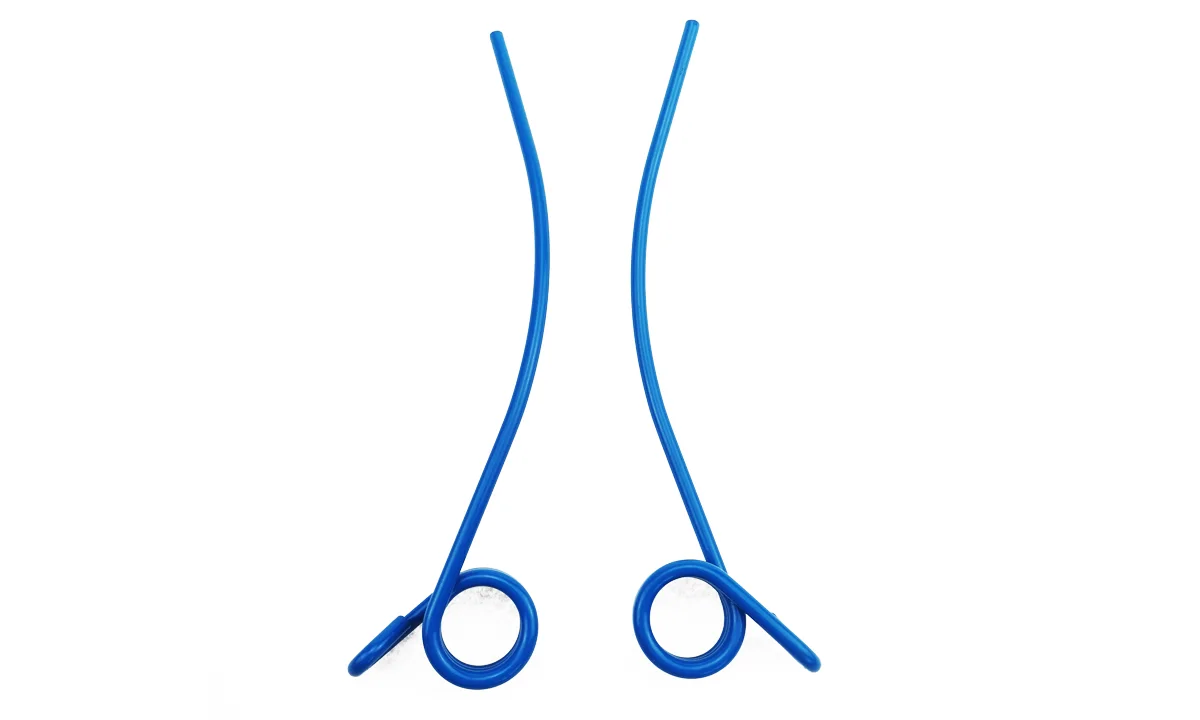
Compared with a baler pickup or rake tine, a harrow tine:
- Touches the soil all the time. Abrasion shortens the tip, so length tolerance at the tip matters less than at the coil and mount.
- Works at higher frequency. Fast travel over uneven ground means many small bending cycles, so fatigue at the coil exit is the usual break.
- May come in mirrored pairs. On some harrows, left- and right-hand tines are used side by side. If yours are, order them as pairs with the hand marked.
Heavier tined harrows and stubble harrows use thicker wire than weeders. Among the agricultural parts we make, harrow and cultivator tine springs run from about 6 to 12 mm wire in 50CrVA, and torsion spring tines for harrows and subsoilers from 5 to 12 mm in 50CrVA or SWOSC-V.
S-tine cultivators and spring tooth harrows
An S-tine is a flat spring-steel bar bent into an S, bolted to the frame at the top and carrying a share at the bottom. As the tractor moves, the tine flexes and vibrates. The SARE handbook describes “Danish” S-tines that vibrate vigorously to shatter and aerate soil, knock soil off weed roots and leave weeds on the surface [3]. Row-crop cultivators also use C-curved shanks of thin flat spring steel that vibrate slightly and bend around obstacles or compacted soil [3].
Replacement flat spring tines are listed by bar section (for example 32 × 10 mm or 45 × 12 mm), length, hole pattern and share mounting. Those dimensions, not the width alone, decide whether a replacement fits the holder. The older spring tooth harrow uses the same idea with C-shaped teeth.
If your machine has flat S-tines, the springs we can supply are the round-wire parts around them: the coil-spring tine holders used on some designs, return springs, and the R-pins and clips that retain the tines. Our guide to R-clips (hairpin cotter pins) shows how to size them to the pin.
Trip and cushion springs on cultivator shanks
Deeper tools such as chisel plows, rippers and heavy field cultivators cannot simply flex. They need protection when a shank hits a rock or a buried root. There are three common answers:
- Shear bolt. A bolt shears to protect the structure when the tool meets an obstruction such as a shelf rock [4]. It then has to be replaced before work continues.
- Spring trip or spring reset. A preloaded spring holds the shank in work. Above a threshold force the shank lifts, then the spring pulls it back to working depth [2] [4].
- Hydraulic reset. A cylinder and accumulator do the same job without a coil spring.
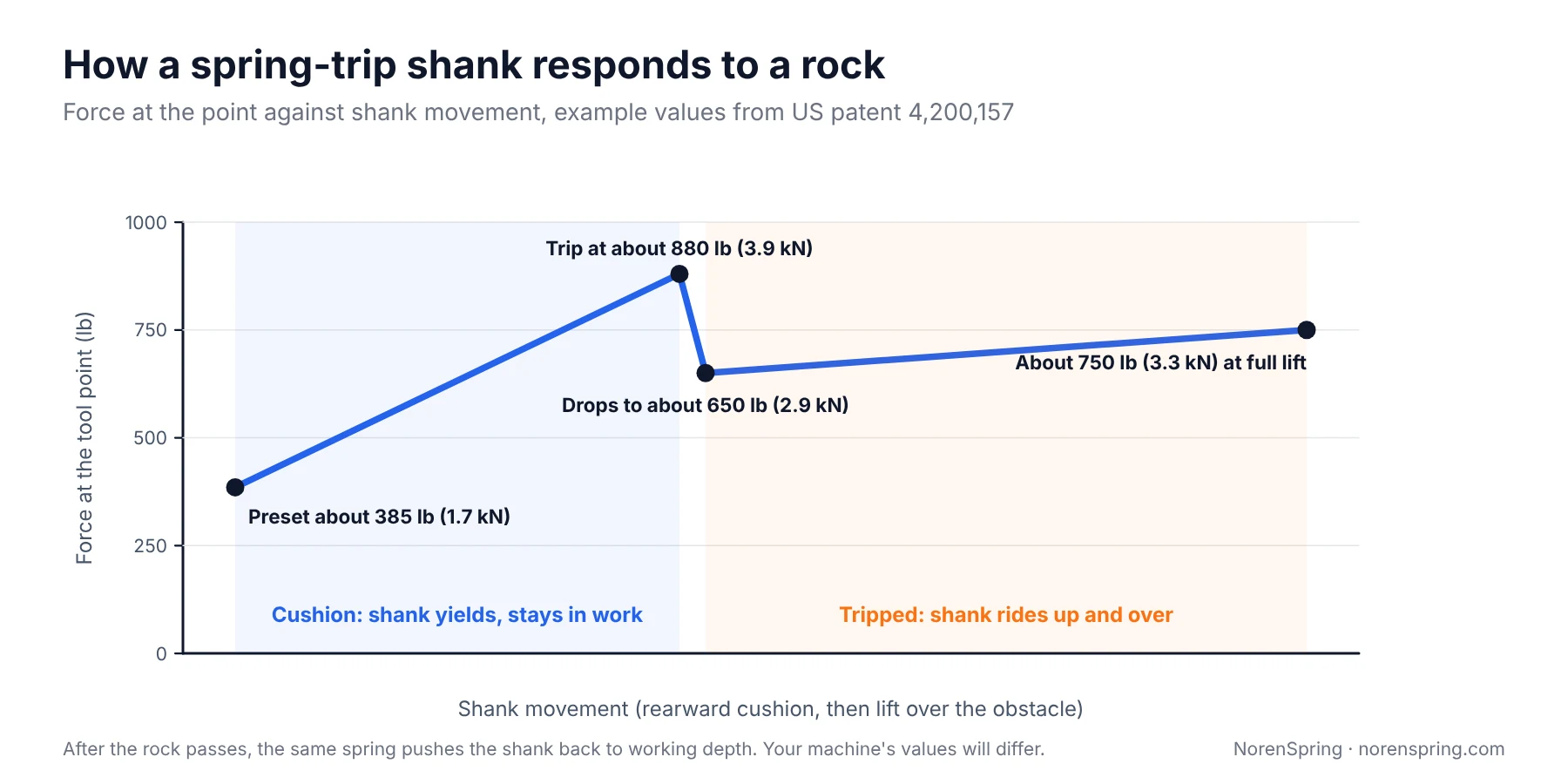
The force curve above uses the values published in US patent 4,200,157 for a spring-cushioned chisel shank [2]. The coil spring is compressed between two abutments and preset to give about 385 lb (1.7 kN) at the point. As soil load rises, the shank cushions rearward until the force reaches about 880 lb (3.9 kN); then it trips, the force at the point falls to about 650 lb (2.9 kN) and rises to about 750 lb (3.3 kN) as the shank lifts over the obstacle. Once clear, the same spring swings the tool back into the soil [2]. Another design, US patent 4,548,277, uses two coil springs with a nut on a bolt to set the preload and lists field cultivator shanks, chisel plows and furrow openers among its uses [4].
What this means for the spring:
- Preload and rate both matter. The trip force depends on the installed length, not just the free length. A replacement spring of the right rate but wrong free length changes the trip point.
- Stress at full lift is the design case. The spring sees its highest deflection when the shank is fully tripped. Check that the spring does not reach solid height there; see our heavy duty compression springs guide for the checks on large springs.
- Sets of springs need matching loads. On a toolbar with many shanks, springs with different loads make the shanks trip at different forces and work at uneven depth. Ask for the load at installed length to be checked on every spring, or at least on a sample from each lot.
Cushion and trip springs on cultivators are usually heavy compression springs, sometimes extension springs. A related example from our anonymised projects is a coil compression shock spring for agricultural machinery in the USA: the original lost force in long field use, so we re-analysed material, wire size, coils and working height from the sample, changed the heat treatment and added load-test control. The samples passed fitting tests on the machine. The full project is on our compression spring case studies page.
Materials and finishes for soil work
Soil springs work outdoors, in abrasive dirt, with shock loads. The usual steels are oil-hardened alloy or carbon spring steels:
| Steel | Typical use on soil tools | Notes |
|---|---|---|
| 50CrVA (close to 50CrV4 / SAE 6150) | Harrow and cultivator tines, tine springs | Good fatigue strength in thicker sections. Most of our agricultural tines use it. |
| 65Mn | Tines, clips, extension springs | Common carbon-manganese spring steel; lower hardenability than 50CrVA. |
| 60Si2Mn | Heavy compression springs | Silicon-manganese steel for larger springs. |
| SWOSC-V | Smaller tine springs | Oil-tempered chrome-silicon wire, coiled cold. |
Grade equivalents and where each is used are in our spring wire material guide.
Hardness is set by heat treatment and is a trade-off: harder tines resist wear and set but are less tolerant of impact. As one real example, a double torsion spring tine we make in 65Mn, about 10 mm wire, is specified at 42 to 47 HRC with a black polymer coating to RAL 9005.
The agricultural tines we make are finished with phosphate, black oxide, powder coating or paint. A finish slows corrosion during storage and between seasons, but soil soon wears it off at the tip; the coil and mounting area are where it matters. Zinc plating on hardened spring steel needs hydrogen-relief baking after plating to reduce the risk of delayed brittle fracture [5]. All our zinc-plated springs are baked after plating. Our spring finishes guide compares the options. Buyers we met at CIAME 2026 put finish quality first; our notes on what agricultural spring buyers look for show how to specify it in an RFQ.
Why cultivator springs fail
| What you see | Likely cause | What the replacement should change |
|---|---|---|
| Tine much shorter, tip rounded | Abrasive wear | Nothing in the spring; replace on a schedule or harden the tip zone if the design allows |
| Tine broken at the coil exit or first bend | Bending fatigue | Lower stress: larger wire, larger bend radius, more coils, or a better surface |
| Tine bent and stays bent | Overload or soft material | Check hardness and whether the tine is the right section for the soil |
| Trip spring shorter than new, shanks trip early | Set (load loss) | Lower working stress, correct heat treatment, and presetting (a common industry step) |
| Spring broken in the middle coils | Fatigue, often started by corrosion pits | Better finish, check stress at full lift |
| Coils rubbed bright on one side | Buckling or misalignment | Guide the spring or change its proportions |
Our article on why springs fail explains each mode in more detail. If a part breaks repeatedly at the same place, keep the broken pieces: the fracture face shows whether it was fatigue or a single overload.
How to measure a worn tine or trip spring for a replacement
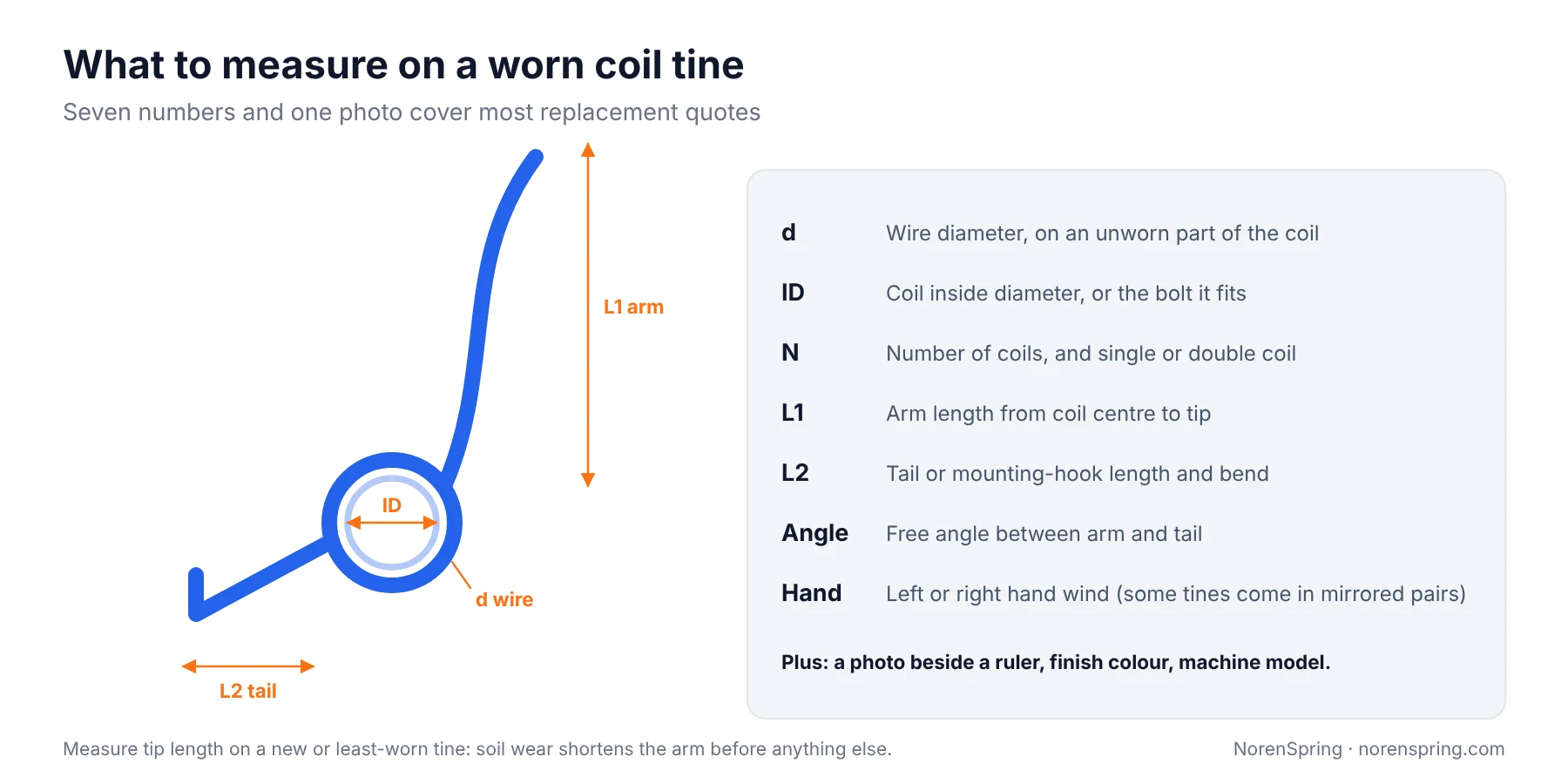
For a coil tine, measure:
- Wire diameter on the coil, where there is no wear.
- Coil inside diameter, or the diameter of the bolt or bush it fits on.
- Number of coils, and whether it is a single or double tine.
- Arm length from the coil centre to the tip, on a new or least-worn tine.
- Tail or mounting-hook length and the shape of the bend.
- Free angle between arm and tail.
- Hand of wind. If tines are used in pairs, measure one of each hand.
For a trip or cushion spring, measure the wire diameter, outside diameter, free length, number of coils and end type, and write down the installed length on the machine. If you can, give the load at installed length or the trip force from the machine manual. Our step-by-step guide to measuring a spring shows how to measure each dimension without a lab.
Take a photo of each part beside a ruler, note the finish colour, and send one good sample if you have it. Most projects start from a drawing or sketch, but we can also work from a physical sample.
Replacement springs for your machine
If you have a worn part and a machine model rather than a drawing, that works: we confirm manufacturability before quoting, return engineering feedback within 24 hours, and make prototype samples for dimensional, load and fitting approval before production. There is no fixed minimum order; quantity is evaluated by spring type, tooling and material. Samples usually take 7 to 15 working days and production 15 to 30 working days, and we confirm the lead time for your part with the quotation.
Our harrow and cultivator tine springs have shipped to buyers in the USA and Australia, and cultivator extension springs to India and Brazil. You can see the range of agricultural parts we make, from tines to R-pins, on our agricultural machinery springs page.
Cultivator spring RFQ checklist
| Item | What to send |
|---|---|
| Part | Coil tine, trip spring, return spring or clip; machine type and model |
| Drawing or sample | Drawing, sketch or one good sample; photo beside a ruler |
| Dimensions | The measurements above, from the least-worn part |
| Load | Installed length and load, or trip force, for trip springs |
| Hand | Left, right or both; quantity of each |
| Material and hardness | If known; otherwise the soil and working conditions |
| Finish | Colour and type: phosphate, black oxide, powder coat or paint |
| Quantity | Annual volume and first-order quantity |
| Documents | Inspection report, material certificate, packing and labelling needs |
Frequently asked questions
What is a spring tine cultivator?
A spring tine cultivator uses flexible tines instead of rigid shanks. On light machines the tines are round wire with a coil at the top; on field cultivators they are flat spring-steel S-tines. The flexing makes the tines vibrate, which breaks clods and shakes soil off weed roots.
What is a spring tine harrow used for?
It is used for shallow weeding. Rows of thin tines, about 6 to 8 mm, are pulled through the top layer of soil at 4 to 8 mph (about 6 to 13 km/h). They break surface crust and uproot small weeds, while the tines vibrate and glide around or over obstructions [1].
What is the difference between a spring tooth harrow and a tine harrow?
A spring tooth harrow typically uses fewer, heavier C-shaped teeth of flat spring steel that dig in and loosen soil. A tine harrow or weeder uses many thin round-wire tines, about 6 to 8 mm on weeders, that skim the surface to break crust and pull out small weeds [1].
How do spring-trip shanks work?
A preloaded coil spring holds the shank in the soil. When the force at the point exceeds a set value, for example about 880 lb (3.9 kN) in one published design, the shank trips and lifts over the obstacle; the spring then pulls it back to working depth [2].
Why do harrow tines break at the coil?
The coil exit and the first bend carry the highest bending stress, and harrow tines see many cycles at speed. Fatigue cracks start there, often at a surface mark or corrosion pit. A larger wire, more generous bend radius or a better surface condition lowers the stress.
Can you make replacement tines from a worn sample?
Yes. Send the least-worn sample you have, or a few measurements and a photo beside a ruler. We measure it, confirm the material and finish with you, and make samples for fitting before production.
About the authors
This guide was prepared by the NorenSpring engineering team, which designs and manufactures custom compression, extension and torsion springs and wire forms, including tines and springs for agricultural machinery, in Xuzhou, China. Technical review by Feng Yulin, General Manager and senior structural engineer, who has 15 years of spring R&D experience and more than 30 national patents. NorenSpring holds IATF 16949, ISO 9001, ISO 13485, ISO 14001 and ISO 45001 certifications. The tine photo is from our own plant; the cover is an AI illustration based on a photo of the same part. Sources were last checked on October 20, 2026.
Need replacement tines or trip springs? Send us a sample, photo or drawing and we will return engineering feedback with the quotation.
Sources
The numbers in square brackets in the text refer to this list.
- SARE (Sustainable Agriculture Research and Education, USDA), Steel in the Field, Flex-tine weeder. Source for tine diameter, tines per foot, tension positions, working speed and tine stiffness. Retrieved 2026-10-20.
- US Patent 4,200,157, Spring cushioned shank for earthworking chisel having trip mechanism with automatic reset, granted April 29, 1980. Source for the preset, trip and lift forces and the reset action. Retrieved 2026-10-20.
- SARE, Steel in the Field, Cultivator, low-residue. Source for Danish S-tines and C-curved spring-cushioned shanks. Retrieved 2026-10-20.
- US Patent 4,548,277, Spring reset mechanism for tillage tool, granted October 22, 1985. Source for the shear bolt, the two coil springs with preload set by a nut on a bolt, and use on field cultivator shanks, chisel plows and furrow openers. Retrieved 2026-10-20.
- ASTM International, ASTM B850, Standard Guide for Post-Coating Treatments of Steel for Reducing the Risk of Hydrogen Embrittlement. Source for hydrogen-relief baking after zinc plating. Retrieved 2026-10-20.



