In this article
- Key takeaways
- What is spring index?
- Spring index range: what is a good value?
- Why does spring index matter?
- Spring index for extension and torsion springs
- Compression spring end types: spring pitch, total coils and solid height
- Spring index calculator
- What to do when your design is outside the range
- What to put on the drawing or request for quote
- Frequently asked questions
- Summary
- About the authors
- Sources
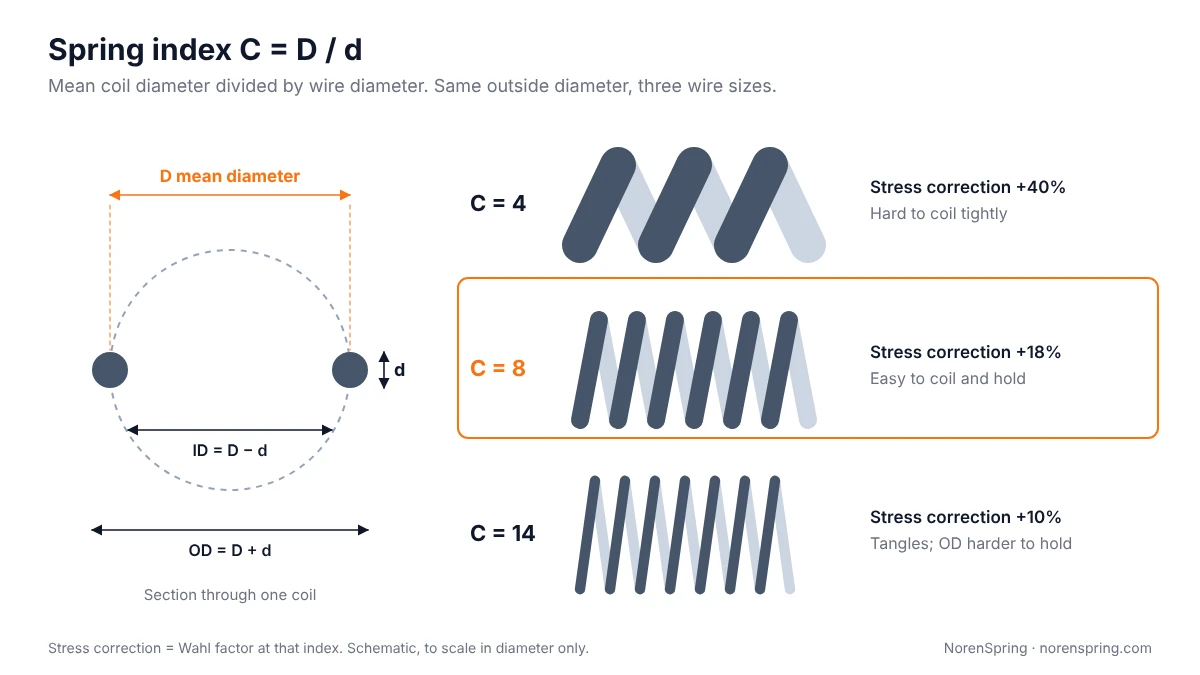
Spring index is the ratio of a spring’s mean coil diameter to its wire diameter: C = D / d. A spring wound from 2 mm wire to a 20 mm outside diameter has a mean diameter of 18 mm and an index of 9. That single number tells an engineer how tightly the wire is bent, how much higher the real stress is than the simple formula says, and how easy the spring will be to coil and hold to tolerance.
Most compression, extension and torsion springs are designed with an index between about 4 and 12. This guide explains why, shows how the index feeds into the stress correction factor, covers the related numbers that decide whether a spring fits (pitch, total coils and solid height for each end type), and includes a free spring index calculator that works through all of them.
Key takeaways
- Calculate it from the mean diameter. C = D / d, where D = OD − d. Using the outside diameter instead of D overstates the index by exactly 1.
- Aim for 4 to 12. Shigley’s Mechanical Engineering Design gives 4 to 12 as the usual range. The European standards for cold-coiled compression springs, EN 13906-1 and EN 15800, accept 4 to 20; for hot-coiled springs EN 13906-1 uses 3 to 12.
- A low index raises the real stress. The Wahl correction factor is 1.40 at C = 4, 1.16 at C = 9 and 1.12 at C = 12. At C = 4 the inner surface of the wire carries 40% more stress than the uncorrected formula predicts.
- A high index is a manufacturing problem. Above about 12, springs tangle in bulk and the coil diameter is harder to hold.
- End type changes solid height, not the index. In our 2 mm, 8-active-coil example, solid height runs from 18.0 to 22.0 mm depending on the end type.
What is spring index?
Spring index is the mean coil diameter divided by the wire diameter. It is written C in American texts and w in the European standards; both mean the same thing.
Spring index formula
To calculate it:
- Measure or take from the drawing the wire diameter d and either the outside diameter OD or the inside diameter ID.
- Find the mean diameter: D = OD − d, or D = ID + d.
- Divide: C = D / d.
Example: d = 2.0 mm, OD = 20 mm. D = 20 − 2 = 18 mm. C = 18 / 2 = 9.
The index has no units, so it describes the shape of the coil whatever its size. A 0.5 mm wire spring with a 4.5 mm mean diameter and a 10 mm wire spring with a 90 mm mean diameter both have C = 9, and both bend the wire to the same relative curvature.
Spring index range: what is a good value?
The usual design range is 4 to 12, and the middle of that band is the easiest to make. The range is not a law of physics. It is where the stress penalty, the coiling process and the tolerances all stay reasonable.
| Index C | What happens | Typical advice |
|---|---|---|
| Below 4 | Wire is bent very sharply. Real stress at the inner surface is 40% or more above the simple formula. Hard to coil tightly, especially with hard wire. | Avoid for cold-coiled springs. Discuss alternatives with the manufacturer. |
| 4 to 12 | Stress correction 12–40%. Coils readily and holds tolerance. | Normal design range. |
| 12 to 20 | Stress correction 7–12%, but the coil diameter is harder to hold and loose springs tangle. | Workable. Flag it on the drawing and say how the springs will be packed. |
| Above 20 | Outside the range covered by EN 15800 for cold-coiled compression springs. | Redesign, or agree tolerances with the manufacturer in advance. |
The standards set wider limits than textbook practice. EN 15800, the European quality specification for cold-coiled compression springs (it replaced DIN 2095), covers wire from 0.07 to 16 mm with a spring index of 4 to 20 [2]. EN 13906-1, the calculation standard, uses the same 4 to 20 for cold-coiled springs up to 20 mm wire, and 3 to 12 for hot-coiled springs from 8 to 100 mm wire [1]. Other references quote slightly different bands, from 3–12 to 4–16 [4][5], which is another reason to treat the index as a guide rather than a pass/fail limit.
Why does spring index matter?
It changes the real stress in the wire
The basic formula for shear stress in a compression or extension spring wire is τ = 8FD / (πd³), where F is the load. That formula treats the wire as a straight bar in torsion. A coiled wire is curved, and the inside of each coil is shorter than the outside, so the stress there is higher. The load also adds a small direct shear. Both effects grow as the index gets smaller.
The correction is made with a stress correction factor, usually the Wahl factor [3][6]:
K = (4C − 1) / (4C − 4) + 0.615 / C
so the corrected stress is τ = K × 8FD / (πd³). Shigley also gives the slightly simpler Bergsträsser factor, K = (4C + 2) / (4C − 3), which agrees with Wahl within about 2% across the normal range [3].
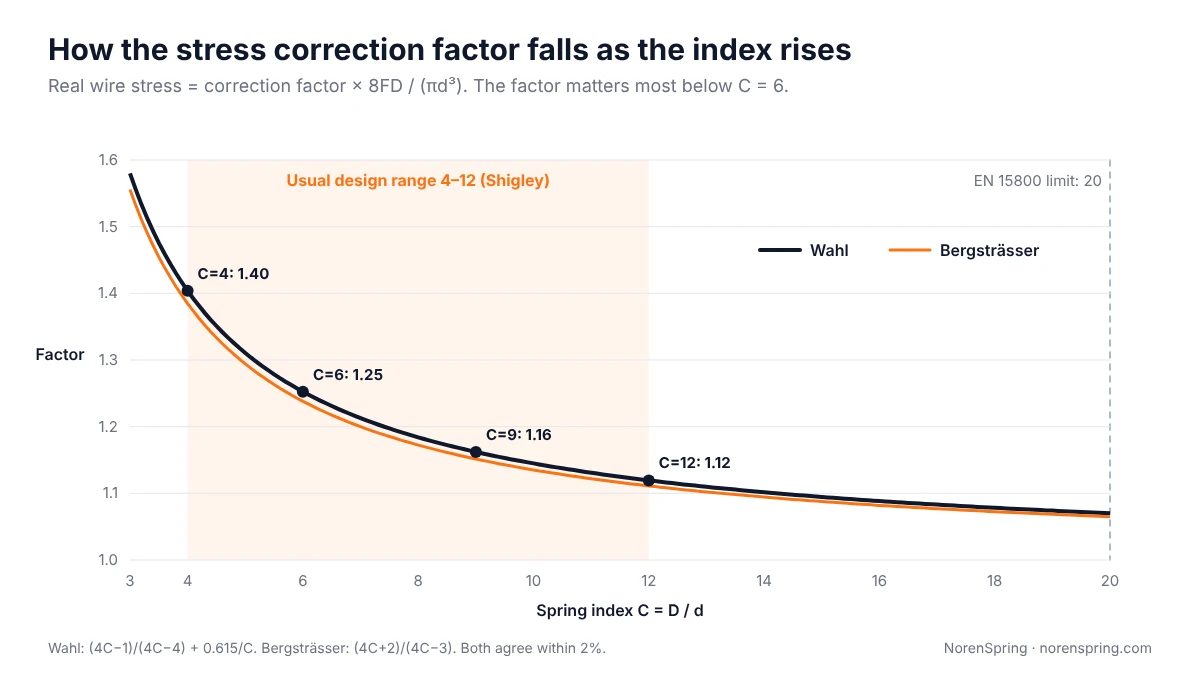
| Spring index C | 4 | 5 | 6 | 8 | 9 | 10 | 12 | 16 |
|---|---|---|---|---|---|---|---|---|
| Wahl factor K | 1.40 | 1.31 | 1.25 | 1.18 | 1.16 | 1.14 | 1.12 | 1.09 |
| Bergsträsser factor | 1.38 | 1.29 | 1.24 | 1.17 | 1.15 | 1.14 | 1.11 | 1.08 |
The practical point: if two designs carry the same load at the same stress by the simple formula, the one with the lower index is working harder. In fatigue applications such as valve, clutch or vibrating-screen springs, that extra stress shortens life. It is also why the correction should be applied whenever you compare a design stress with a material’s allowable stress.
The spring rate formula, k = Gd⁴ / (8D³Na), does not include the index directly, but it uses the same D and d. Doubling the wire size inside a fixed 20 mm outside diameter (2 mm to 4 mm, C = 9 to C = 4) makes each coil about 23 times stiffer. With the same number of coils, the low-index spring is far stiffer and reaches high stress in a short travel; to keep the same rate it needs many more active coils, which adds length and solid height.
It decides how easily the spring can be made
On a coiling machine the wire is pushed against a coiling point and bent into a helix. At a low index the wire has to be bent around a tight radius. Shigley notes that springs with an index below about 4 are more difficult to form because of the risk of surface cracking, and the European standards stop at 4 for cold-coiled springs [1][2][3]. Hard-drawn and oil-tempered wires, which are already at high strength, are the least forgiving.
At a high index the opposite happens. The coil is large for the wire, so it springs back more after coiling and the diameter is harder to hold. Shigley warns that above an index of about 12 springs are prone to tangling and may need individual packing [3]. For a buyer, that can mean longer handling time at the assembly line.
It affects tolerances and fit
The coil diameter grows slightly when a compression spring is compressed, and it has its own manufacturing tolerance. A spring with a high index usually has a looser diameter tolerance in proportion to its size. If the spring works in a bore or over a rod, leave clearance for both. The compression spring specification guide covers bore and rod clearance in more detail.
Spring index for extension and torsion springs
The index is defined the same way for all helical springs, but the critical stress is in a different place.
- Extension springs. The body behaves like a compression spring, so the Wahl factor applies to the coils. The highest stress is often at the hook, where the wire is bent to a tighter radius. Shigley defines a separate index for the hook bend, C₂ = 2r₂ / d, and recommends keeping it above 4 [3]. Our extension spring guide shows how a tight hook bend can push hook stress above the body stress.
- Torsion springs. The wire is in bending, not torsion. The correction is the inner-fibre factor Kᵢ = (4C² − C − 1) / (4C(C − 1)), applied to the bending stress 32M / (πd³) [3]. It is 1.23 at C = 4 and 1.10 at C = 8, smaller than the Wahl factor but rising in the same way. See the torsion spring guide for torque and leg design.
Compression spring end types: spring pitch, total coils and solid height
Spring index describes the coil cross-section. The other half of a compression spring’s geometry is along its length: how many coils there are, how far apart they are, and how short the spring gets when every coil touches. All three depend on the end type.
| End type | Total coils Nt | Solid height Ls | Pitch p |
|---|---|---|---|
| Open (plain) | Na | d (Nt + 1) | (L0 − d) / Na |
| Open, ground | Na + 1 | d × Nt | L0 / (Na + 1) |
| Closed, not ground | Na + 2 | d (Nt + 1) | (L0 − 3d) / Na |
| Closed and ground | Na + 2 | d × Nt | (L0 − 2d) / Na |
Na is the number of active coils, L0 the free length. Formulas from Shigley, Table 10-1 [3].
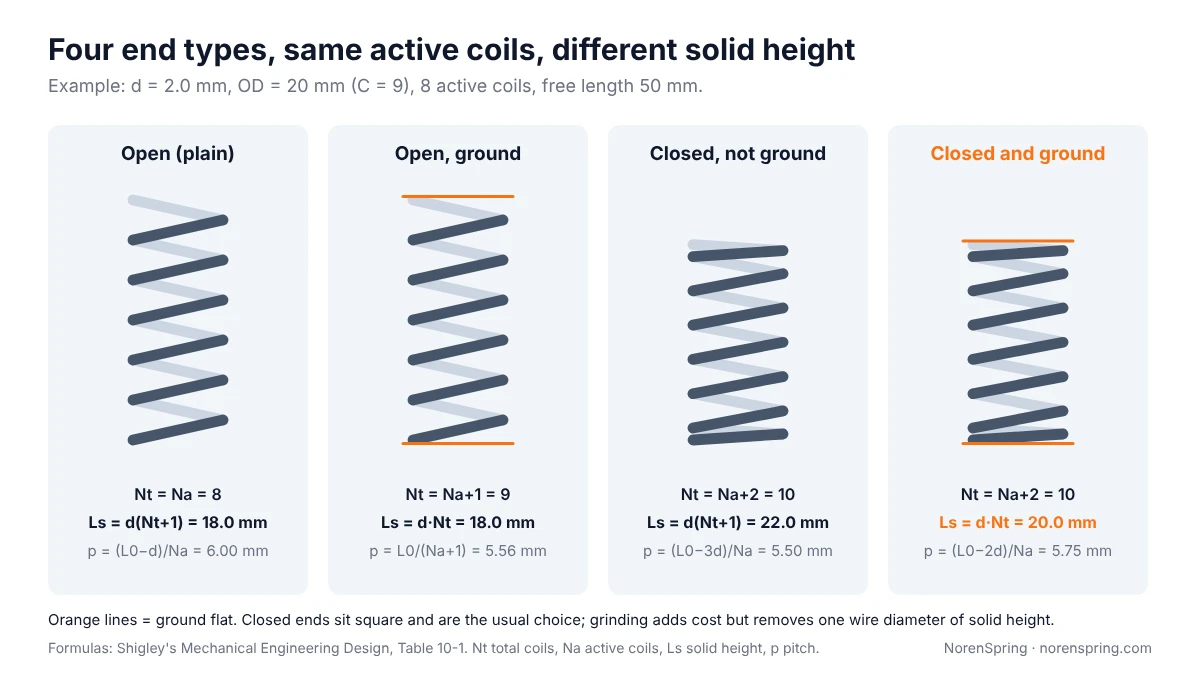
Worked example. d = 2.0 mm, OD = 20 mm (C = 9), 8 active coils, free length 50 mm, oil-tempered wire.
- Closed and ground ends: 10 total coils, nominal solid height 2.0 × 10 = 20.0 mm, pitch (50 − 4) / 8 = 5.75 mm.
- The same spring with closed ends that are not ground: solid height 22.0 mm, 2 mm more.
- Rate, with G = 79.3 GPa (11.5 × 10⁶ psi, the typical value for oil-tempered and hard-drawn carbon wire, also used in our spring rate calculator): k = Gd⁴ / (8D³Na) = 79,300 × 16 / (8 × 18³ × 8) = 3.40 N/mm.
- Force at solid (closed and ground): 3.40 × (50 − 20) = 102 N.
- Shear stress at solid: 584 MPa by the simple formula, 679 MPa after the Wahl factor of 1.16.
Closed and ground ends are the usual choice for springs that must stand square and load evenly. Grinding costs an extra operation, and on very fine wire or a high index it may not be practical, in which case closed, unground ends are normal.
Two cautions on solid height. First, these are nominal figures: wire tolerance, slight pitch variation and any coating make the real solid height a little higher, so specify a maximum solid height and keep the shortest working length above it. Our spring finishes guide shows how a thick coating adds to solid height. Second, check the stress at solid, as in the example. If the spring can be pushed to solid in service or assembly and that stress is too high for the material, it will take a permanent set.
Spring index calculator
Spring index calculator
Round-wire helical compression spring. Gives the index, stress correction factor, total coils, solid height, pitch, rate and the corrected stress at solid.
Estimates from textbook formulas (Wahl stress correction; shear modulus values are typical handbook figures, the same as in our spring rate calculator; end-coil formulas from Shigley’s Mechanical Engineering Design, Table 10-1). Actual solid height runs slightly higher because of wire tolerance, so put a maximum solid height on the drawing. Compare the stress at solid with the allowable for your wire and send the design to us for a check before ordering.
What to do when your design is outside the range
If the space you have pushes the index below 4 or above 12, there are usually better options than forcing it.
Index too low (thick wire in a small diameter):
- Increase the coil diameter if the bore or rod allows it. Even a small increase in D raises the index and reduces the stress factor.
- Use a smaller wire with more coils and a stronger material. Our spring wire material guide compares the strength of the common grades.
- Split the load between two nested springs, one inside the other and wound in opposite directions so they do not lock together.
- Consider another spring type. For very high loads in a short space, a disc spring stack may suit better than a coil spring.
- For large wire, consider hot coiling. EN 13906-1 covers hot-coiled springs down to an index of 3 [1]; we make hot-coiled large springs as well as cold-coiled ones.
Index too high (fine wire on a large diameter):
- Increase the wire size slightly and add coils to keep the rate.
- Guide the spring on a rod or in a bore so diameter variation and buckling matter less.
- Tell the manufacturer how the springs will be handled: loose in bulk, on rods, or in trays. That decides whether tangling will be a problem.
- If you need a rising force or a very short solid height, a conical spring changes the index coil by coil.
What to put on the drawing or request for quote
The index itself rarely needs to be written on a drawing, because it follows from the diameters and wire size. What the manufacturer needs is:
- Wire diameter d and outside diameter (or inside diameter), and which diameter is critical to the fit.
- Free length and the load at one or two working lengths, so the coils and pitch can be chosen to meet the force.
- End type, and whether the ends must be ground.
- Maximum solid height, if space is tight.
- Material and finish.
- Service conditions: static or cyclic load, temperature, and expected number of cycles.
- How the springs will be packed and handled, especially for an index above 12.
If your design falls outside the usual range, say so in the inquiry. We can check whether it can be made as drawn, suggest a nearby geometry that meets the same loads, and confirm the stress before tooling. Send your drawing or sample through our contact page, or see the compression springs we make to your drawing.
Frequently asked questions
What is spring index in simple terms?
It is how large the coil is compared with the wire it is made from: mean coil diameter divided by wire diameter. A low index means thick wire in a small coil; a high index means thin wire in a large coil.
What is the formula for spring index?
C = D / d, where D is the mean coil diameter (outside diameter minus wire diameter) and d is the wire diameter.
What is a good spring index?
Between 4 and 12 for most springs. EN 15800 accepts cold-coiled compression springs from 4 to 20.
Why is a low spring index bad?
The wire is bent sharply, so the stress on the inside of the coil is much higher than the simple formula predicts, and the spring is harder to coil. At C = 4 the correction is 40%.
Why is a high spring index a problem?
The coil diameter is harder to hold to tolerance, and loose springs tangle together in packing.
Does spring index affect spring rate?
Not directly, but rate depends on d⁴ / D³. For a fixed outside diameter, a lower index (thicker wire) gives a much stiffer coil per turn, so more active coils are needed to keep the same rate.
How do I calculate solid height?
Multiply the wire diameter by the total number of coils for ground ends, or by the total coils plus one for unground ends. Use the table above or the calculator, and specify a maximum solid height because the real value runs slightly higher.
Does spring index apply to extension and torsion springs?
Yes. The definition is the same. Extension springs use the Wahl factor for the body and a separate hook-bend index; torsion springs use a bending correction factor, Kᵢ.
Summary
Spring index is the quickest check of whether a spring design is sensible. Calculate it from the mean diameter, aim for 4 to 12, apply the stress correction whenever you compare stress with the material’s limit, and choose the end type knowing what it does to solid height. If your space forces an index outside the usual range, raise it early. It is far cheaper to adjust the geometry on paper than after the first samples.
About the authors
This guide was prepared by the NorenSpring engineering team, which designs and manufactures custom springs and wire forms in Xuzhou, China. Technical review by Feng Yulin, General Manager and senior structural engineer, who has 15 years of spring R&D experience and more than 30 national patents. NorenSpring holds IATF 16949, ISO 9001, ISO 13485, ISO 14001 and ISO 45001 certifications. More about NorenSpring. Figures and calculations were last checked on 13 October 2026.
Sources
The numbers in square brackets in the text refer to this list.
- CEN, EN 13906-1:2013, Cylindrical helical springs made from round wire and bar — Calculation and design — Part 1: Compression springs, summary of Table 1 at iTeh Standards. Source for the spring index limits 4 ≤ w ≤ 20 (cold coiled, d ≤ 20 mm) and 3 ≤ w ≤ 12 (hot coiled, 8 to 100 mm). Retrieved 2026-10-13.
- CEN, EN 15800:2008, Cylindrical helical springs made of round wire — Quality specifications for cold coiled compression springs, scope and Table 1 at Genorma. Source for the wire range 0.07 to 16 mm and spring index 4 ≤ w ≤ 20. Retrieved 2026-10-13.
- R. G. Budynas and J. K. Nisbett, Shigley’s Mechanical Engineering Design, 9th edition, McGraw-Hill, 2011, chapter 10 (Mechanical Springs). Source for the index range of 4 to 12, the Bergsträsser factor, the end-type formulas (Table 10-1), the hook bend index, the torsion spring factor Kᵢ, and the notes on manufacturing at low and high index.
- Autodesk, Inventor Help: Compression spring calculation formulas. Source for the recommended geometry 4 ≤ D/d ≤ 16. Retrieved 2026-10-13.
- RoyMech, Helical springs. Source for the statement that most helical springs have C between 3 and 12. Retrieved 2026-10-13.
- A. M. Wahl, Mechanical Springs, 2nd edition, McGraw-Hill, 1963. Original source of the Wahl curvature correction factor.