










In this article
- Key takeaways
- What does a pedal return spring do?
- Extension or torsion: which pedal spring design fits?
- How much return force does a pedal spring need?
- Why the hooks fail before the coils
- Throttle return springs: the two-source rule
- Materials and finishes for pedal springs
- What to send for a pedal return spring quote
- How we make pedal return springs
- Frequently asked questions
- About the authors
- Sources
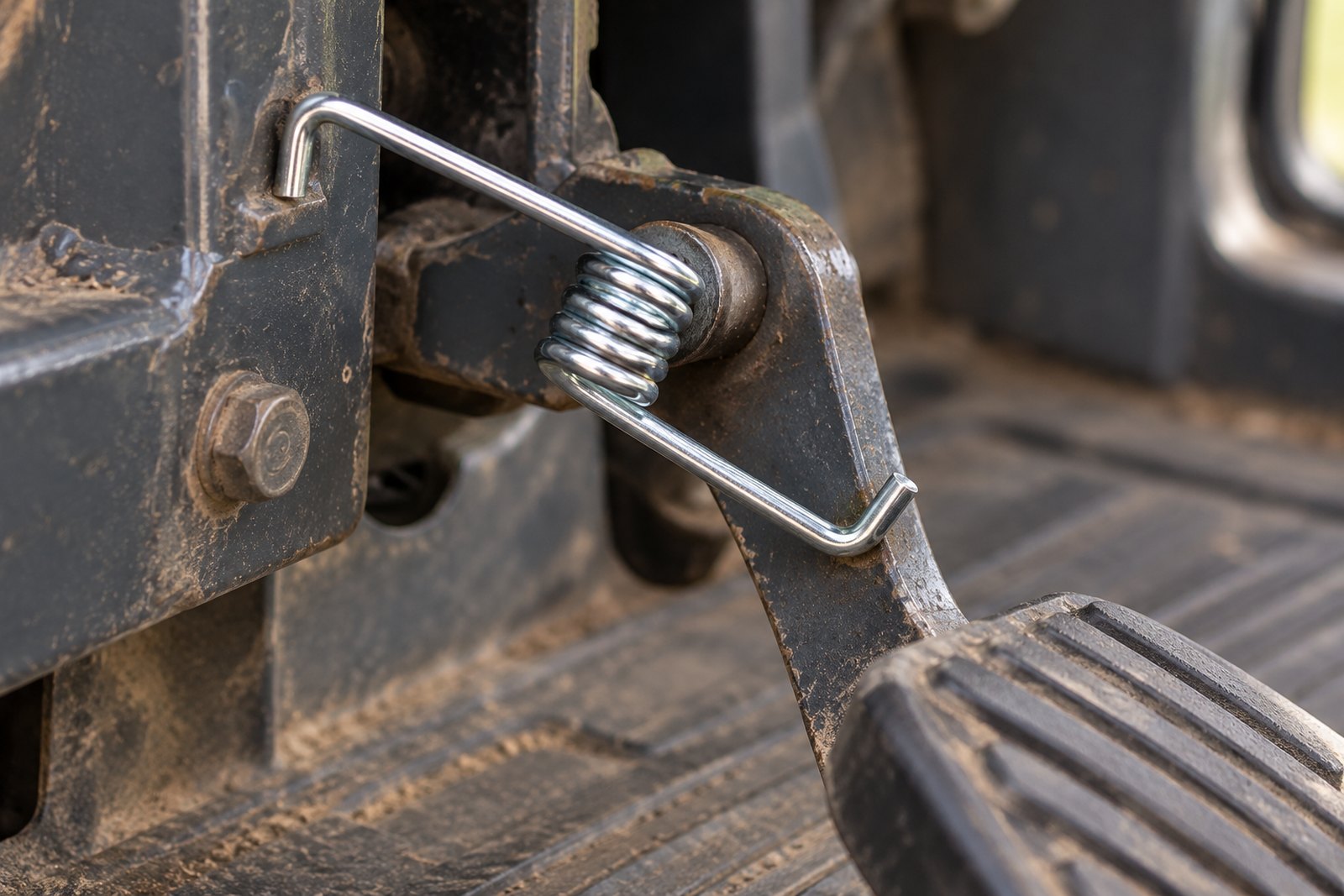
Cover image: an AI illustration based on a photograph of an accelerator pedal spring we make, placed in a new setting.
A pedal return spring is the spring that pushes a brake, clutch or throttle pedal back to its released position when the operator lifts their foot. It has one job, but it has to do it every time: hold the pedal firmly against its stop, beat the friction in the pivot and linkage, and keep doing that for the whole life of the machine.
Most pedal return springs are either extension springs hooked between the pedal lever and a fixed bracket, or torsion springs wound around the pedal pivot. Choosing between them, setting the force and getting the hooks right decide whether the spring lasts. A weak spring leaves the brake dragging or the engine running above idle. A spring that breaks at the hook leaves no return at all.
This guide covers what each pedal spring does, how to work out the force you need, where these springs fail, the US rule that throttles must have two return sources, and what to send a spring maker for a quote. If you are new to the spring type itself, start with our extension spring guide or torsion spring guide.
Key takeaways
- The spring must win against friction at every position. Size it from the return moment needed at the pivot, not from a force figure copied off an old part.
- Extension or torsion is a packaging choice. Extension springs need a straight line from lever to anchor. Torsion springs sit on the pivot and need clearance on the shaft.
- The hook usually fails first. In our worked example, the coil body runs at 57% of its static limit while a hook bent to a tight radius uses 93% of its limit.
- Throttles need two return sources in US vehicles. FMVSS No. 124 requires at least two sources of energy able to return the throttle to idle, and a return within 1 to 3 seconds [1].
- Specify a drawing, two loads and the finish. “Brake pedal spring for model X” is not enough to make a part that fits and lasts.
What does a pedal return spring do?
A pedal return spring stores energy while the pedal is pressed and uses it to bring the pedal back. Each pedal puts slightly different demands on it.
Brake pedal return spring. It lifts the brake pedal off the master cylinder push rod or the mechanical brake linkage and holds it against the released stop, so the brakes are fully off. Many tractors have separate left and right brake pedals for steering brakes, so each pedal has its own return spring and the two must return at the same rate. A spring that has lost force lets the pedal sit slightly down, which can keep the brake lightly applied. On hydraulic brakes, a pedal that does not return fully can keep the master cylinder’s compensating port covered, and the brakes can drag as the fluid warms.
Clutch pedal return spring (clutch return spring). It returns the clutch pedal and keeps the release bearing clear of the pressure-plate fingers, so the clutch keeps its free play. Some clutch pedals also use an over-centre (assist) spring that helps the driver once the pedal passes a set point. A wiper arm spring uses the same over-centre idea: it presses the blade onto the glass, then holds the arm up once it is lifted past the tip-over angle. That is a different design task from a plain return spring, and the drawing should say which one you need. Don’t confuse either with the clutch pressure-plate springs inside the clutch cover; those are compression springs that clamp the friction disc. Our guide to clutch springs covers how those springs, and the diaphragm spring that replaced them, set the clamp load.
Throttle (accelerator) return spring. It pulls the throttle back to idle. On a cable throttle there is usually a spring at the pedal and another at the injection pump, governor lever or throttle body. This is the pedal spring with a legal minimum in the US, covered below.
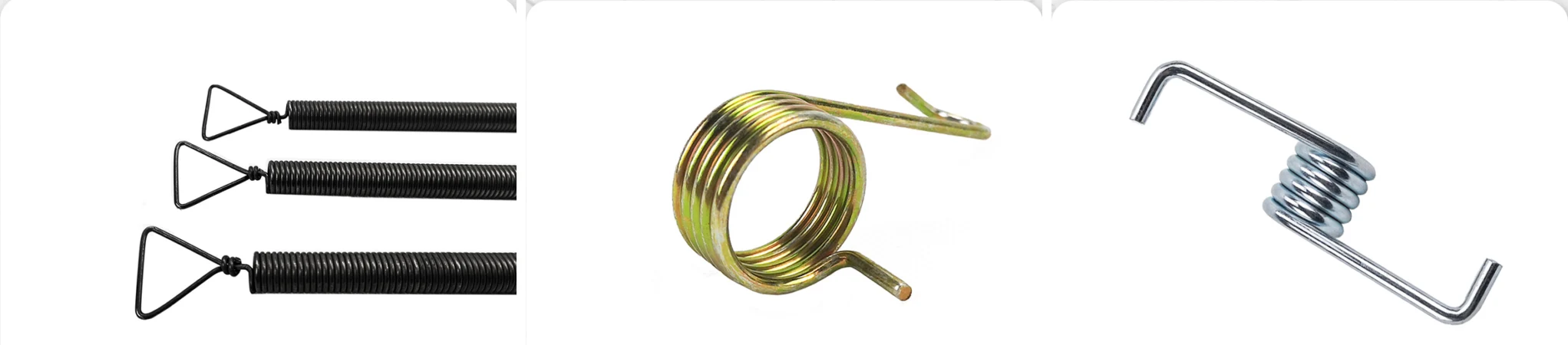
These three parts come from our own production. The figures below are from our technical records for each part:
| Part (as listed on our case pages) | Spring type | Material | Wire range | Usual finish | Main markets |
|---|---|---|---|---|---|
| Brake pedal spring suitable for Mahindra tractors | Extension, triangular end loops | SWC / 65Mn | 2–5 mm | Zinc plating | India |
| Clutch pedal spring compatible with Tata vehicles | Torsion, two bent legs | 65Mn | 2–6 mm | Zinc plating | India |
| Accelerator foot spring suitable for Massey Ferguson tractors | Torsion, long bent legs | SWC | 2–5 mm | Zinc plating | India, Brazil |
Brand names are used only to identify compatible equipment; NorenSpring is not affiliated with these manufacturers.
The brake springs in the photo were shot in a black finish; the table gives the usual finish recorded for that part. SWC is hard-drawn carbon spring wire (JIS G 3521 grade SW-C) [4] and 65Mn is a manganese spring steel from the Chinese standard GB/T 1222 [5], which we explain in our GB/T 1222-2025 article. You can see these parts with their applications on our extension spring case page and torsion spring case page.
Extension or torsion: which pedal spring design fits?
Choose an extension spring when there is a clear straight path from a point on the pedal lever to a fixed bracket, and choose a torsion spring when the only free space is around the pivot. Both work. They fail in different places and need different information on the drawing.
| Extension return spring | Torsion return spring | |
|---|---|---|
| Where it sits | Between a hole or pin on the lever and a fixed bracket | Around the pedal pivot shaft, one leg on the bracket, one on the lever |
| Force at rest | Can carry initial tension, so it pulls even with no stretch | Starts at zero unless the legs are pre-wound on assembly |
| Weak point | Hooks and loops | Legs and the leg bends; binding on the shaft |
| Main risk if it breaks | Pieces can fall into the pedal box | Leg can drop and jam the pedal |
| Key drawing data | Free length, initial tension, loads at two lengths, hook type and orientation | Leg angles, torque at two angles, leg lengths and bends, shaft diameter |
Extension springs suit tractors and older vehicles with open pedal boxes, where a long spring can be hooked to the bulkhead. Torsion springs suit compact pedal assemblies. For the torsion side, our torsion spring calculator works out torque per degree, stress and the clearance the coil needs on its shaft.
How much return force does a pedal spring need?
Work from moments about the pivot. The spring must give a return moment larger than the friction moment of the pivot, bushings, cable or rods at every pedal position, with margin for dirt, cold grease and wear. The force at the released stop matters most, because that is where the spring is weakest and where a dragging brake or high idle shows up.
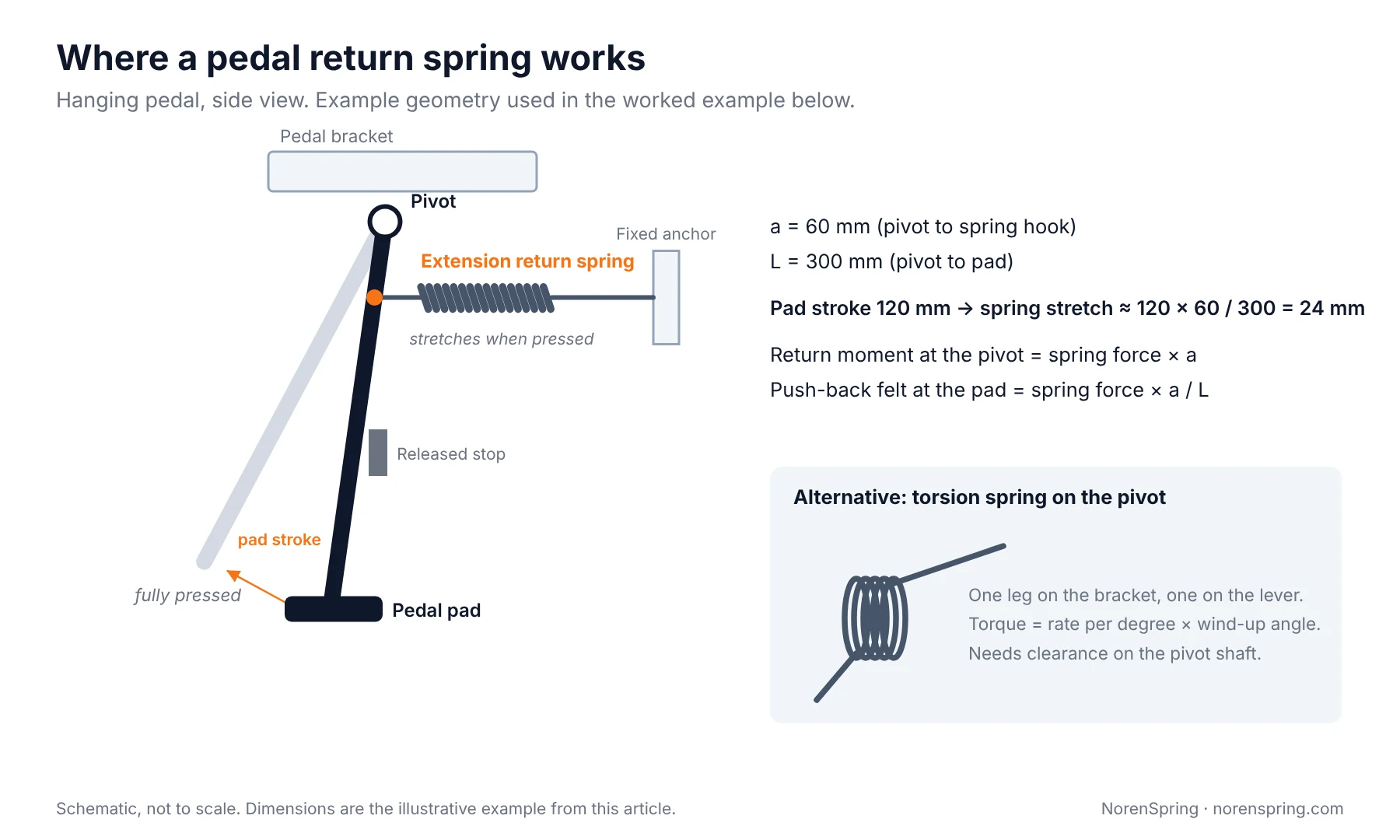
Two lever-arm relations do most of the work, using the geometry in Figure 1:
- Spring stretch ≈ pad stroke × a / L. With the spring hooked 60 mm from the pivot and the pad 300 mm from it, a 120 mm pad stroke stretches the spring about 24 mm. A short hook arm means a short, stiff spring; a long one means a longer spring with more travel.
- Return moment = spring force × a, and the push-back the operator feels at the pad is roughly spring force × a / L. Measure or estimate the friction moment on a sample pedal, then add margin.
Worked example: a tractor brake pedal extension spring
The numbers below are an illustration of the method, not the design of any part we make. Take the Figure 1 pedal and say the released position needs 4.8 N·m of return moment, a figure that already includes margin over the friction moment measured on a sample pedal.
- Spring: 3.0 mm hard-drawn carbon wire (strength taken from Shigley’s constants for A227 wire; JIS SW-C is somewhat stronger, so this is conservative), 24 mm outside diameter (21 mm mean diameter, spring index C = 7), 28 active coils.
- Rate: k = G·d⁴ / (8·D³·Na) = 79,300 × 3⁴ / (8 × 21³ × 28) ≈ 3.1 N/mm. Our spring rate guide explains each term.
- Initial tension: 50 N. For C = 7, the preferred range in Shigley’s design text works out at roughly 44 to 68 N for this wire and diameter [2], so 50 N is easy to coil.
- Installed (released) position, stretched 10 mm: F = 50 + 3.1 × 10 ≈ 81 N, a return moment of 81 N × 0.06 m ≈ 4.9 N·m.
- Fully pressed, stretched 34 mm: F = 50 + 3.1 × 34 ≈ 155 N, which the operator feels as about 31 N of push-back at the pad, roughly 15 N more than at the released position.
Initial tension is useful here. It gives a solid return force at the released stop without making the spring stiff over the stroke. Preload does the same job in compression and torsion springs.
Why the hooks fail before the coils
In a pedal extension spring, the hook is usually more highly stressed than the coil body. Shigley’s design method checks two points in a standard machine hook [2]: point A, the inside of the hook loop where the load acts (bending plus direct tension), and point B, the small bend where the hook leaves the last coil (torsion stress). The smaller the radius at point B, the higher the stress concentration.
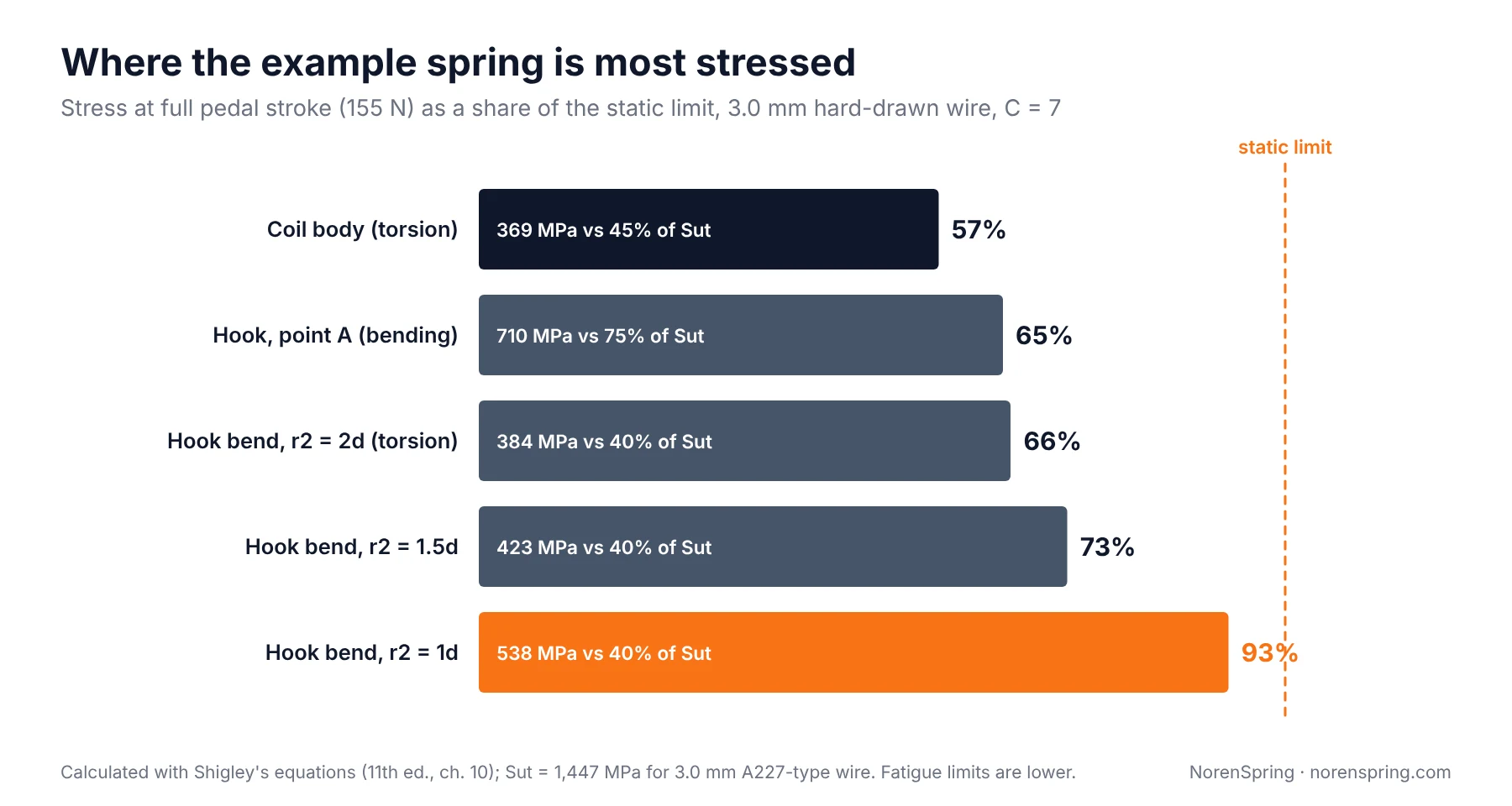
Figure 2 uses the static stress limits Shigley gives for cold-drawn carbon steel extension springs: 45% of tensile strength in the body, 75% for hook bending and 40% for hook torsion [2]. With a hook bend radius of twice the wire diameter (r2 = 2d), the hook bend is at 66% of its limit. Bend the same hook tight, to r2 = 1d, and it reaches 93%, leaving almost no margin. The coil body has not changed at all.
Pedal springs also cycle every time the pedal is used, and fatigue limits are well below these static limits. That is why the drawing should show the hook type, the bend radius where it matters, and the hook orientation relative to the anchor. Hooks twisted on assembly to reach a pin also add stress. The brake pedal springs in our photo avoid a tight machine hook altogether: a separate triangular wire loop is wrapped into the end coils.
One more point for the drawing: a new extension spring can lose a little initial tension in its first cycles, so ask for the loads to be checked after presetting or a short run-in.
For other failure causes, from corrosion pits to coil clash, see why springs fail.
Throttle return springs: the two-source rule
In the US, Federal Motor Vehicle Safety Standard No. 124 (49 CFR 571.124) requires at least two sources of energy capable of returning the throttle to idle. If one fails through a single severance or disconnection, the other must still return the throttle [1].
The standard also sets the return time. It is 1 second for vehicles of 4,536 kg (10,000 lb) gross vehicle weight rating or less, 2 seconds above that, and 3 seconds when the vehicle is exposed to air at −18 °C to −40 °C. These limits apply with the engine running at any ambient temperature from −40 °C to +52 °C, after 12 hours of conditioning in that range [1].
FMVSS 124 applies to passenger cars, multipurpose passenger vehicles, trucks and buses [1]. It does not list agricultural tractors. Even so, two independent return springs on a throttle, each strong enough on its own, is a sound design rule for any machine where a stuck throttle is dangerous. For a spring maker, it means:
- Each spring is sized alone. Either spring must return the throttle against full friction without help from the other.
- The springs do not share a failure. Separate anchors, so one broken bracket or hook does not release both.
- Cold is the design case. Grease stiffens and friction rises, so check the return force against the cold friction moment.
Throttle return springs at the pedal, pump and carburettor
On a cable or rod throttle, the pedal usually has a torsion spring at its pivot, and the injection-pump, governor or carburettor lever has its own small extension spring. On a governed small engine, the spring at the governor lever also sets the engine speed, as our guide to governor springs explains. Either can serve as one of the two return sources, provided each can close the throttle alone. Check also that neither spring stops the throttle reaching full open, and that the cable cannot snag and hold the throttle open. For carburettor spring kits on cars and small engines, a parts retailer is the faster route; for a production or replacement spring made to a drawing or sample, send the details below.
Materials and finishes for pedal springs
Most pedal return springs are plain carbon spring steel, because they work at ordinary ambient temperatures inside a cab or under a dashboard, away from engine heat. Hard-drawn carbon wire such as SWC, or manganese spring steel such as 65Mn for higher stress, covers nearly all of them. Our spring wire material guide compares the options.
Pedal boxes on tractors and off-road machines collect mud, water and fertiliser dust, so the finish matters:
- Zinc plating (clear or yellow) is the usual choice and is what our three example parts list. High-strength spring steel can become brittle from hydrogen taken in during plating. Guidance such as ASTM B850 sets out baking treatments after plating to reduce that risk [3]. All of our zinc-plated springs are baked after plating to relieve hydrogen, at temperatures set by the applicable national standard.
- Black coatings, phosphate and oil, or powder coat are used where a darker finish or a different corrosion system is wanted.
- Stainless steel is worth considering for wash-down or very wet machines, at a lower strength for the same wire size.
Our spring finishes guide compares coating options in more detail.
What to send for a pedal return spring quote
For a new design, send a drawing. For a replacement, send the drawing if you have it, or a sample spring plus the pedal it fits. Either way, include:
- Spring type and geometry: extension or torsion, wire diameter, outside diameter, free length (extension) or free leg angle (torsion), and the end details: hook or loop type, orientation, leg lengths and bends.
- Loads at two working points: force at the released position and at full pedal stroke for an extension spring, or torque at both angles for a torsion spring. For extension springs, also give the initial tension you want.
- Installation: the lever arm from the pivot, the anchor position, and for torsion springs the pivot shaft diameter.
- Material and finish, or the environment so we can propose them.
- Function: brake, clutch or throttle, and whether the spring is one of two in a redundant pair.
- Quantity and documents: annual volume, sample quantity, and any material certificates or inspection reports you need. For automotive programmes, PPAP packages are available.
If you only have a worn sample, tell us so. A spring that has been in service for years may have lost some initial tension or taken a set, so we measure it and confirm the loads with you rather than copying it blindly. Our guide on how to measure a spring shows what to check before you send one.
How we make pedal return springs
We make pedal springs on CNC coiling and forming machines, which control the coil diameter, pitch, hooks and leg bends. Springs are then stress-relieved, finished, and inspected for dimensions and loads against the control plan agreed for the part. We have made pedal springs for tractor and vehicle brake, clutch and accelerator pedals for buyers in India and Brazil, as shown above, along with other agricultural machinery springs and automotive springs.
We also photographed a motorcycle rear brake pedal return spring on display in Shanghai; see springs we spotted at CIIE 2026. Another motorcycle extension spring with a safety role is the side stand spring; see how kickstand springs hold the stand up and down.
Frequently asked questions
What is the difference between a brake return spring and a brake pedal return spring?
A brake pedal return spring returns the pedal. A brake return spring, in mechanic’s language, usually means the springs inside a drum brake that pull the shoes back off the drum. They are different parts in different places. This guide covers the pedal spring; for the shoe springs, see our guide to drum brake return, hold-down and adjuster springs.
Why does my brake pedal not return all the way?
Common causes are a pedal return spring that has lost force or broken at the hook, a seized pivot or bushing, or a problem in the master cylinder or linkage. Check the spring first: compare its free length and hook condition with a new one. If the spring is fine, the problem is friction or hydraulics, and a stronger spring is not the fix.
Can I use a stronger spring to make the pedal return faster?
Only within limits. A stronger spring raises pedal effort and spring stress. It can also hide a friction problem that will keep getting worse. Work out the force needed from the friction moment, then add a sensible margin.
What does a clutch return spring do?
It pulls the clutch pedal back to its top stop and on clutches set up with free play, keeps the release bearing clear of the pressure-plate fingers, so the clutch stays fully engaged. Many hydraulic clutches are designed with the bearing in light constant contact, so check the vehicle’s design before judging free play.
Should a pedal spring be an extension spring or a torsion spring?
Use an extension spring when there is a straight line from the lever to a fixed anchor, and a torsion spring when the space is around the pivot. If you are replacing an existing part, keep the same type unless the pedal is being redesigned.
How do you check a pedal return spring?
Measure the load at two lengths (or two angles) and compare with the drawing. For extension springs, also check initial tension, hook orientation and hook bends for cracks. Two-point load checks are the usual acceptance method for extension and torsion springs alike.
About the authors
This guide was prepared by the NorenSpring engineering team, which designs and manufactures custom compression, extension and torsion springs and wire forms in Xuzhou, China. Technical review by Feng Yulin, General Manager and senior structural engineer, who has 15 years of spring R&D experience and more than 30 national patents. NorenSpring holds IATF 16949, ISO 9001, ISO 13485, ISO 14001 and ISO 45001 certifications. The product photos are of our own springs; the cover is an AI illustration based on our own product photo. The worked example is a calculation for illustration. Sources were last checked on October 26, 2026.
Need a brake, clutch or throttle return spring made to your drawing or sample? Send us the details with the loads, finish and annual quantity. Our engineers give feedback within 24 hours and confirm the design with the quotation. You can also browse our extension springs and torsion springs.
Sources
The numbers in square brackets in the text refer to this list.
- US Code of Federal Regulations, 49 CFR 571.124, Standard No. 124: Accelerator control systems (Legal Information Institute, Cornell Law School): S3 application, S5 temperature range, S5.1 two sources of energy, S5.3 maximum return times. Retrieved 2026-10-26.
- Budynas, R. G. and Nisbett, J. K., Shigley’s Mechanical Engineering Design, 11th edition, McGraw-Hill, chapter 10 (Mechanical Springs): extension spring hook stresses at points A and B, preferred initial tension range, static stress limits for extension springs, and tensile strength constants for hard-drawn wire (A227).
- ASTM International, ASTM B850, Standard Guide for Post-Coating Treatments of Steel for Reducing the Risk of Hydrogen Embrittlement. Retrieved 2026-10-26.
- Japanese Industrial Standards, JIS G 3521, Hard drawn steel wires (grades SW-A, SW-B, SW-C).
- Standardization Administration of China, GB/T 1222-2025, Spring steels (includes 65Mn).



