










In this article
- Key takeaways
- Why does spring steel spring back?
- Types of spring steel
- Spring steel composition at a glance
- Wire, strip and bar: the forms of spring steel
- How is spring steel heat treated?
- How hot can spring steel run?
- How to choose a spring steel
- What to write on a drawing
- Frequently asked questions
- About the authors
- Sources
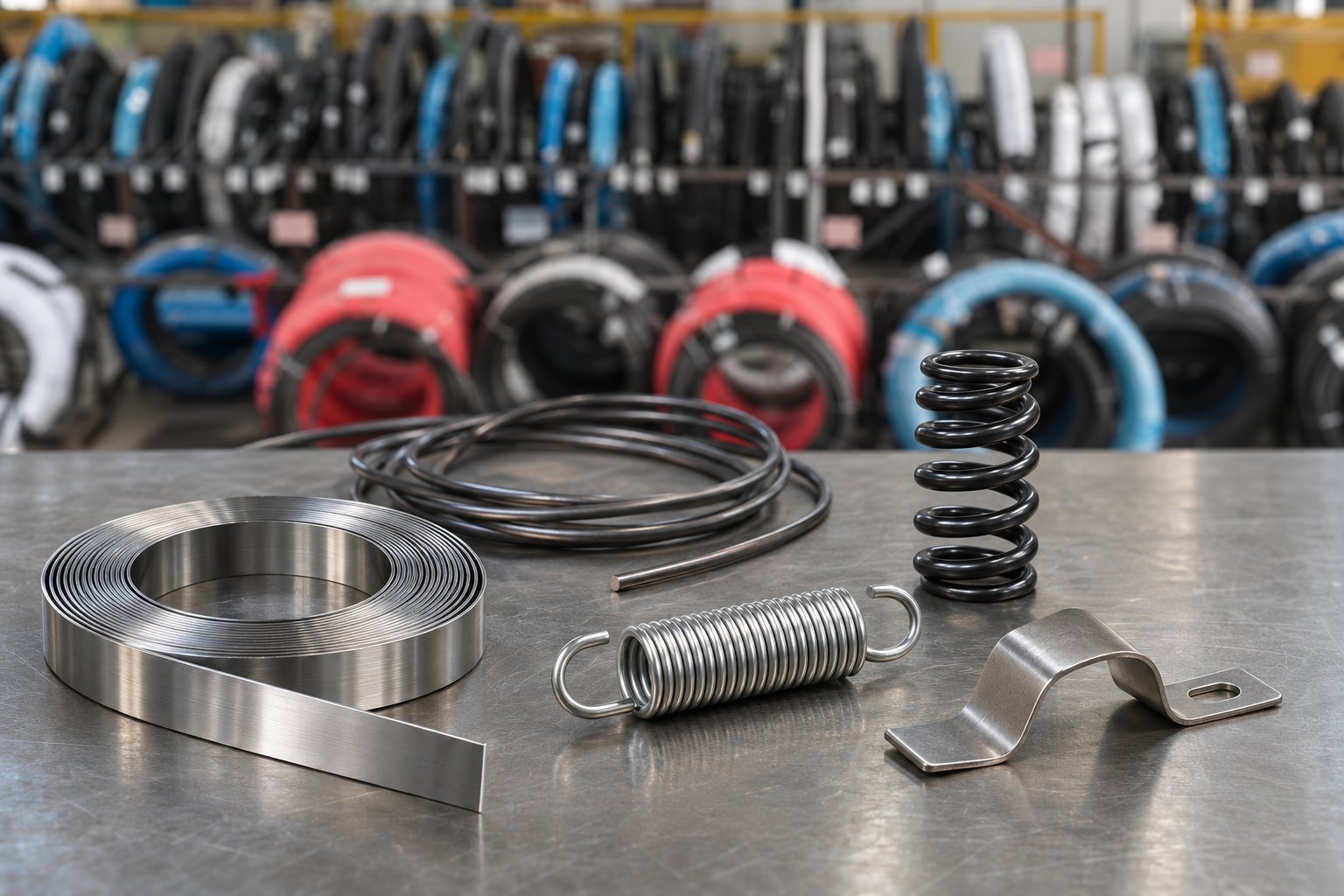
Cover image: an AI illustration based on a photograph of our spring wire store, with spring steel strip, wire and finished springs added in the foreground. It is not a photo of a specific order.
Spring steel is steel that has been made strong enough to bend, twist or stretch a long way and then return to its original shape. It is not one alloy. The name covers a family of medium- and high-carbon steels, low-alloy steels and some stainless steels that share one property: a very high yield strength. Wikipedia describes it as “generally low-alloy manganese, medium-carbon steel or high-carbon steel with a very high yield strength” (Wikipedia: Spring steel).
Spring steel is used for coil springs, flat springs, clips, wave washers, saw blades and anything else that has to flex and recover thousands or millions of times. This guide explains why it springs back, which grades exist, how they are hardened, how hot they can run, and what to write on a drawing. For a grade-by-grade cross-reference between Chinese, US, Japanese and European wire standards, see our spring wire material guide.
Key takeaways
- Spring steel is about yield strength, not stiffness. All steels have about the same elastic modulus, around 200 GPa. A spring steel bar is no stiffer than a mild steel bar of the same size. It can just bend much further before it takes a permanent set.
- The difference is large. Quenched and tempered 51CrV4 has a yield strength of at least 1,220 MPa in Ovako’s data, against 250 MPa for A36 structural steel. That is almost five times more elastic strain before permanent bending.
- There are three families: carbon spring steels (1075, 1095, music wire), alloy spring steels (5160, 6150 / 51CrV4, chrome silicon) and stainless spring steels (301, 302, 316, 17-7 PH).
- Strength comes from heat treatment or cold drawing. Most small springs are coiled from wire that is already hard. Strip parts and hot-coiled springs are hardened and tempered after forming.
- Temperature sets the grade. A common spring maker’s table rates music wire to 121 °C, chrome silicon to 246 °C and 17-7 PH stainless to 343 °C.
Why does spring steel spring back?
Every steel behaves like a spring at first. Load it a little and it stretches in proportion to the load, then returns to shape when the load is removed. Yield strength is the stress at the limit of that elastic range. Beyond it, the steel bends permanently.
The slope of the elastic range, the elastic modulus, is almost the same for all steels. Wikipedia lists 200 GPa for A36 structural steel (Wikipedia: Young’s modulus), and music wire to ASTM A228 is given as 207 GPa (Wikipedia: Piano wire). So a spring steel part and a mild steel part of the same size deflect the same amount under the same small load. What spring steel adds is a much higher yield strength, so it can go much further before it stops coming back.
We can show the difference as the largest elastic strain each steel can take, which is the yield strength divided by the modulus:
| Steel | Yield strength | Elastic modulus | Largest elastic strain | Yield source |
|---|---|---|---|---|
| A36 structural steel | 250 MPa | 200 GPa | 0.13% | Wikipedia: A36 |
| 301 stainless, spring tempered | 1,014 MPa (147 ksi) | 193 GPa | 0.53% | Wikipedia |
| 51CrV4, quenched and tempered flat bar | 1,220 MPa | 200 GPa | 0.61% | Ovako |
The 301 modulus is from the Lee Spring materials table (28 × 10⁶ psi). The strain column is our calculation.
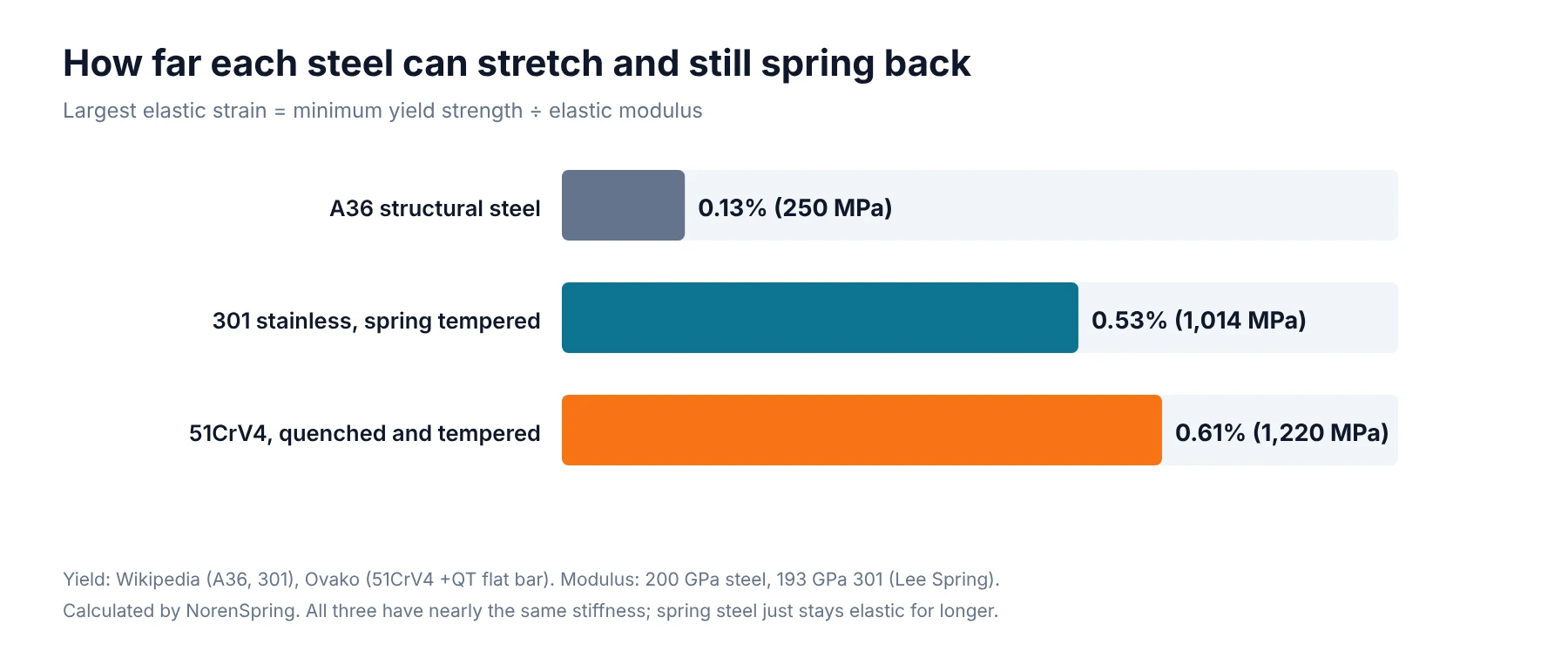
This is why a spring made from mild steel takes a set the first time it is compressed hard, while the same spring in spring steel recovers. For the same reason, upgrading to a stronger spring steel will not make a spring stiffer. To change stiffness, you change the wire size, coil diameter or number of coils, as our spring rate guide explains.
Types of spring steel
Carbon spring steels
Plain carbon steels with a high carbon content and little else; the table below gives the limits. They are the cheapest spring steels and the most common for indoor springs at room temperature.
- SAE 1074/1075: a strip grade. Wikipedia gives a typical hardness of 44–50 HRC for this strip grade.
- SAE 1095: a higher-carbon strip grade, supplied to ASTM A684. Typical hardness 48–51 HRC.
- Music wire (ASTM A228): high-carbon wire cold drawn to very high strength. The strongest common wire in small sizes.
- Hard-drawn (ASTM A227) and oil-tempered (ASTM A229) wire: lower-cost carbon wires for general springs.
- 65Mn: a Chinese manganese spring steel in GB/T 1222. We use it for clips, circlips and retaining springs.
Alloy spring steels
Alloy spring steels add chromium, vanadium or silicon. These elements let thicker sections harden all the way through, resist softening at temperature and improve fatigue strength. Our guides to chrome vanadium springs and high temperature springs go further into the alloy grades.
- 5160: a chromium steel used for leaf springs and heavy flat springs.
- 6150 / 51CrV4 / 50CrVA: chromium-vanadium steel, made to EN 10089 in Europe and GB/T 1222 in China. It is the usual grade for hot-coiled and heavy springs, and for agricultural tines.
- 9255 and other silicon-manganese grades (60Si2Mn): high-silicon steels for heavy coil and leaf springs.
- Chrome silicon (ASTM A401, 55CrSi): for highly stressed springs that run warm, such as valve springs. See our chrome silicon springs guide.
- Chrome vanadium wire (ASTM A231): for shock loads at moderate temperature.
Stainless spring steels
Stainless spring steels resist corrosion and run hotter, but most are weaker than hardened carbon steel of the same size.
- 301 (1.4310): cold rolled to spring temper for flat springs and clips. Wikipedia lists 42 HRC for spring-tempered 301.
- 302 and 304 (ASTM A313): the standard stainless spring wire.
- 316 (ASTM A313): adds molybdenum for chlorides and seawater.
- 17-7 PH (AMS 5678): precipitation hardened after the spring is formed, for higher strength and temperature.
Our stainless steel springs guide compares these grades in detail.
Spring steel composition at a glance
| Grade | Family | Carbon (C) | Main alloying elements | Typical form | Source |
|---|---|---|---|---|---|
| 1075 | Carbon | 0.70–0.80% | Mn 0.50–0.80% | Strip | Wikipedia |
| 1095 (A684) | Carbon | 0.90–1.03% | Mn 0.30–0.50% | Strip | Wikipedia |
| Music wire (A228) | Carbon | 0.70–1.00% | Mn 0.20–0.70% | Wire | Lee Spring |
| 5160 | Alloy | 0.55–0.65% | Cr 0.70–0.90%, Mn 0.75–1.00% | Bar, flat | Wikipedia |
| 51CrV4 (EN 10089) | Alloy | 0.47–0.55% | Cr 0.90–1.20%, V 0.10–0.25% | Bar, wire | Ovako |
| Chrome silicon (A401) | Alloy | 0.51–0.59% | Cr 0.60–0.80%, Si 1.20–1.60% | Wire | Lee Spring |
| 9255 | Alloy | 0.50–0.60% | Si 1.80–2.20%, Mn 0.70–0.95% | Bar | Wikipedia |
| 301 stainless | Stainless | 0.08–0.15% | Cr 16–18%, Ni 6–8% | Strip | Wikipedia |
| 302/304 (A313) | Stainless | low | Cr 17–20%, Ni 8–10.5% | Wire | Lee Spring |
| 17-7 PH | Stainless | low | Cr 16–18%, Ni 6.5–7.7%, Al 0.75–1.5% | Wire, strip | Lee Spring |
Always check the exact limits in the standard you order to.
Wire, strip and bar: the forms of spring steel
Spring steel is bought in three main forms, and the form decides how the spring is made:
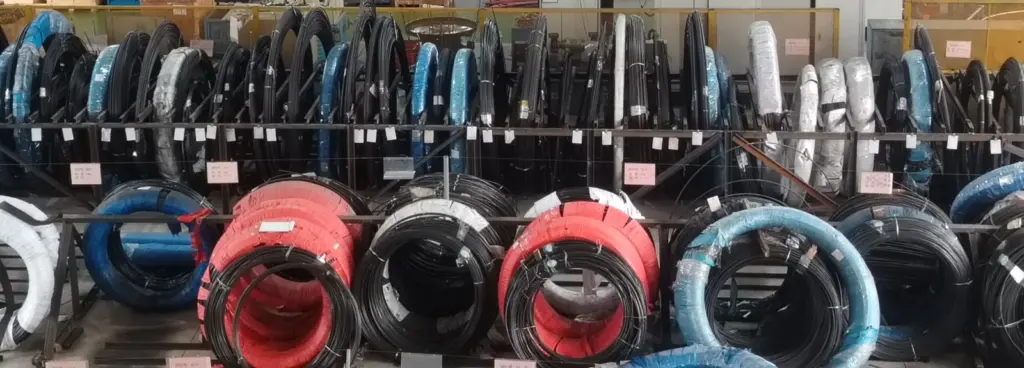
- Round wire for compression, extension and torsion springs and wire forms. Our coiling range starts at 0.1 mm wire.
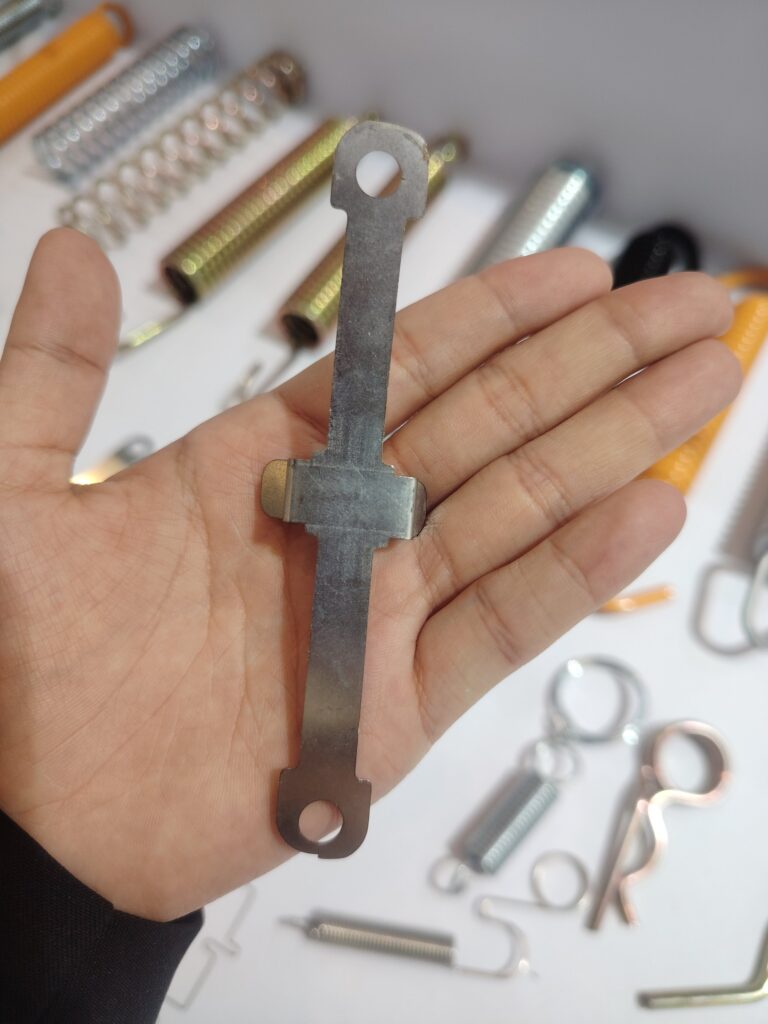
- Flat strip for flat springs, clips, wave washers and constant-force springs. It is usually bought hardened or is hardened after stamping.
- Hot-rolled bar for large coil springs. Springs above about 16 mm wire are hot coiled from bar and then quenched and tempered; ISO 11891 covers hot-coiled springs from 8 to 60 mm bar (ISO 11891).
How is spring steel heat treated?
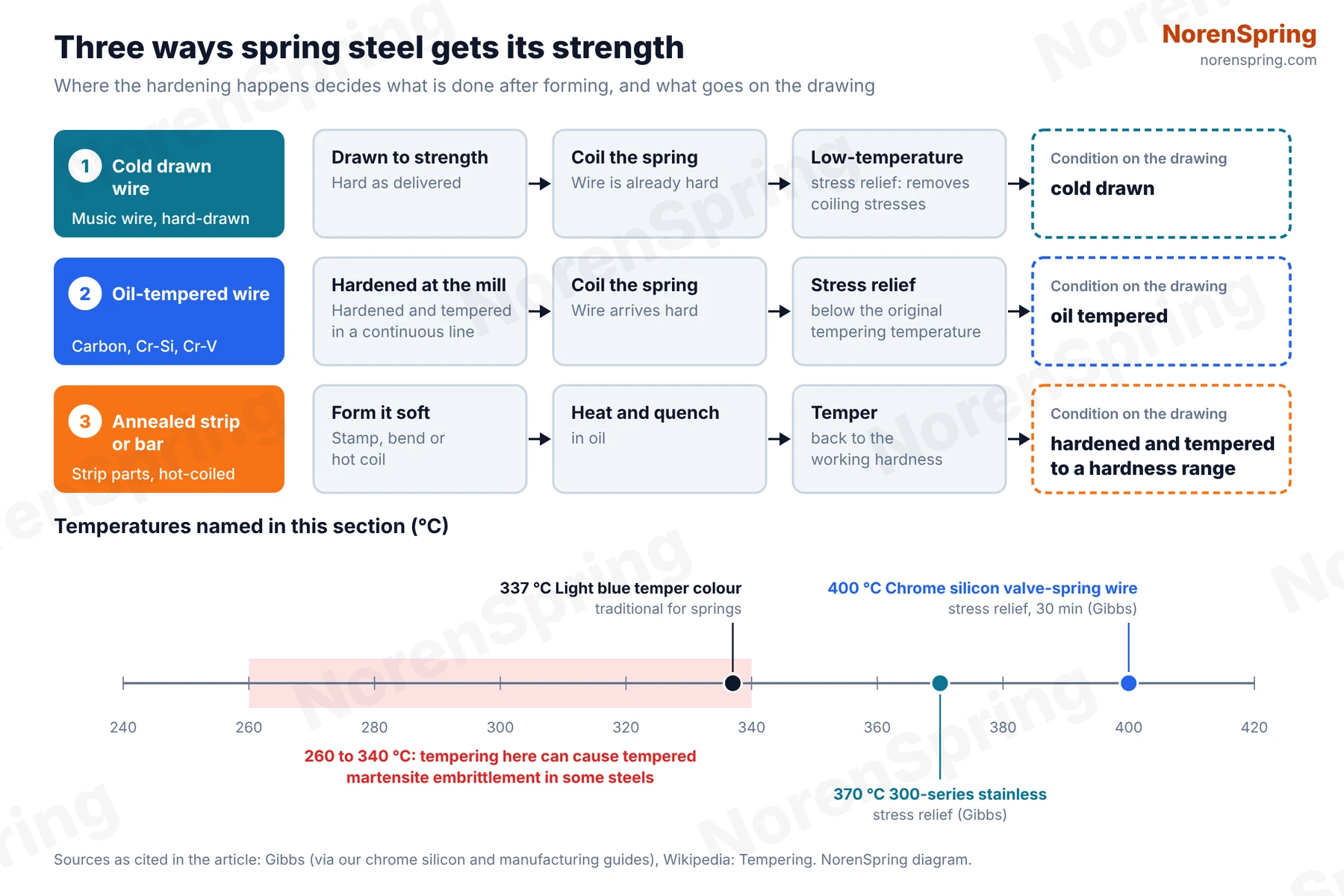
Spring steel gets its strength in one of three ways. Which one applies changes how you specify the part.
- Cold drawn wire, hard as delivered. Music wire and hard-drawn wire get their strength from drawing. After coiling, the spring only needs a low-temperature stress relief to remove coiling stresses and settle its dimensions.
- Oil-tempered wire, hardened at the mill. Oil-tempered carbon, chrome silicon and chrome vanadium wire is hardened and tempered in a continuous line before it reaches the spring maker. After coiling it is stress relieved below its original tempering temperature. For chrome silicon valve-spring wire, Gibbs recommends about 400 °C for 30 minutes, as our chrome silicon guide shows.
- Annealed steel, hardened after forming. Strip parts and hot-coiled springs are formed soft, then heated, quenched in oil and tempered back to the working hardness. This route sets the final hardness of the whole part at once.
Tempering trades hardness for toughness. Wikipedia notes that a light blue temper colour, at about 337 °C, is traditionally used for springs. It also warns that tempering between about 260 °C and 340 °C can cause tempered martensite embrittlement in some steels (Wikipedia: Tempering). Austempering is an alternative in which the steel is quenched into a hot bath and held, forming bainite rather than martensite, so no separate temper is needed.
Stainless spring wire is also stress relieved after coiling. For 300-series stainless, Gibbs gives about 370 °C (700 °F), as described in our spring manufacturing guide.
How hot can spring steel run?
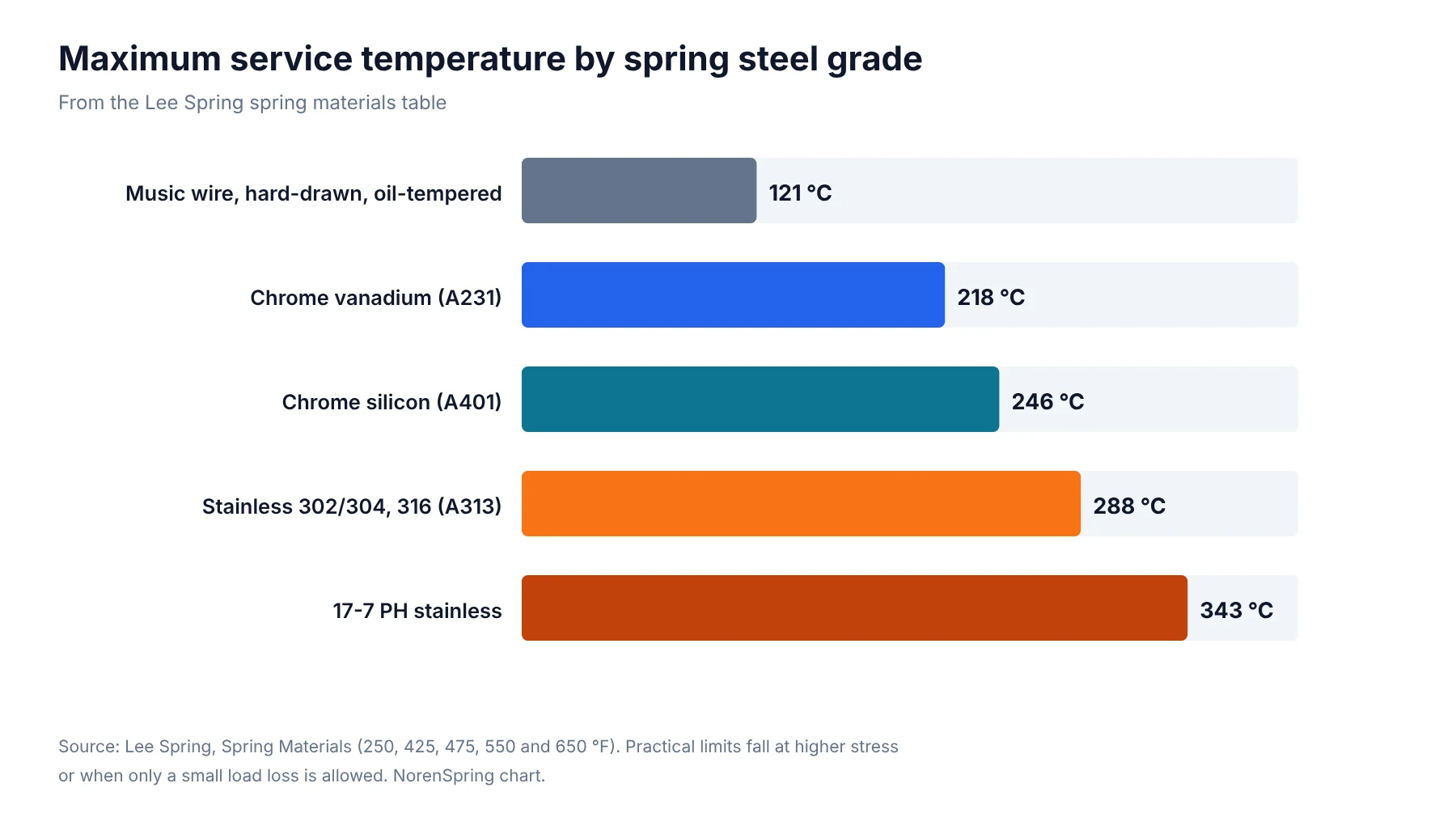
Relaxation is the slow loss of force in a loaded spring, and heat speeds it up. Each grade has a practical upper temperature. The Lee Spring materials table gives these limits:
| Material | Maximum service temperature |
|---|---|
| Music wire (A228), hard-drawn (A227), oil-tempered carbon (A229) | 121 °C (250 °F) |
| Chrome vanadium (A231) | 218 °C (425 °F) |
| Chrome silicon (A401) | 246 °C (475 °F) |
| Stainless 302/304 and 316 (A313) | 288 °C (550 °F) |
| 17-7 PH stainless (AMS 5678) | 343 °C (650 °F) |
Source: Lee Spring, Spring Materials. Higher temperatures call for nickel alloys such as Inconel.
How to choose a spring steel
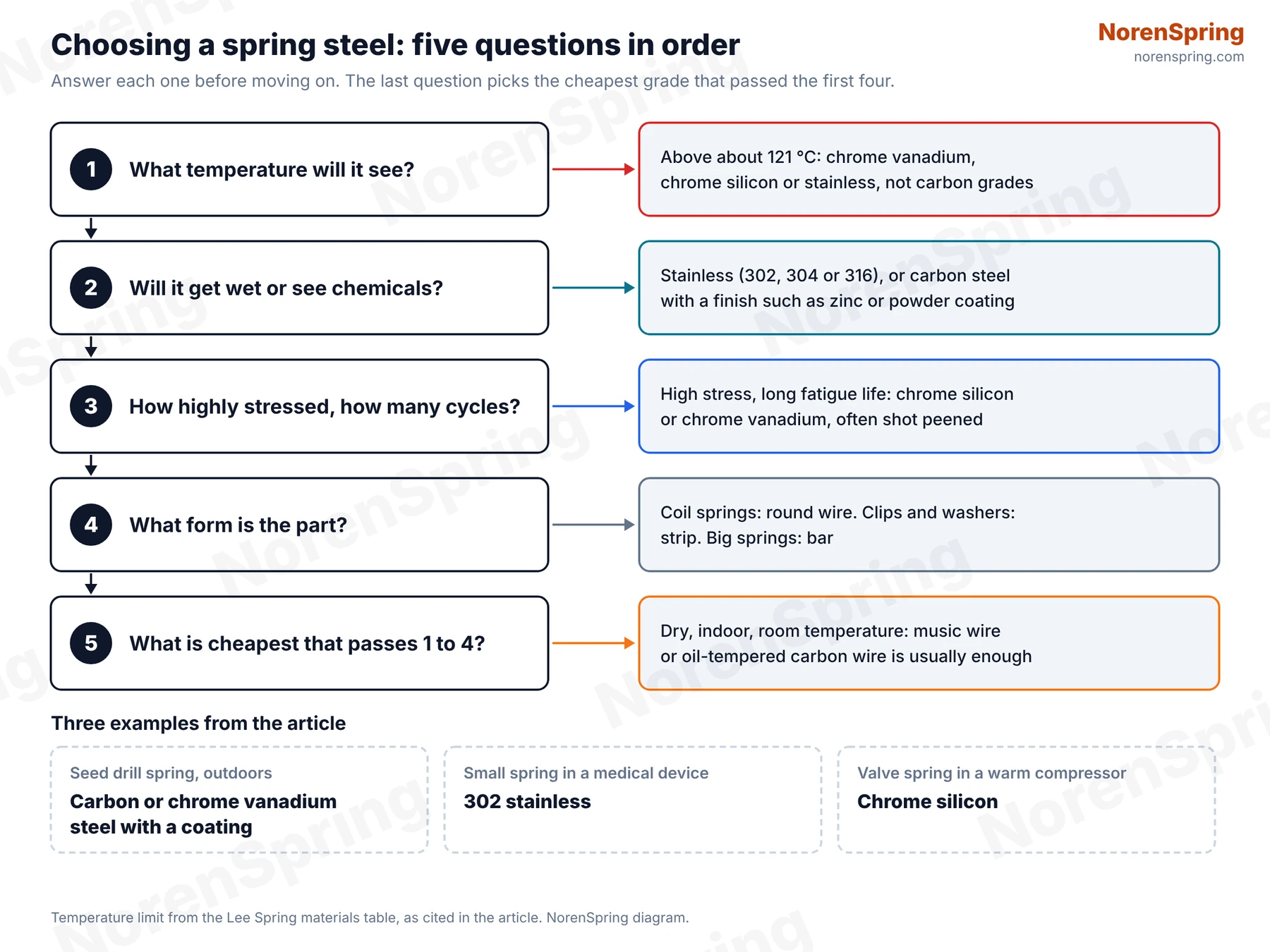
Work through these questions in order:
- What temperature will it see? Above about 121 °C, the Lee Spring table moves you off carbon grades to chrome vanadium, chrome silicon or stainless.
- Will it get wet or see chemicals? Use stainless (302, 304 or 316), or carbon steel with a protective finish such as zinc plating or powder coating. See our spring finishes guide.
- How highly stressed is it, and how many cycles? For high stress and long fatigue life, use chrome silicon or chrome vanadium, often with shot peening.
- What form is the part? Coil springs use round wire; clips and washers use strip; big springs use bar.
- What is cheapest that passes 1 to 4? For a dry indoor spring at room temperature, music wire or oil-tempered carbon wire is usually enough.
For example, a seed drill spring outdoors would normally be carbon or chrome vanadium steel with a coating. A small spring inside a medical device would usually be 302 stainless. A valve spring in a warm compressor would usually be chrome silicon.
What to write on a drawing
A drawing that only says “spring steel” leaves the choice to the supplier. Different suppliers may pick 65Mn, music wire or 302 stainless, and all three would meet the words. Give the grade and the standard:
- Grade and standard, for example “music wire to ASTM A228” or “50CrVA to GB/T 1222”. Our GB/T 1222-2025 guide covers the Chinese spring steel standard.
- Condition, for example oil tempered, cold drawn or hardened and tempered to a hardness range.
- Finish and any salt spray hours.
- Certificates you need, such as an EN 10204 3.1 mill certificate.
We check incoming wire grade with a spectrometer and can supply material certificates with the parts. Send your drawing or sample through our contact page and we will confirm the grade at review.
Frequently asked questions
Is spring steel the same as stainless steel?
No. Most spring steel is carbon or low-alloy steel that will rust without a coating. Some stainless steels, such as 301, 302 and 17-7 PH, are also used as spring steels. They resist corrosion but are usually weaker than hardened carbon steel of the same size.
What hardness is spring steel?
It depends on the grade and the job. Wikipedia lists typical hardness of 44–50 HRC for 1074/1075 strip and 48–51 HRC for 1095. Spring-tempered 301 stainless is listed at 42 HRC. Harder steel is stronger but more brittle, so springs are tempered to a balance of strength and toughness.
Can you weld spring steel?
It is best avoided. Welding heats the steel far above its tempering temperature, so the weld area loses its spring temper and may become brittle when it cools. If a spring part needs a joint, design it with a mechanical fastening or form it from one piece.
Is spring steel stiffer than mild steel?
No. Both have an elastic modulus of about 200 GPa, so the same shape bends the same amount under the same small load. Spring steel can bend much further without taking a permanent set, because its yield strength is several times higher.
About the authors
This guide was prepared by the NorenSpring engineering team, which designs and manufactures custom compression, extension and torsion springs and wire forms in Xuzhou, China, since 2001. Technical content reviewed by Feng Yulin, General Manager and senior structural engineer, who has 15 years of spring R&D experience and more than 30 national patents. Our certificates are shown on our about page. Sources were last checked on November 4, 2026.
Sources
- Wikipedia, Spring steel, grade compositions, yield strengths and hardness. en.wikipedia.org. Retrieved 2026-11-04.
- Ovako, 51CrV4 EN10089:2002 material data sheet, composition and quenched and tempered properties. steelnavigator.ovako.com. Retrieved 2026-11-04.
- Lee Spring, Spring Materials, compositions, moduli and maximum operating temperatures. leespring.com. Retrieved 2026-11-04.
- Wikipedia, Young’s modulus (A36 steel 200 GPa) and Piano wire (ASTM A228, 207 GPa). en.wikipedia.org. Retrieved 2026-11-04.
- Wikipedia, A36 steel, minimum yield strength 36 ksi (250 MPa). en.wikipedia.org. Retrieved 2026-11-04.
- Wikipedia, Tempering (metallurgy), spring temper colour, tempered martensite embrittlement and austempering. en.wikipedia.org. Retrieved 2026-11-04.
- ISO, ISO 11891:2012 Hot formed helical compression springs. iso.org. Retrieved 2026-11-04.



