










In this article
- Key takeaways
- What happens to a spring when it gets hot?
- Spring material temperature limits
- How much force does a spring lose when hot?
- How to keep relaxation under control
- Common high temperature spring applications
- Finishes for hot springs
- How to specify a high temperature spring
- Frequently asked questions
- About the authors
- Sources
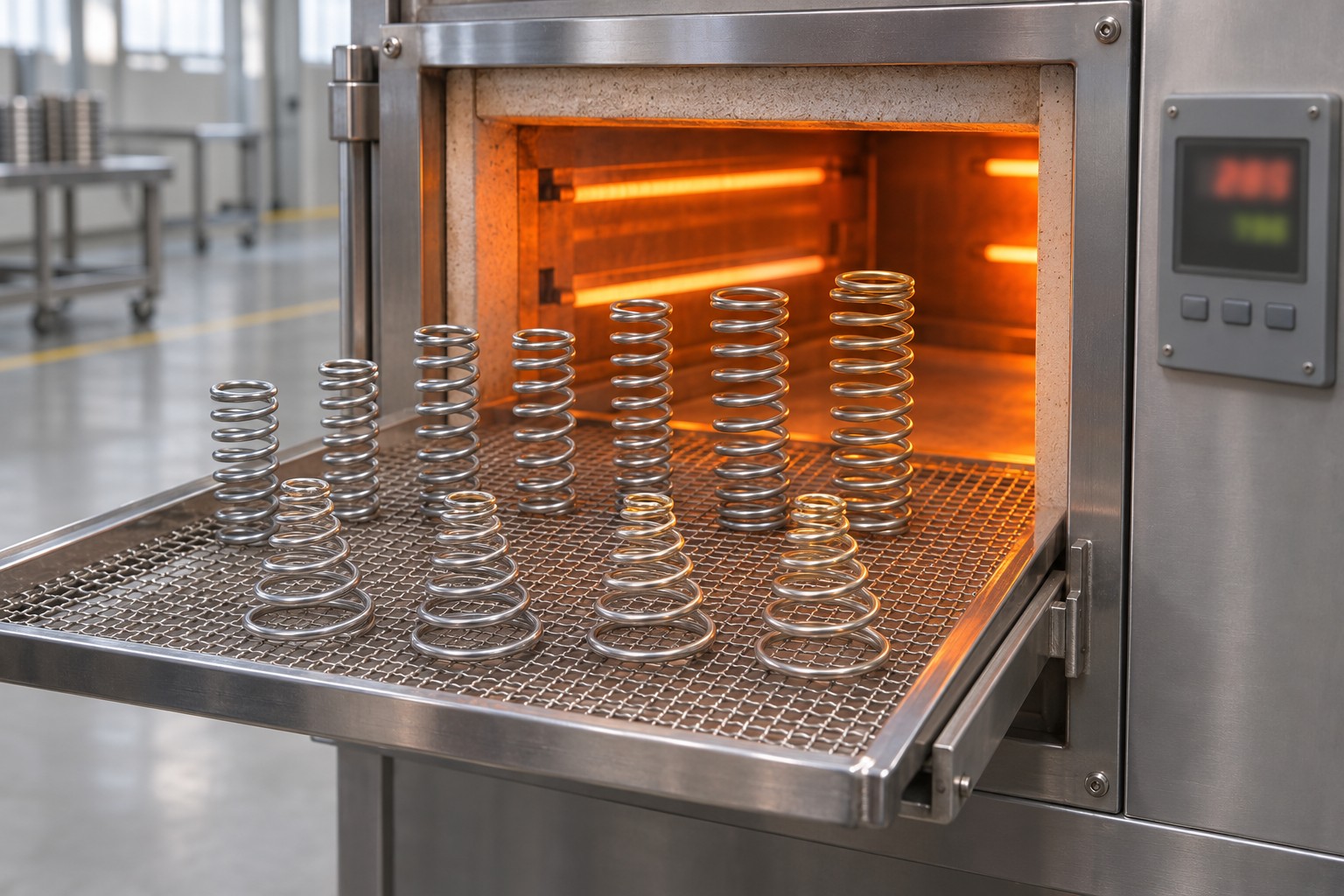
Cover image: an AI illustration based on a photograph of springs we make, showing springs entering a heat-treatment oven. It is not a photo of a specific order.
High temperature springs are springs made from materials that keep their force when they work hot, from chrome vanadium and chrome silicon steels at about 220–250 °C, through stainless steels at about 290–340 °C, to nickel alloys such as Inconel 718 at up to about 593 °C [1]. Ordinary music wire and carbon spring wire are only rated to about 121 °C (250 °F) [1]. Above that, a carbon steel spring keeps relaxing and loses load, even if it never breaks.
Choosing the right material is the main decision, but it is not the only one. This guide explains what heat does to a spring, lists the temperature limit of each common spring material, works through how much force a hot spring loses, and gives a checklist for the drawing.
Key takeaways
- Pick the material by the hottest continuous temperature. Carbon wires to 121 °C, chrome vanadium 218 °C, chrome silicon 246 °C, 302/316 stainless 288 °C, 17-7 PH 343 °C, Inconel X-750 and 718 up to 593 °C [1].
- Heat costs force twice. The elastic modulus drops, so a spring gives less force at the same length, and the spring relaxes over time, which loses force permanently.
- The stiffness loss is predictable. By our calculation, a carbon steel spring at 204 °C gives about 94% of its room-temperature force at the same deflection, before any relaxation.
- Relaxation is controlled by stress. Lower working stress, heat setting and a better alloy all reduce load loss at temperature.
- Tell the spring maker the temperature profile. Continuous temperature, peak temperature, hours at temperature and the force you need when hot all change the design.
What happens to a spring when it gets hot?
Four things change as a spring heats up:
- The elastic modulus falls. Spring force depends on the shear modulus G. As the metal heats, G drops, so a spring compressed to the same length pushes back with less force. This change is reversible; the force returns when the spring cools.
- The spring relaxes. Under constant load at temperature, the metal slowly creeps. A compression spring takes a permanent set and gets shorter; a spring held at fixed length loses load. This loss stays after the spring cools. It is the main reason springs fail in hot service, and it is covered in our guide to why springs fail.
- The material can soften. Hardened and tempered steels lose strength if they run above their tempering temperature, for example in a fire or an overheated engine.
- The surface oxidises. Carbon steel scales in hot air, and many plating and coating systems have their own temperature limits. Stainless steels and nickel alloys keep a protective oxide film.
Spring material temperature limits
The table below lists the maximum operating temperature of common spring materials, converted from Lee Spring’s published table [1]:
| Material | Specification | Max. operating temperature | Typical use |
|---|---|---|---|
| Phosphor bronze | ASTM B159 | 93 °C (200 °F) | Electrical contacts |
| Music wire | ASTM A228 | 121 °C (250 °F) | General springs at room temperature |
| Oil-tempered carbon wire | ASTM A229 | 121 °C (250 °F) | Larger general springs |
| Beryllium copper | ASTM B197 | 204 °C (400 °F) | Conductive springs, non-magnetic |
| Chrome vanadium | ASTM A231 | 218 °C (425 °F) | Shock loads, moderate heat |
| Monel 400 | AMS 7233 | 232 °C (450 °F) | Marine and chemical service |
| Chrome silicon | ASTM A401 | 246 °C (475 °F) | High stress and moderate heat |
| Stainless 302/304 | ASTM A313 | 288 °C (550 °F) | General corrosion and heat resistance |
| Stainless 316 | ASTM A313 | 288 °C (550 °F) | Chlorides and marine service |
| Monel K-500 | QQ-N-286 | 288 °C (550 °F) | Higher strength than Monel 400 |
| Stainless 17-7 PH | AMS 5678 | 343 °C (650 °F) | Higher strength stainless springs |
| Inconel 600 | ASTM B166 | 371 °C (700 °F) | Moderate heat, chemical processing |
| Hastelloy C276 | ASTM B574 | 371 °C (700 °F) | Sulfur and chloride environments |
| Elgiloy | AMS 5833 | 454 °C (850 °F) | Cobalt-nickel, non-magnetic |
| Inconel X-750 | AMS 5698 / 5699 | 399–593 °C (750–1,100 °F) | Hot aerospace and turbine springs |
| Inconel 718 | ASTM B637 | 593 °C (1,100 °F) | Highest temperature in this list |
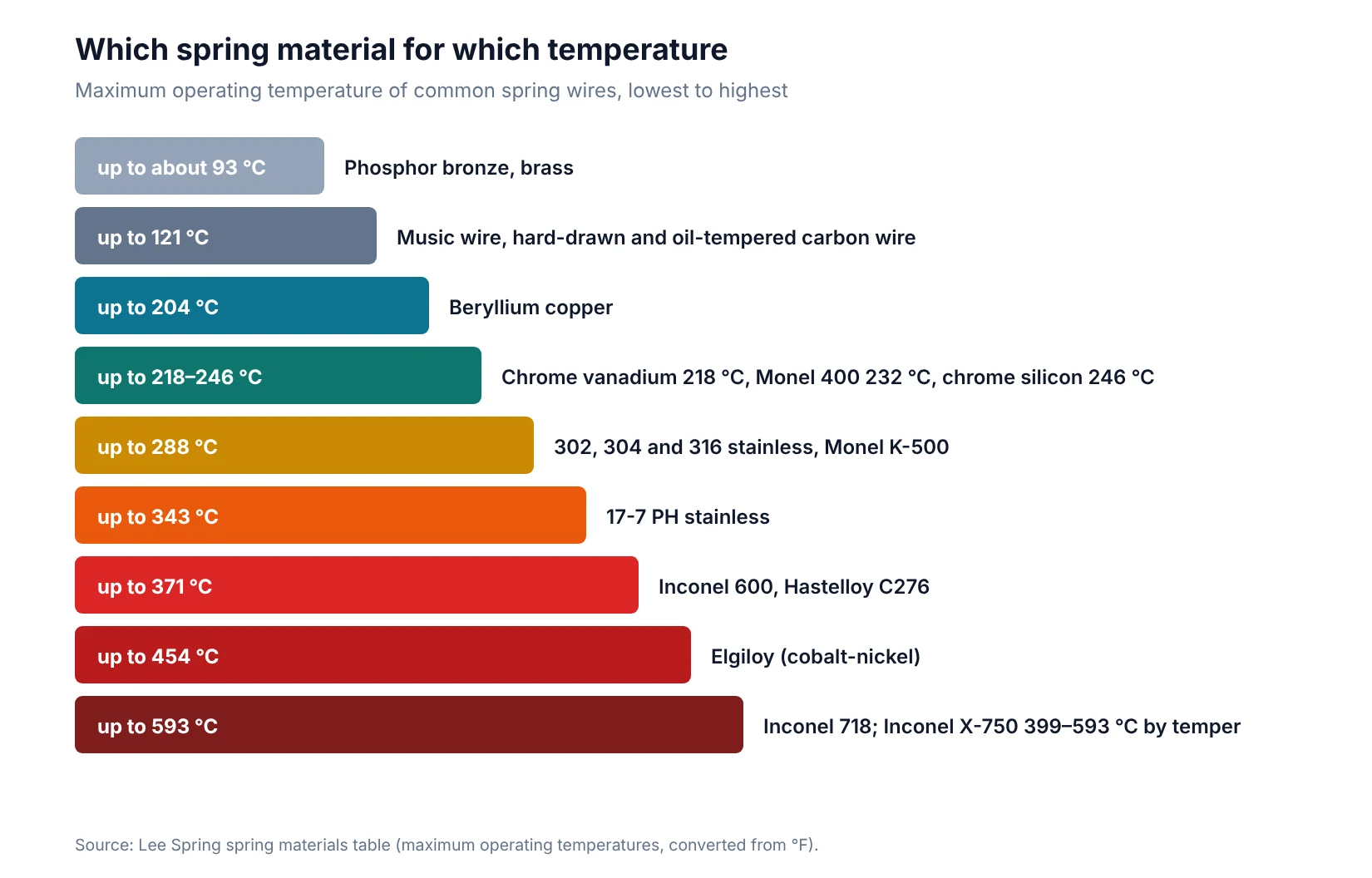
These are rule-of-thumb limits for springs at normal working stress. Master Spring’s material table notes that higher temperatures are possible with lower stresses for some nickel alloys [2]. The reverse is also true: a highly stressed spring may need a material one step higher than the table suggests.
For more detail on each family, see our guides to chrome vanadium springs, chrome silicon springs, stainless steel springs and Inconel springs.
How much force does a spring lose when hot?
The reversible part is easy to estimate. Spring rate is proportional to the shear modulus G, and G falls with temperature roughly in step with Young’s modulus E. Engineering ToolBox publishes E against temperature for common metals [3]. For carbon steel with 0.3% carbon or more, E drops from 29.3 to 27.5 million psi between 21 °C and 204 °C, which is 93.9% of the room-temperature value.
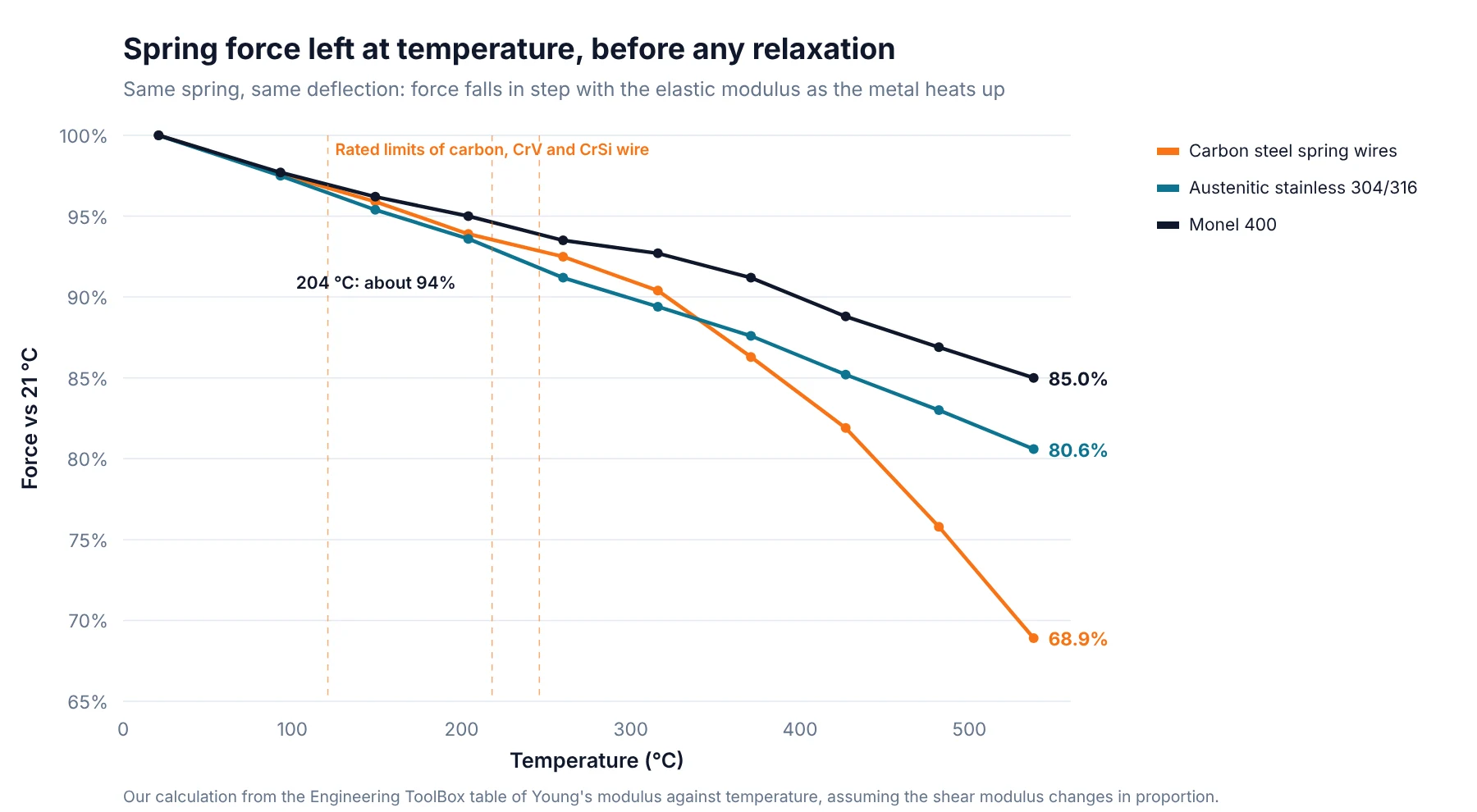
Worked example. A compression spring gives 500 N at its installed length at 21 °C. Assuming G changes in proportion to E, at the same length it gives about:
| Material | 204 °C | 316 °C | 427 °C |
|---|---|---|---|
| Carbon steel wire (chrome vanadium, chrome silicon) | 469 N | 452 N (above rated limit) | 410 N (above rated limit) |
| Austenitic stainless 302/304/316 | 468 N | 447 N (above rated limit) | 426 N (above rated limit) |
| Monel 400 | 475 N | 463 N (above rated limit) | 444 N (above rated limit) |
Values are our calculation from the Engineering ToolBox modulus table [3] and the Lee Spring temperature limits [1].
So even a well-chosen spring loses about 6% of its force at 204 °C simply because the metal is less stiff. If the mechanism needs 500 N when hot, design for about 530 N cold. That margin is separate from relaxation, which depends on stress, time and material.
How to keep relaxation under control
Relaxation is the permanent part of the loss, and four measures reduce it:
- Lower the working stress. Relaxation rises steeply with stress. A larger wire or more coils for the same load lowers stress and is often cheaper than a more exotic alloy.
- Heat set the spring. Holding the spring compressed at or above its service temperature during manufacture takes out the first, fastest part of the relaxation before the spring is fitted. This is often called heat setting or hot presetting.
- Use the right heat treatment. Precipitation-hardening alloys such as 17-7 PH, Inconel X-750 and Inconel 718 are aged after coiling, and the ageing cycle sets their high-temperature strength [1].
- Step up the alloy. When stress cannot drop, move one step up the temperature table.
For the hottest service, test data matter more than tables. A NASA contractor report on switchgear springs for space power systems at 538 °C (1,000 °F) selected Inconel 718 with a triple heat treatment, and tests over a 2,000 hour period at that temperature “showed low relaxation and good performance” [4]. For a new hot application, a relaxation test of samples at the real temperature and stress is the most reliable check.
Common high temperature spring applications
| Application | Why heat matters | Typical material choice |
|---|---|---|
| Engine and compressor valve springs | Hot oil and millions of cycles | Chrome vanadium or chrome silicon, valve spring quality |
| Exhaust system springs | Radiant heat and exhaust gas | Stainless steel or nickel alloy, see our exhaust springs guide |
| Drum brake return springs | Heat soaks in from the drum during hard braking | Carbon or oil-tempered spring wire, replaced at each reline, see our drum brake springs guide |
| Ovens, dryers and furnace doors | Long hours in hot air | 302/316 or 17-7 PH stainless |
| Turbine, valve and aerospace hot-section springs | Highest temperatures and long life | Inconel X-750 or Inconel 718 |
Always design to the measured temperature at the spring position, not the general temperature of the machine or room.
In our own production, compressor valve springs are a regular high temperature part: we supply them in SWOSC-V chrome silicon or 50CrVA chrome vanadium wire from 1 to 5 mm, with zinc plating or an oil-tempered finish, mainly to customers in the USA and Japan. Our inquiry form also lists stainless 304 and 316, nickel alloy and titanium alloy spring wire for hotter or corrosive service. For pressure relief valves, our relief valve spring guide explains how load lost to relaxation lowers the set pressure.
Finishes for hot springs
- Carbon and alloy steels: phosphate, black oxide, zinc plating or powder coating protect against rust in storage and mild service. Check the coating supplier’s temperature rating, because organic coatings can soften or discolour well below the spring material’s own limit.
- Stainless steels: usually passivated, with no coating needed.
- Nickel and cobalt alloys: normally supplied bare after ageing; a light heat tint is normal.
How to specify a high temperature spring
Put these on the drawing or in the inquiry:
- Temperature profile: normal continuous temperature, peak temperature, how long at peak, and the number of heating cycles.
- Force at temperature: the force you need at the working length when hot, not only at room temperature.
- Allowed load loss: for example, no more than 5% loss after a stated number of hours at temperature.
- Duty: static or cyclic, cycles per minute and target life.
- Environment: air, exhaust gas, oil, steam or chemicals, and any corrosion requirement.
- Material and tests: the preferred grade, any approved alternatives, and whether you need heat setting, relaxation testing or material certificates.
We make compression, extension and torsion springs and wire forms to drawing, and we review the temperature and stress together during the drawing check. Send your drawing or the data above through our contact page, or see our custom compression springs range.
Frequently asked questions
What is the best material for high temperature springs?
It depends on the temperature. For example, chrome silicon is a good choice up to about 246 °C, 17-7 PH stainless up to about 343 °C, and Inconel X-750 or Inconel 718 up to about 593 °C. Choose the cheapest material whose limit is comfortably above your continuous operating temperature at the real working stress.
How hot can a stainless steel spring get?
Lee Spring rates 302, 304 and 316 stainless spring wire to about 288 °C (550 °F) and 17-7 PH to about 343 °C (650 °F). Above that, stainless springs relax too much for most designs, and nickel alloys such as Inconel are the usual step up.
Do springs lose force when hot?
Yes, in two ways. The spring gets less stiff, so it gives less force at the same length; for carbon steel at 204 °C we calculate about 94% of the room-temperature force. It also relaxes over time under load, which is a permanent loss and depends on stress, time and material.
What is spring relaxation?
Relaxation is the gradual, permanent loss of force in a spring held under load, or the permanent shortening of a spring under constant force, which engineers call set. It increases with temperature and stress. Heat setting during manufacture, lower working stress and better alloys reduce it.
Can music wire be used at high temperature?
Only up to about 121 °C (250 °F). Above that, music wire relaxes quickly and loses load. For warm service, chrome vanadium or chrome silicon are the usual upgrades, then stainless steel and nickel alloys for hotter service.
About the authors
This guide was prepared by the NorenSpring engineering team, which designs and manufactures custom compression, extension and torsion springs and wire forms in Xuzhou, China, since 2001. Technical content reviewed by Feng Yulin, General Manager and senior structural engineer, who has 15 years of spring R&D experience and more than 30 national patents. Our certificates are shown on our about page. Sources were last checked on November 6, 2026.
Sources
- Lee Spring, Spring Materials table: maximum operating temperature, specification and use of spring wires. leespring.com. Retrieved 2026-11-06.
- Master Spring and Wire Form Co., Properties of Materials (maximum operating temperatures and notes on stress). masterspring.com. Retrieved 2026-11-06.
- Engineering ToolBox, Metals: Temperature and Young’s Modulus of Elasticity. engineeringtoolbox.com. Retrieved 2026-11-06.
- NASA Contractor Report, General Electric Company, Compression Springs for Long Time Operation in Vacuum at 1000° F (1971). ntrs.nasa.gov. Retrieved 2026-11-06.



