In this article
- Key takeaways
- Why the finish is part of the spring design
- Spring finishes compared at a glance
- Hydrogen embrittlement: the risk you must manage with plated springs
- Zinc plating and its passivate colours
- Phosphate and black oxide coatings for springs
- Painted and powder coated springs
- Zinc flake and nickel
- Stainless springs: passivation and polishing
- How a coating changes fit, clearance and solid height
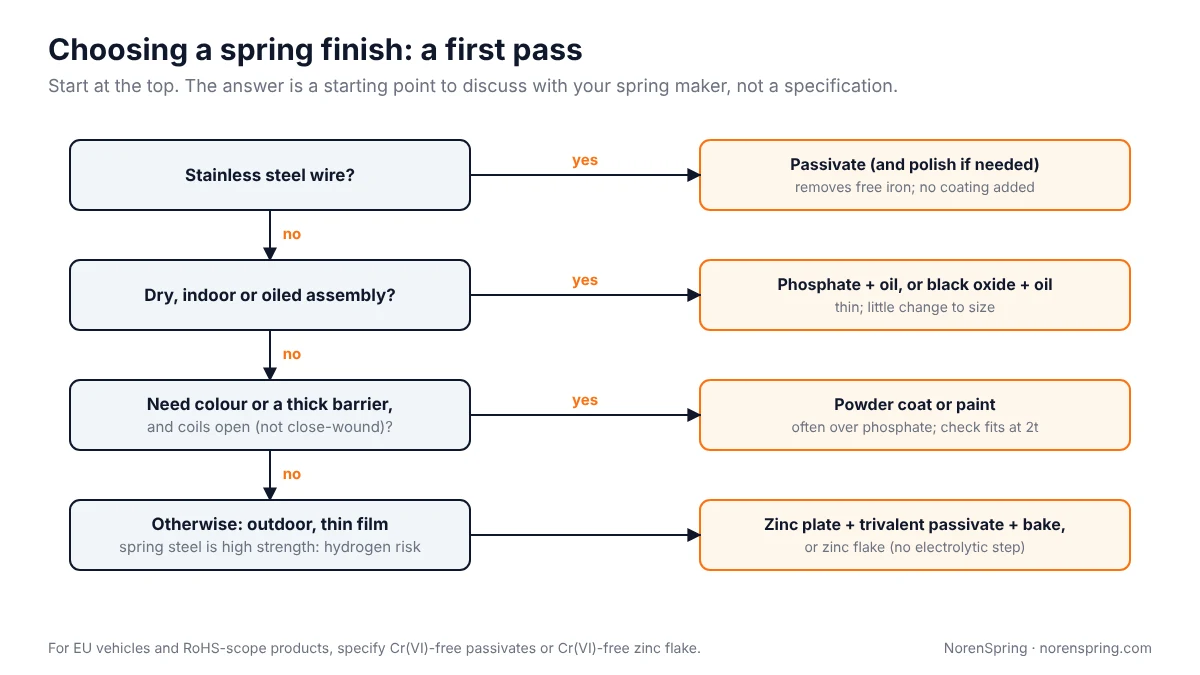
- Salt spray hours: what they tell you and what they don’t
- Which finish suits which spring: examples from our production
- How to write the finish on a drawing or RFQ
- Frequently asked questions
- Summary: choose the finish with the spring, not after it
- About the authors
- Sources
A spring’s finish, or coating, does more than set its colour. It decides how long the spring resists rust, whether it still fits its bore or shaft, and, on high-strength spring steel, whether the plating process leaves it brittle. Most steel springs leave the factory with one of these finishes: zinc plating, phosphate, black oxide, paint or powder coating, zinc flake, nickel plating or, for stainless steel, passivation. Each suits a different job.
This guide compares them, explains the one risk that matters most with plated springs (hydrogen embrittlement), shows how much a coating changes a spring’s dimensions, and lists what to write on a drawing or request for quote. It draws on the finishes on our own production parts, which across 36 recent compression, extension, torsion and wire form designs include black oxide, phosphate, zinc and nickel plating, paint, powder coating, passivation and polishing.
Key takeaways
- Match the finish to where the spring works. Phosphate or black oxide with oil suits dry, indoor or oiled assemblies. Zinc plating, zinc flake or powder coating suits outdoor parts. Stainless springs are passivated, not coated.
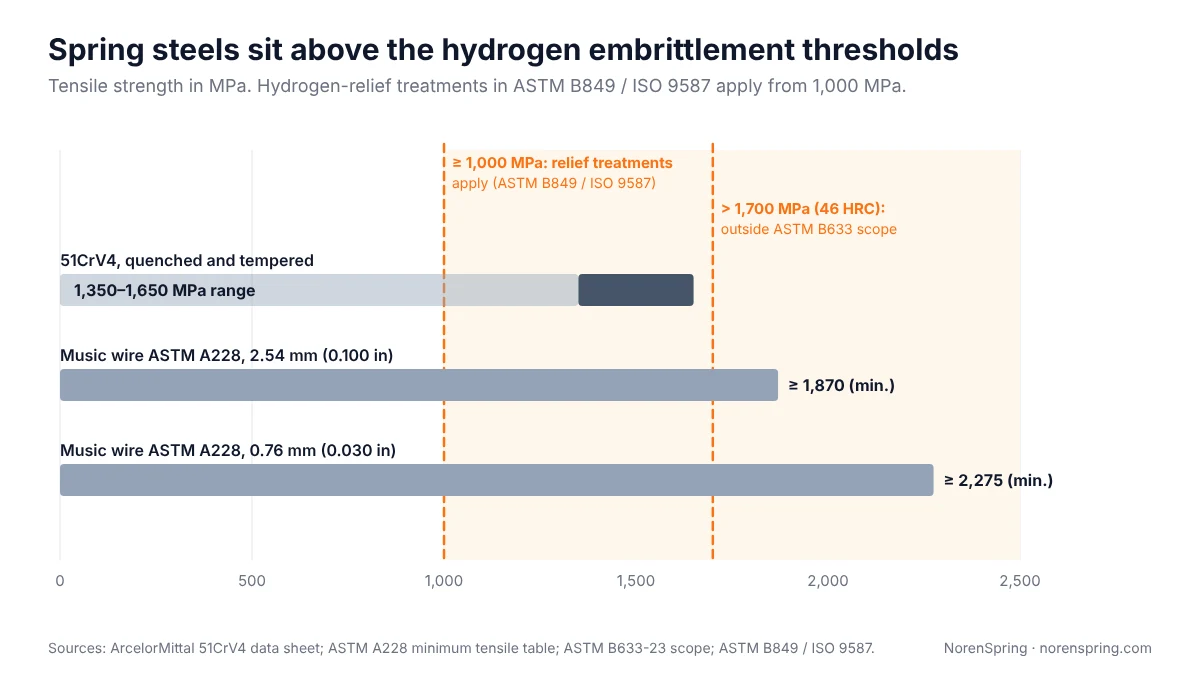
- Plated spring steel must be baked. Spring steels are well above 1,000 MPa, the strength from which ASTM B849 / ISO 9587 call for treatments to reduce the risk of hydrogen embrittlement. We bake every zinc plated spring after plating to drive the hydrogen out.
- Coatings change dimensions. A coating of thickness t adds 2t to the outside diameter, removes 2t from the inside diameter and adds 2t per touching coil to the solid height. An 80 µm powder coat on a 10-coil spring adds 1.6 mm at solid.
- Salt spray hours are a comparison, not a lifetime. ASTM B117 itself warns that salt spray results seldom predict performance outdoors.
- Write the finish on the drawing. Give the finish, colour, thickness class, passivate type (trivalent or chromium(VI)-free if required) and any bake or test requirement.
Why the finish is part of the spring design
A finish on a spring does four jobs, and they can pull against each other.
- Corrosion protection. Bare carbon spring steel rusts quickly, and rust pits concentrate stress. A spring that is cycled under load can crack from a corrosion pit long before it would wear out in a clean, dry assembly.
- Dimensions and fit. Every coating adds thickness to the wire. A compression spring working in a bore, over a shaft or close to solid height can lose its clearance once coated.
- Fatigue and strength. The process matters as much as the coating. Acid cleaning and electroplating can put hydrogen into high-strength steel, and curing ovens add heat to a part whose properties were set by heat treatment.
- Appearance and identification. Colour codes, a clean look on visible parts, and colour matching to the machine (common on agricultural tines) all depend on the finish.
So the finish is best chosen with the spring design, not added at the end. If the spring has a tight fit or works close to solid, tell your spring maker the finish before the dimensions are fixed.
Spring finishes compared at a glance
The table compares the finishes we see most often on steel springs. Thicknesses for zinc plating are the four ASTM B633 service condition classes; the other figures are typical ranges, not specification limits.
| Finish | What it is | Corrosion protection | Effect on size | Hydrogen risk from the process | Typical uses |
|---|---|---|---|---|---|
| Zinc plating + passivate | Electroplated zinc, then a clear, blue, yellow or black conversion layer | Good; set by thickness class (5, 8, 12 or 25 µm in ASTM B633) | Small; 2t on diameters | Yes: acid cleaning and plating; bake required on spring steel | Extension springs, compression springs, pedal and return springs |
| Zinc flake (Dacromet type) | Zinc and aluminium flakes in a binder, dipped or sprayed, then cured | Good | Small to moderate | No electrolytic step, but see the note under zinc flake below | High-strength parts where plating is a concern; disc springs |
| Phosphate + oil | Crystalline zinc or manganese phosphate conversion layer, oiled or used as a paint base | Limited on its own; depends on the oil or top coat | Very small | Some: phosphating is an acid process | Agricultural springs and tines, springs that will be painted |
| Black oxide + oil | Thin black conversion layer | Very limited; mild indoor conditions only | Negligible | Low | Circlips, clips, indoor springs, dark appearance |
| Paint or powder coat | Organic film sprayed and cured | Good barrier while the film is unbroken | Largest; tens of micrometres or more per side | None from the coating; pretreatment may be phosphate | Agricultural tines, coloured springs, large suspension springs |
| Nickel plating | Electroplated nickel | Moderate; mainly decorative and wear | Small | Yes: electroplating; bake required | Visible extension springs and clips |
| Passivation (stainless) | Chemical treatment that removes free iron from stainless steel | Restores stainless performance | None | Not relevant to austenitic stainless | Stainless exhaust, chain tensioner and food-equipment springs |
Hydrogen embrittlement: the risk you must manage with plated springs
Hydrogen embrittlement is a loss of toughness that happens when atomic hydrogen enters high-strength steel. The steel can pass inspection, then crack under load hours or days later with no warning. It explains why a plated spring can break in service while an unplated one from the same batch does not.
Where the hydrogen comes from. Acid pickling, cathodic cleaning and the electroplating itself all release hydrogen at the steel surface. ASTM B849 lists electroplating, autocatalytic plating, chemical conversion coating and phosphating, “and the associated pretreatment processes”, as sources of the problem [3].
Why springs are especially at risk. Susceptibility rises with strength. ASTM B849, the pre-treatment standard coordinated with ISO 9587, applies its stress-relief procedures to steel parts with a tensile strength of 1,000 MPa or greater [3]. ASTM B633, the main zinc electroplating specification, says steels with a tensile strength above 1,700 MPa (about 46 HRC) should not be zinc electroplated to that specification at all [1]. Spring steels sit well above the first figure, and music wire, even at 2.54 mm (at least 1,870 MPa), is above the second (Figure 2) [15][16].
What controls the risk.
- Bake after plating, promptly. ASTM B850 (technically equivalent to ISO 9588) says the hydrogen relief heat treatment “shall be used after plating operations but prior to any secondary conversion coating operation” [2]. The governing specification sets the actual time and temperature from the part’s strength.
- Accept that baking reduces the risk rather than removing it. B850 notes that the treatment “does not guarantee complete freedom from the adverse effects of hydrogen degradation” [2]. ASTM F519 provides a mechanical test method for evaluating plating and coating processes for hydrogen embrittlement [10].
- Avoid electroplating where you can. Zinc flake is applied without electric current, and the ISO 10683 note describes it as especially used for high-strength fasteners of 1,000 MPa and above to avoid internal hydrogen embrittlement [5].
What we do. Every zinc plated spring we make is given a hydrogen relief bake after plating, with the temperature set according to the applicable Chinese national standard [17]. If your drawing calls for a specific bake standard or an embrittlement test, write it on the drawing and we will confirm it at quotation. Aerospace drawings often name one, which our aerospace springs page covers alongside FAIR records.
Zinc plating and its passivate colours
Electroplated zinc is the most common protective finish on carbon steel springs. Zinc corrodes in place of the steel, so small scratches do not immediately rust. ASTM B633 defines four thickness classes for increasingly severe service; in practice these are 5, 8, 12 and 25 µm [1]. Thicker zinc lasts longer outdoors but adds more to the spring’s dimensions.
After plating, the zinc is given a conversion layer, commonly called the passivate. It sets the colour and adds corrosion resistance:
- Clear or blue-white, the bright silver-blue finish on most standard springs.
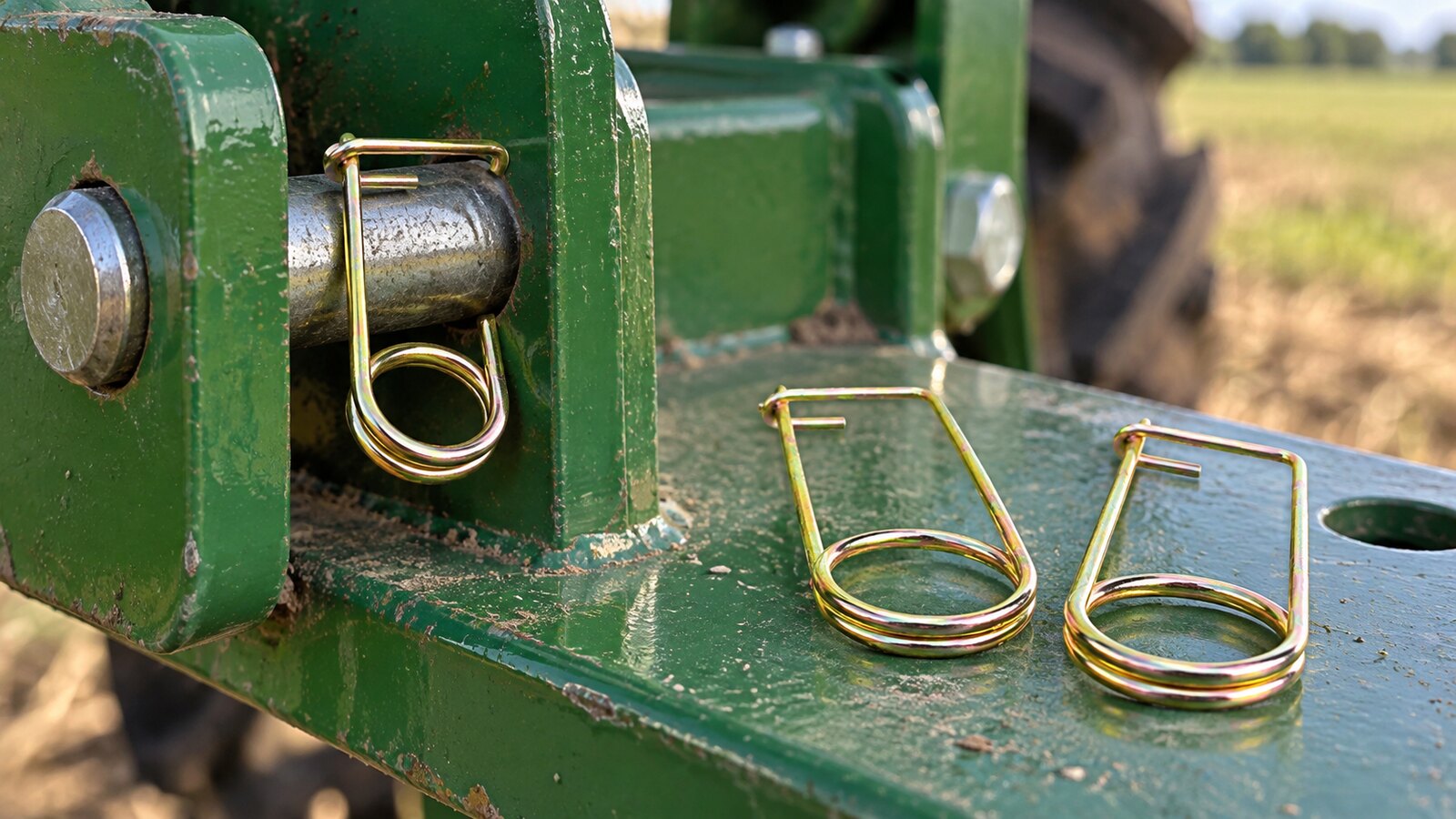
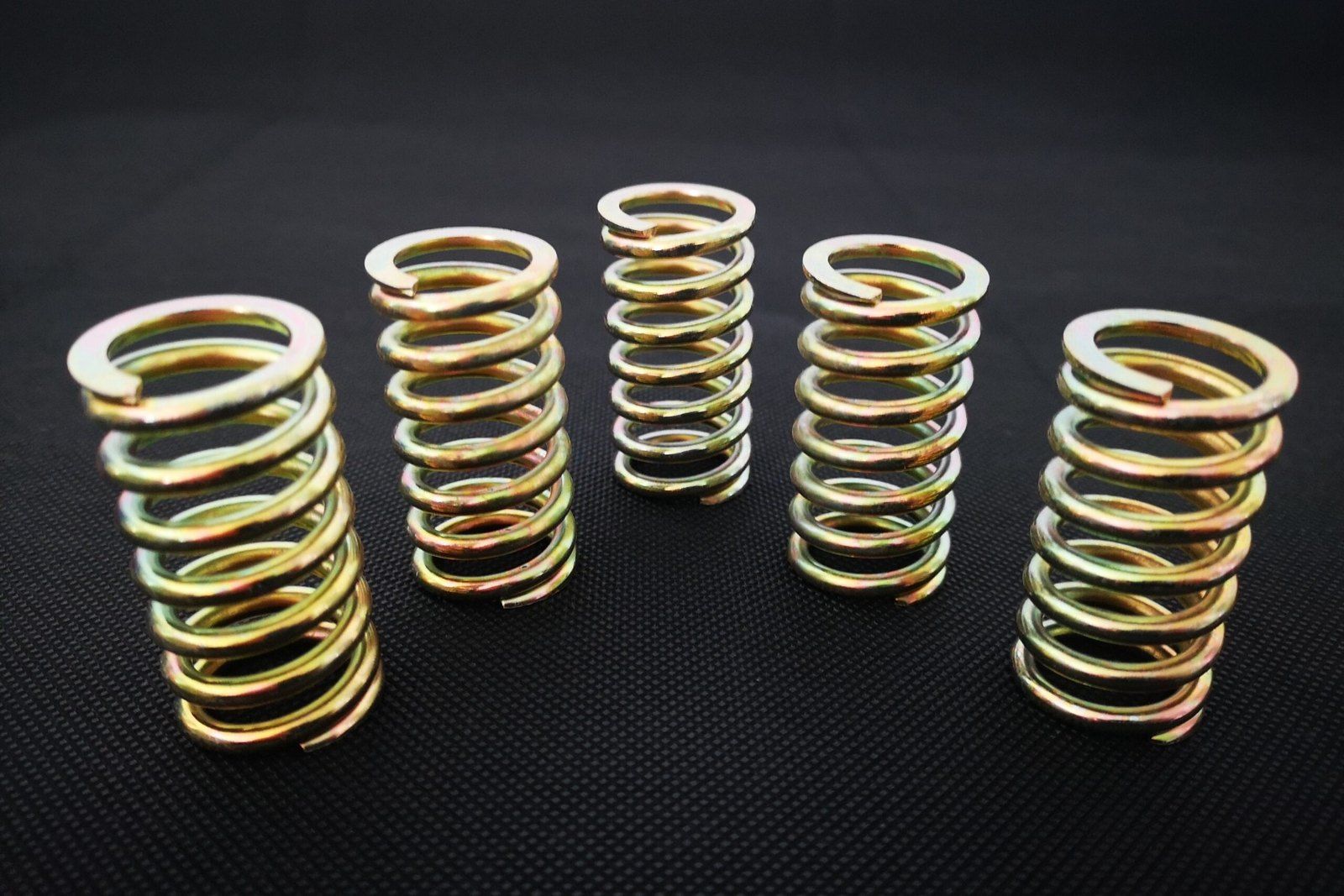
- Yellow (iridescent), the gold-coloured finish seen on many extension springs.
- Black, a dark zinc finish for visible parts.
The older yellow and olive finishes used hexavalent chromium (chromium(VI)). The EU End-of-Life Vehicles Directive prohibits chromium(VI) in vehicles put on the market after 1 July 2003, apart from listed exemptions [6], and the RoHS Directive limits it to 0.1% by weight in homogeneous materials of electrical and electronic equipment [7]. ASTM B633 added its Type V and VI finishes to allow non-chromate passivates [1]. For those markets, write “trivalent” or “chromium(VI)-free” passivate on the drawing.
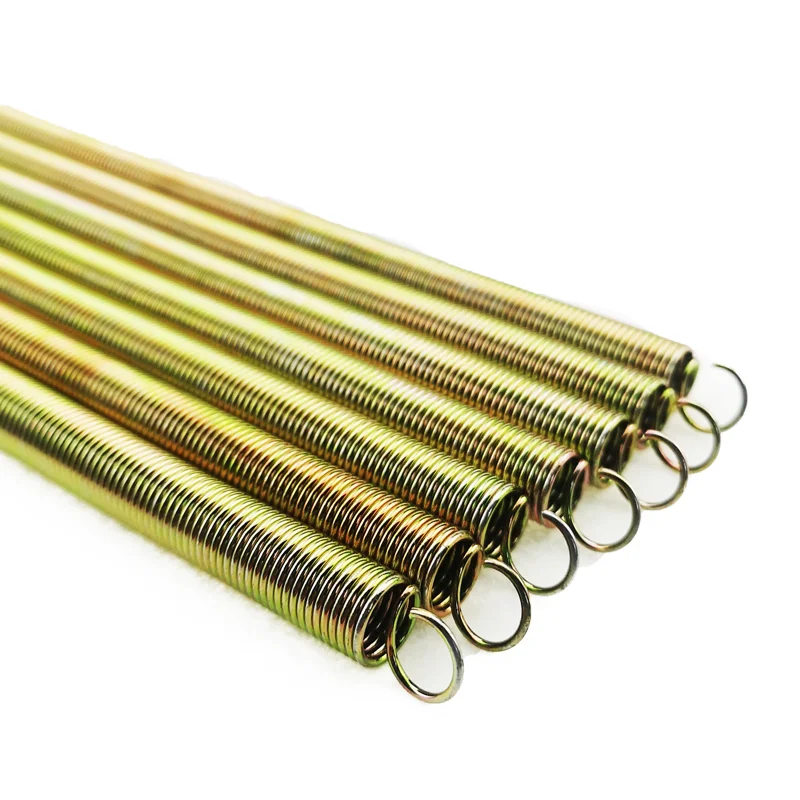
One limit to know for extension springs. The ISO zinc electroplating standard, ISO 2081 (2018 edition), excluded coatings applied to close-coiled springs from its scope [11]. Tightly wound extension spring bodies are hard to plate evenly between the coils and hard to rinse, so coverage there is usually poorer than on an open-coil compression spring. If an extension spring must survive outdoors, discuss whether zinc flake, a thicker coating or stainless wire suits it better.
Phosphate and black oxide coatings for springs
These are conversion coatings: the steel surface is chemically converted into a thin layer rather than coated with another metal.
Phosphate (zinc or manganese phosphate) leaves a grey to black, slightly crystalline surface. On its own it gives little protection. The US military specification for heavy phosphate coatings, MIL-DTL-16232, includes a class with a supplementary oil treatment [8], and phosphate is also the usual base under paint and powder coat because the crystals hold oil and help paint adhere. It is a common finish on our agricultural springs and spring tines in 50CrVA and 65Mn, which are usually phosphated and oiled or phosphated and then painted.
Black oxide is thinner still. The US specification, MIL-DTL-13924, states plainly that “only very limited corrosion protection, under mildly corrosive conditions, is obtained”, with or without a supplementary preservative [9]. Its advantage is that it adds almost nothing to the dimensions, so it suits small precision springs, circlips and clips that work in oil or indoors. On our parts it appears on spring steel circlips and some indoor springs.
Both processes run in chemical baths, and phosphating is acidic, so ASTM B849 includes it among the processes that can charge hydrogen [3]. The risk is lower than with electroplating but not zero on the hardest springs.
Painted and powder coated springs
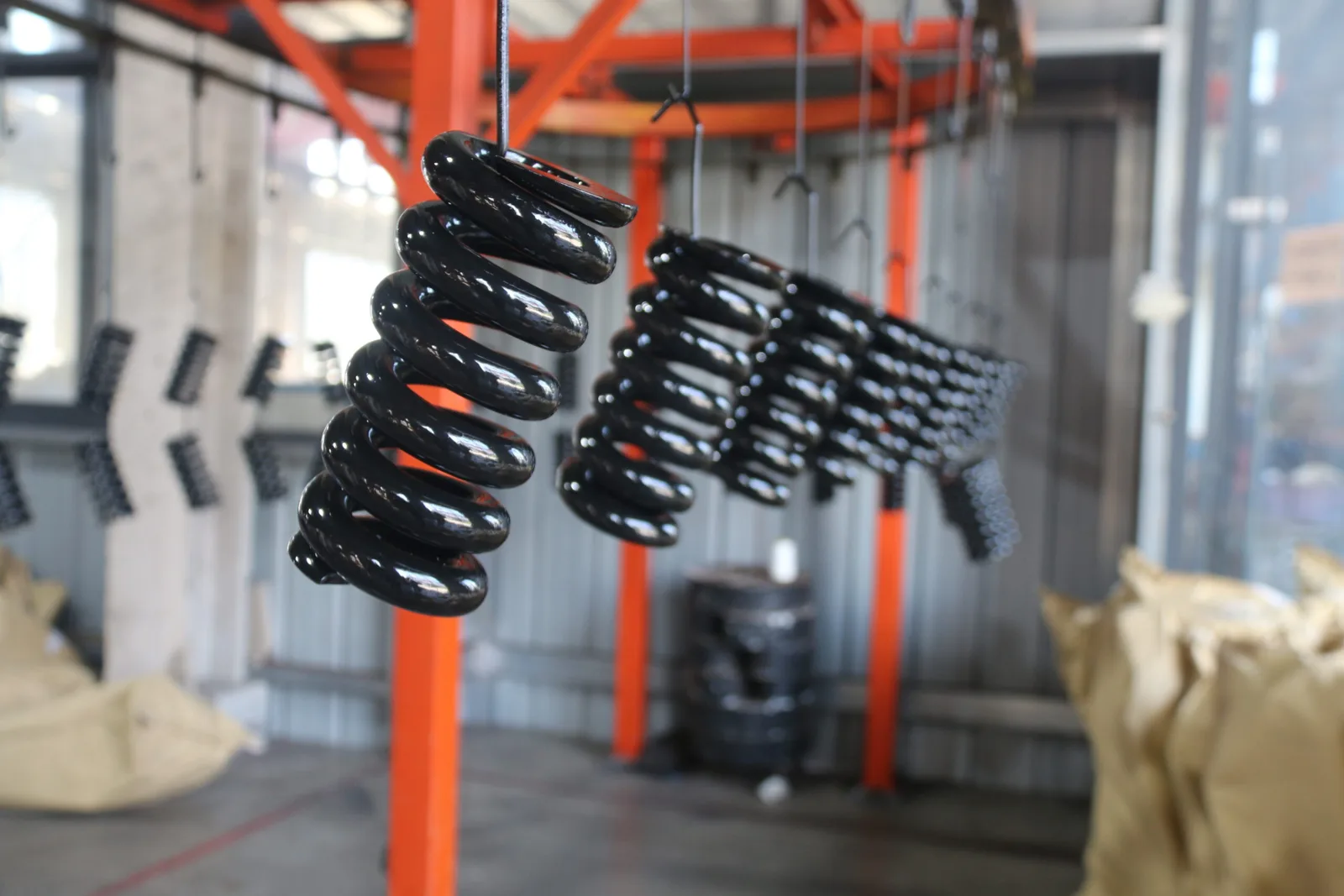
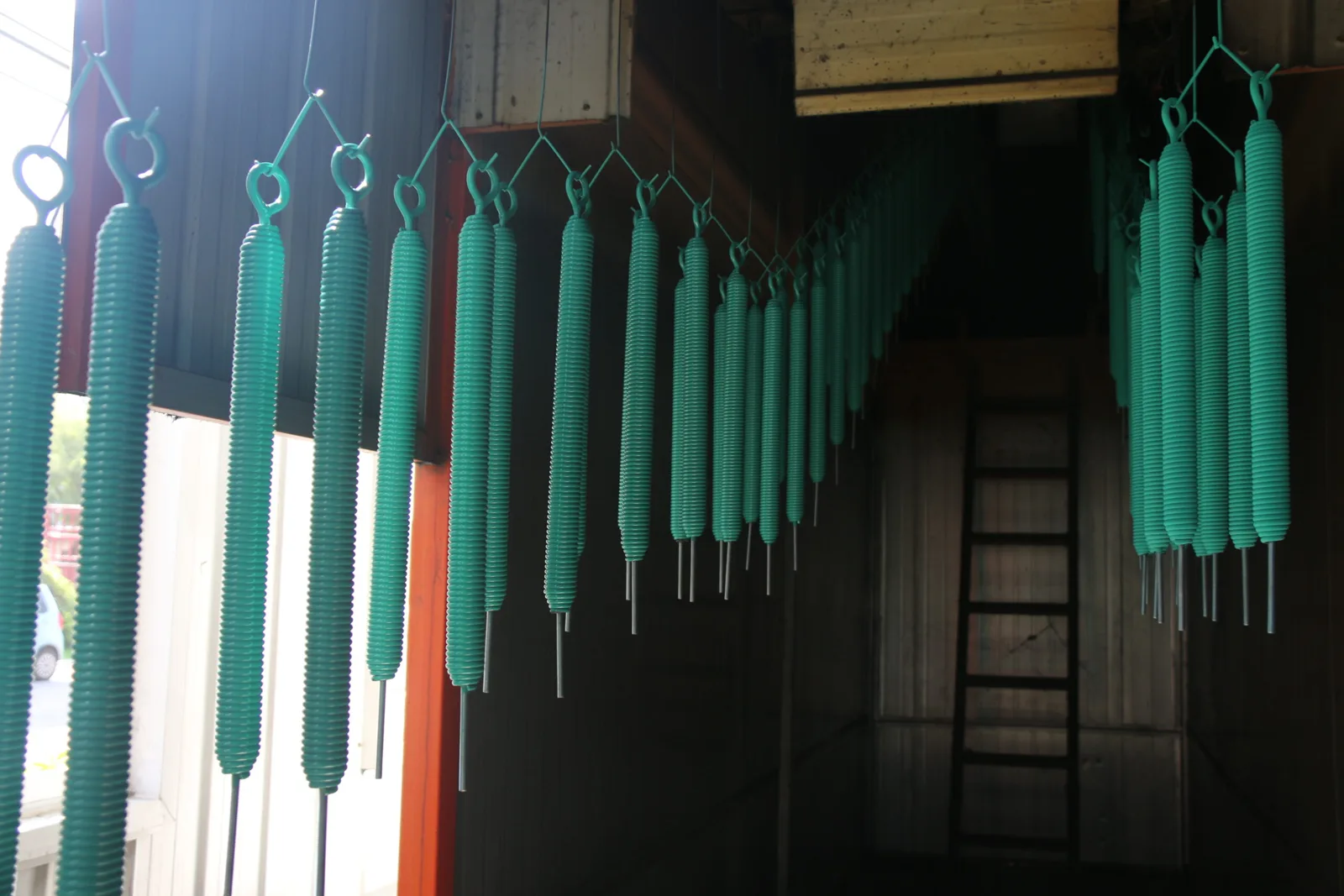
When a spring must be a particular colour or needs a thick barrier outdoors, it is painted or powder coated. Agricultural tines and springs are often matched to the colour of the machine, and large suspension and shock absorber springs are commonly powder coated. On our parts, powder coating appears on shock absorber springs, harvester tine springs and some extension springs, usually over a phosphate pretreatment.
Three points to check with a coated spring:
- Thickness. An organic film is many times thicker than plating. Even an 80 µm film, used here as an example, adds 0.16 mm to the outside diameter and, on a spring with 10 coils touching at solid, 1.6 mm to the solid height (Figure 3).
- Cure temperature. Powder coatings typically need a bake of 177 °C (350 °F) and higher to cure [12]. The cure has to stay below the temperature that would change the spring’s heat-treated properties, so the coating supplier and the spring maker need to agree the cure schedule.
- Coverage and flexing. Close-wound coils cannot be coated between the turns, and a thick film on a spring that is compressed nearly to solid can be crushed between coils. Open-coil designs and enough clearance at solid avoid both problems.
Zinc flake and nickel
Zinc flake coatings (often called by the trade name Dacromet, among others) are a mix of zinc and aluminium flakes in a binder, applied by dip-spin or spray and then cured. ISO 10683 covers these “non-electrolytically applied” systems, with or without hexavalent chromium, top coat or lubricant [5]. Because there is no electroplating step, they are a common choice for high-strength parts. Zinc flake is not automatically chromium(VI)-free, so for EU vehicles or RoHS products specify a chromium(VI)-free system. One caveat on strength: EN 13858, which covers zinc flake coatings on iron or steel parts, notes that where the aluminium flakes form a continuous bond, a high risk of hydrogen embrittlement may exist for steels with a tensile strength over 1,800 MPa [13]. We offer zinc flake on disc springs alongside black oxide, phosphate, zinc and nickel plating.
Nickel plating gives a bright, hard surface and is mainly chosen for appearance or wear. Several of our extension springs and steel spring clips are supplied zinc or nickel plated. Nickel is electroplated, so the same bake rules apply as for zinc.
Stainless springs: passivation and polishing
Stainless steel springs do not need a coating. They are usually passivated: a nitric or citric acid treatment that removes free iron and other contamination left on the surface by coiling and handling, so the chromium oxide film can form evenly. ASTM A967 covers these treatments and the tests that confirm them [14]. Passivation adds no thickness and does not change the colour. Polishing is used where appearance or cleanliness matters. Springs for medical devices usually add cleanliness and record requirements; see our medical springs page for what to send.
On our own production, stainless 304 exhaust pipe springs and chain tensioner springs are passivated, and stainless gym equipment springs are polished. If you want to compare stainless and coated carbon steel springs by cost and strength, our spring wire material guide covers the grades.
How a coating changes fit, clearance and solid height
A coating builds up on the wire surface, so every dimension that includes the wire diameter changes by twice the coating thickness:
- Outside diameter grows by 2t, which matters when the spring works in a bore.
- Inside diameter shrinks by 2t, which matters when it works over a shaft or pin.
- Solid height grows by 2t for every coil that touches at solid. Ten touching coils add 20t.
- Coil gap shrinks by 2t, so a close-wound extension spring or a spring designed very close to solid can lock up.
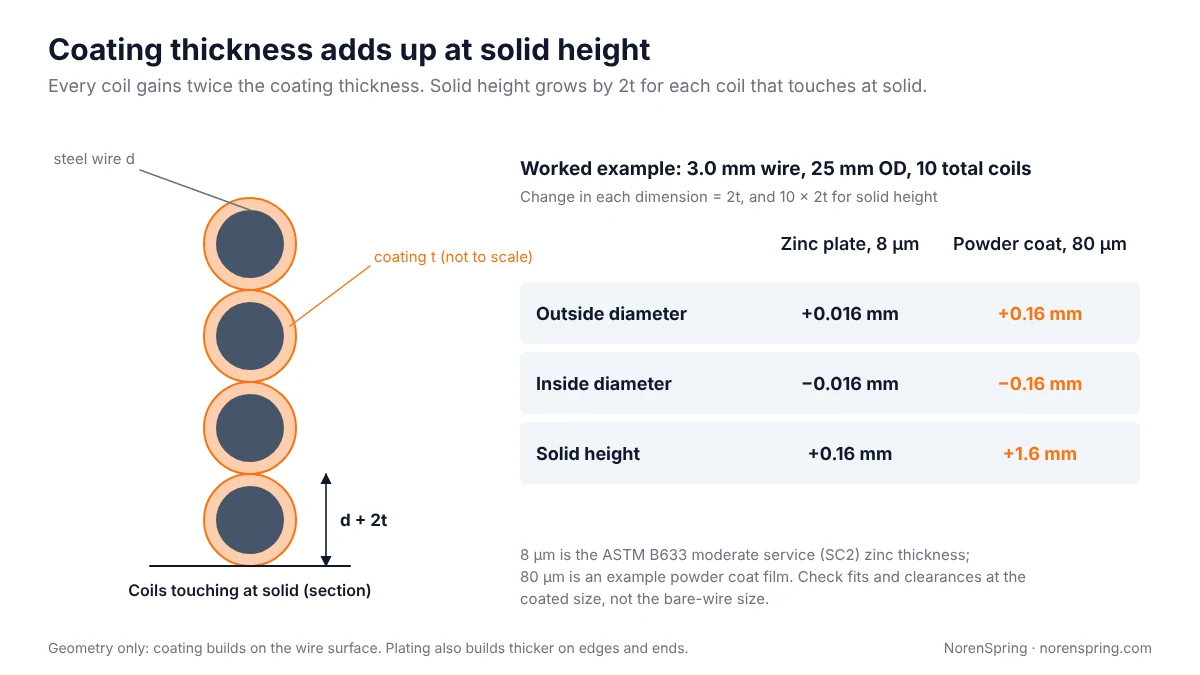
For plating these changes are small (8 µm of zinc adds only 0.16 mm to the solid height in Figure 3), but plating builds up more on edges and ends. For powder coat the changes are large enough to design for. In both cases, state whether your dimensions and tolerances apply before or after finishing. Our compression spring specification guide explains how solid height and clearance are set in the first place, and our wire forms design guide covers fits on clips and bent wire parts.
Salt spray hours: what they tell you and what they don’t
Salt spray testing (ASTM B117) exposes parts to a continuous salt fog and records the hours until white or red rust appears. It is useful for comparing coatings and for checking that a process is under control. It is not a lifetime prediction. ASTM B117 states that “prediction of performance in natural environments has seldom been correlated with salt spray results when used as stand alone data” [4].
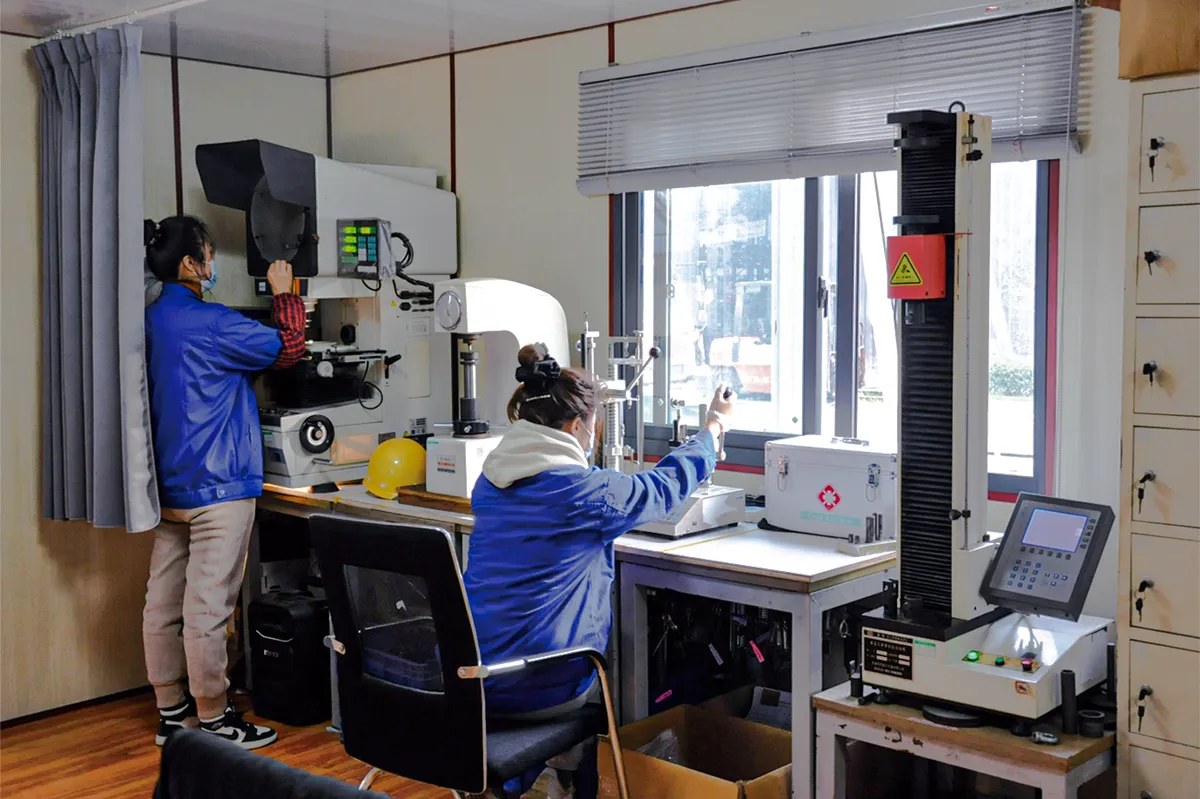
We have an in-house salt spray tester for checking plated and coated parts. If your application needs a salt spray requirement, put the standard, the hours and the acceptance criterion (for example, no red rust) on the drawing, and we will confirm at quotation whether the finish you specified can meet it.
Which finish suits which spring: examples from our production
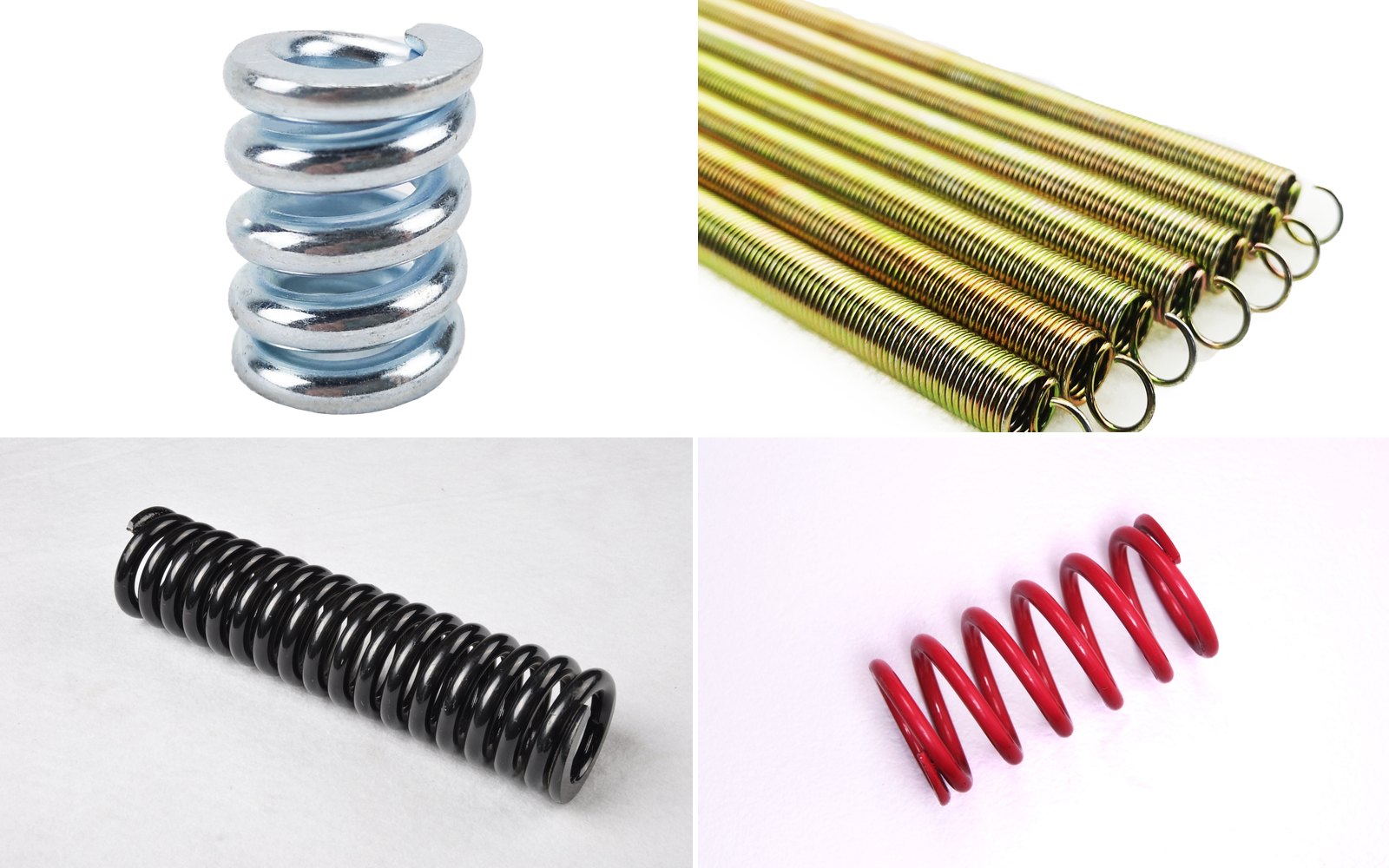
The table below summarises the finishes on 36 recent production parts, grouped by type [17]. Parts outside this sample, such as the coated extension springs shown above, also go through our coating line. It shows real combinations, not rules.
| Spring type and material | Finishes we supply |
|---|---|
| Agricultural tines and tine springs, 50CrVA or 65Mn | Phosphate, black oxide, paint, powder coat |
| Heavy compression springs for agricultural and suspension use, 50CrVA, 60Si2Mn or SWOSC-V | Phosphate, black oxide, powder coat |
| Extension and torsion springs, carbon spring wire (SWC, SWP, SWOSC-V, 65Mn) | Zinc plating, nickel plating |
| Pedal, return and stand springs, SWC or 65Mn | Zinc plating |
| Compressor valve springs, SWOSC-V or 50CrVA | Zinc plating, or left unplated (oil tempered wire) |
| Circlips and clips, 65Mn, SK5 or carbon steel | Black oxide, zinc or nickel plating |
| Stainless springs, 304 | Passivation, polishing |
How to write the finish on a drawing or RFQ
A clear finish callout avoids most disputes about colour, rust and fit. Include:
- The finish and colour, for example “zinc plated, clear trivalent passivate” or “phosphate and oil” or “powder coat, black, gloss”.
- The standard and thickness class, for example “ASTM B633, SC2” for zinc, or a minimum and maximum film thickness for powder coat.
- Restricted substances, for example “chromium(VI)-free” for EU vehicle or RoHS products.
- Hydrogen embrittlement control, for example the bake standard you require, or “bake per ASTM B850 / ISO 9588”, and any test such as ASTM F519.
- Whether dimensions apply before or after finishing, especially outside diameter, inside diameter and solid height.
- Any salt spray requirement, with standard, hours and acceptance criterion.
- Masking or uncoated areas, if a hook, leg or contact face must stay bare.
If you are not sure which finish to choose, describe the environment (indoor, outdoor, wet, salt, oil, temperature) and how the spring is assembled, and we will suggest one. You can send the details with the rest of your spring data; our guides to specifying compression, extension and torsion springs list the other information we need.
Frequently asked questions
What is the best coating for springs?
There is no single best coating. For outdoor carbon steel springs, zinc plating with a trivalent passivate and a hydrogen relief bake is the common default, zinc flake avoids electroplating altogether, and powder coating gives colour and a thick barrier on open-coil springs. Indoors or in oil, phosphate or black oxide with oil is often enough. Stainless springs are passivated.
Why do zinc plated springs need baking?
Because acid cleaning and electroplating put hydrogen into the steel, and high-strength spring steel can crack from it under load. Standards such as ASTM B850 / ISO 9588 call for a bake after plating to drive the hydrogen out. Our zinc plated springs are all baked after plating.
Does powder coating affect a spring’s size or strength?
It can. The film is thick enough to change outside diameter, inside diameter and solid height, the cure heats the spring, and the coating can be crushed if coils close on it. Coatings are best on open-coil springs that do not work close to solid, with dimensions checked at the coated size.
Are black oxide springs rust proof?
No. MIL-DTL-13924 says black oxide gives “only very limited corrosion protection, under mildly corrosive conditions”. It is normally oiled and used indoors or in oiled assemblies.
Do stainless steel springs need a coating?
Usually not. They are passivated to remove free iron from the surface and, if needed, polished.
Can you match a colour for coated springs?
Yes, painted and powder coated springs can be supplied in a range of colours; our agricultural tines, for example, are supplied in black, red, blue, yellow, green and white. Give the colour standard (such as a RAL number) on the drawing.
Summary: choose the finish with the spring, not after it
Choose the finish from where the spring works: phosphate or black oxide with oil indoors, zinc plating, zinc flake or powder coat outdoors, passivation for stainless. If a spring is electroplated, make sure it is baked, because spring steel is well above the 1,000 MPa level at which the standards call for treatments to reduce the risk of hydrogen embrittlement. Allow for the coating in every fit and in the solid height. Then put the finish, colour, thickness, restricted substances and bake requirement on the drawing. To get coated or plated compression springs, extension springs, torsion springs or wire forms quoted, send your drawing or requirements through the contact page.
About the authors
This guide was prepared by the NorenSpring engineering team, which designs and manufactures custom springs and wire forms in Xuzhou, China. Technical review by Feng Yulin, General Manager and senior structural engineer, who has 15 years of spring R&D experience and more than 30 national patents. NorenSpring holds IATF 16949, ISO 9001, ISO 13485, ISO 14001 and ISO 45001 certifications. More about NorenSpring. Figures and standards references were last checked on 12 October 2026.
Sources
The numbers in square brackets in the text refer to this list.
- ASTM International, ASTM B633-23, Standard Specification for Electrodeposited Coatings of Zinc on Iron and Steel. Source for the four thickness classes, the 1,700 MPa (46 HRC) limit, the hydrogen embrittlement treatments and the non-chromate Type V and VI finishes. Retrieved 2026-10-12.
- ASTM International, ASTM B850-98(2022), Standard Guide for Post-Coating Treatments of Steel for Reducing the Risk of Hydrogen Embrittlement, technically equivalent to ISO 9588. Source for the bake after plating and before conversion coating, and the note that baking does not guarantee freedom from hydrogen damage. Retrieved 2026-10-12.
- ASTM International, ASTM B849-02(2019), Standard Specification for Pre-Treatments of Iron or Steel for Reducing Risk of Hydrogen Embrittlement, coordinated with ISO 9587. Source for the 1,000 MPa level and the list of processes, including phosphating, that can cause hydrogen embrittlement. Retrieved 2026-10-12.
- ASTM International, ASTM B117-19, Standard Practice for Operating Salt Spray (Fog) Apparatus. Source for the statement on correlation with natural environments. Retrieved 2026-10-12.
- ISO 10683:2018, Fasteners — Non-electrolytically applied zinc flake coating systems, scope summary at Standards Norway. Source for the scope and the note on high-strength fasteners of 1,000 MPa and above. Retrieved 2026-10-12.
- European Union, Directive 2000/53/EC on end-of-life vehicles, Article 4(2)(a) and Annex II. Source for the chromium(VI) prohibition from 1 July 2003. Retrieved 2026-10-12.
- European Union, Directive 2011/65/EU (RoHS), Annex II. Source for the 0.1% chromium(VI) limit. Retrieved 2026-10-12.
- US Department of Defense, MIL-DTL-16232, Phosphate Coating, Heavy, Manganese or Zinc Base. Source for the manganese and zinc types and the supplementary oil treatment. Retrieved 2026-10-12.
- US Department of Defense, MIL-DTL-13924E, Coating, Oxide, Black, for Ferrous Metals. Source for the quotation on very limited corrosion protection. Retrieved 2026-10-12.
- ASTM International, ASTM F519-17a, Standard Test Method for Mechanical Hydrogen Embrittlement Evaluation of Plating/Coating Processes and Service Environments. Source for the mechanical test method for evaluating plating and coating processes. Retrieved 2026-10-12.
- ISO 2081:2018, Metallic and other inorganic coatings — Electroplated coatings of zinc with supplementary treatments on iron or steel, scope summary. Source for the exclusion of close-coiled springs; the standard has since been revised as ISO 2081:2025. Retrieved 2026-10-12.
- ChemQuest Group, Ultra-thin films: can powder coating accommodate the thickness tolerance we need?. Source for the typical cure temperature of 350 °F (177 °C) and higher. Retrieved 2026-10-12.
- CEN, EN 13858:2006, Non-electrolytically applied zinc flake coatings on iron or steel parts. Source for the note on steels over 1,800 MPa. Retrieved 2026-10-12.
- ASTM International, ASTM A967/A967M, Standard Specification for Chemical Passivation Treatments for Stainless Steel Parts. Source for the passivation treatments and the free-iron tests. Retrieved 2026-10-12.
- ArcelorMittal, 51CrV4 leaf spring steel data sheet. Source for the 1,350–1,650 MPa tensile range after quenching and tempering at 450 °C. Retrieved 2026-10-12.
- Gibbs Wire and Steel, music wire ASTM A228 tensile table. Source for the minimum tensile strengths of 0.030 in and 0.100 in music wire (converted to MPa). Retrieved 2026-10-12.
- NorenSpring production records: finishes on 36 recent production parts and on disc springs, and our post-plating bake practice, as confirmed by our production team in September and October 2026.