










In this article
- Key takeaways
- What is an R-clip?
- How does an R-clip hold a pin?
- How to size an R-clip: the DIN 11024 size chart
- Materials and finishes for R-clips
- R-clip vs cotter pin, linch (lynch) pin and lock pin
- Why R-clips fail
- What to put on an R-clip drawing or RFQ
- How we make R-clips
- Frequently asked questions
- About the authors
- Sources
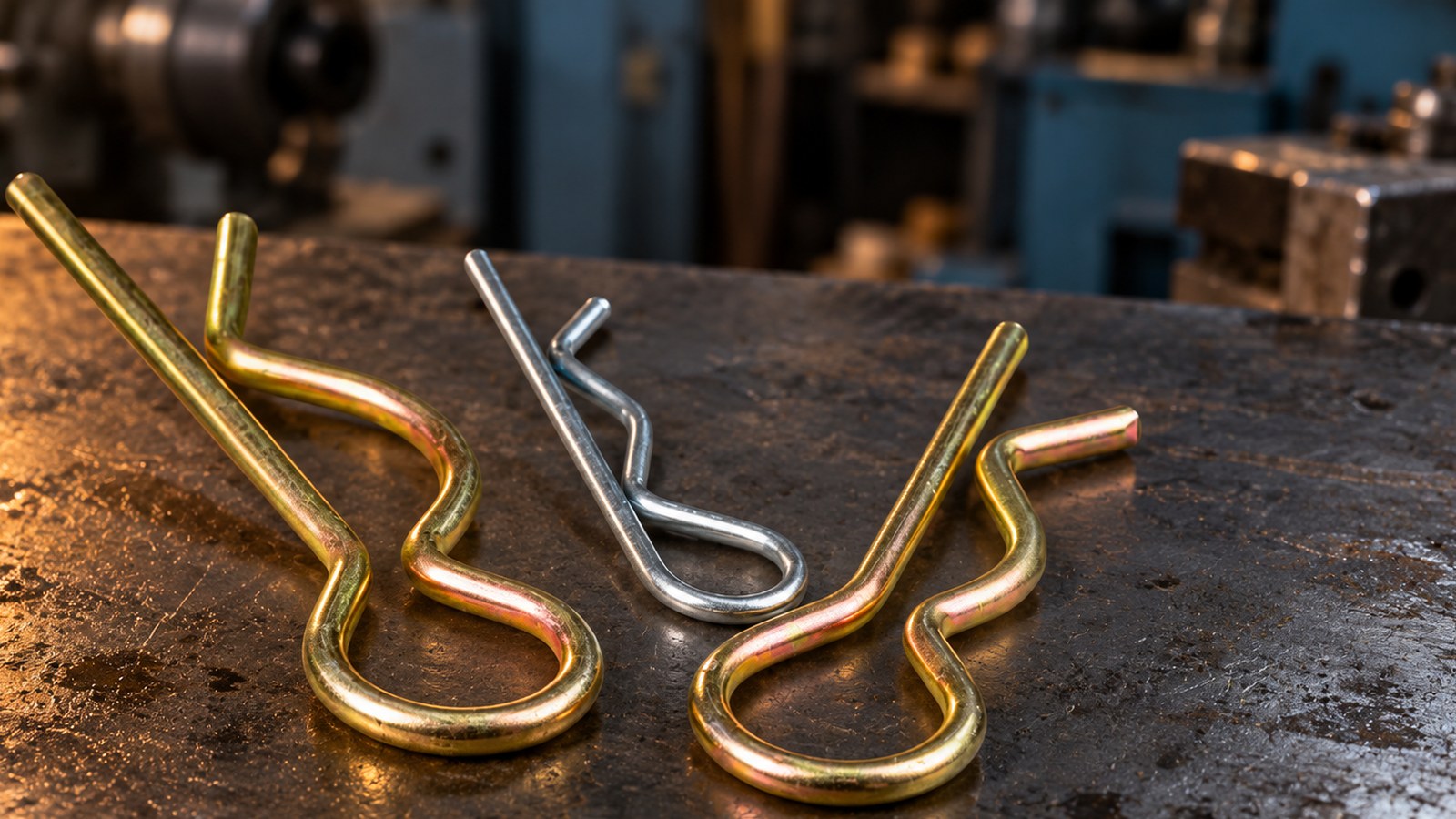
Cover image: an AI illustration based on a photograph of our own R-clips, placed in a new setting.
An R-clip, also called a hairpin cotter pin, R-pin or spring cotter, is a bent spring-steel wire clip that locks a pin in place. Its straight leg passes through a cross hole drilled near the end of the pin, and its curved leg springs over the outside of the pin and holds the clip there. You size it by two numbers: the pin diameter it must grip and the cross hole it must pass through.
The German standard DIN 11024 sets those numbers out in seven sizes. A size 4 clip, for example, is made from 3.6 mm wire, passes through a 4 mm hole and is meant for pins over 14 mm up to 20 mm in diameter [1][3]. Get either number wrong and the clip will be loose, hard to fit or easy to lose.
This guide explains how an R-clip holds, how to choose the size for a pin (with tractor hitch pins as worked examples), which wire and finish to use, how R-clips compare with other pin retainers, and what to put on a drawing or RFQ. For wire forms in general, see our wire forms design guide.
Key takeaways
- Two numbers size an R-clip. The cross hole diameter (the nominal size) and the pin diameter range it grips. A clip used outside its pin range is either loose or overstretched.
- DIN 11024 is the common metric reference. It covers sizes 2.5 to 8, for pins from 9 mm to 56 mm [1].
- The wire is smaller than the hole. In DIN 11024 the wire is 0.25 to 1 mm smaller than the nominal hole size, so the clip slides in without forcing [1].
- Spring steel needs a finish. Zinc plating is the usual choice, and plated high-strength steel should be baked against hydrogen embrittlement [5]. Stainless steel suits wet and washdown service.
- Specify geometry, not just a name. “R-clip 4 mm” is not enough. Give the wire diameter, pin range, leg lengths, material, finish and the documents you need.
What is an R-clip?
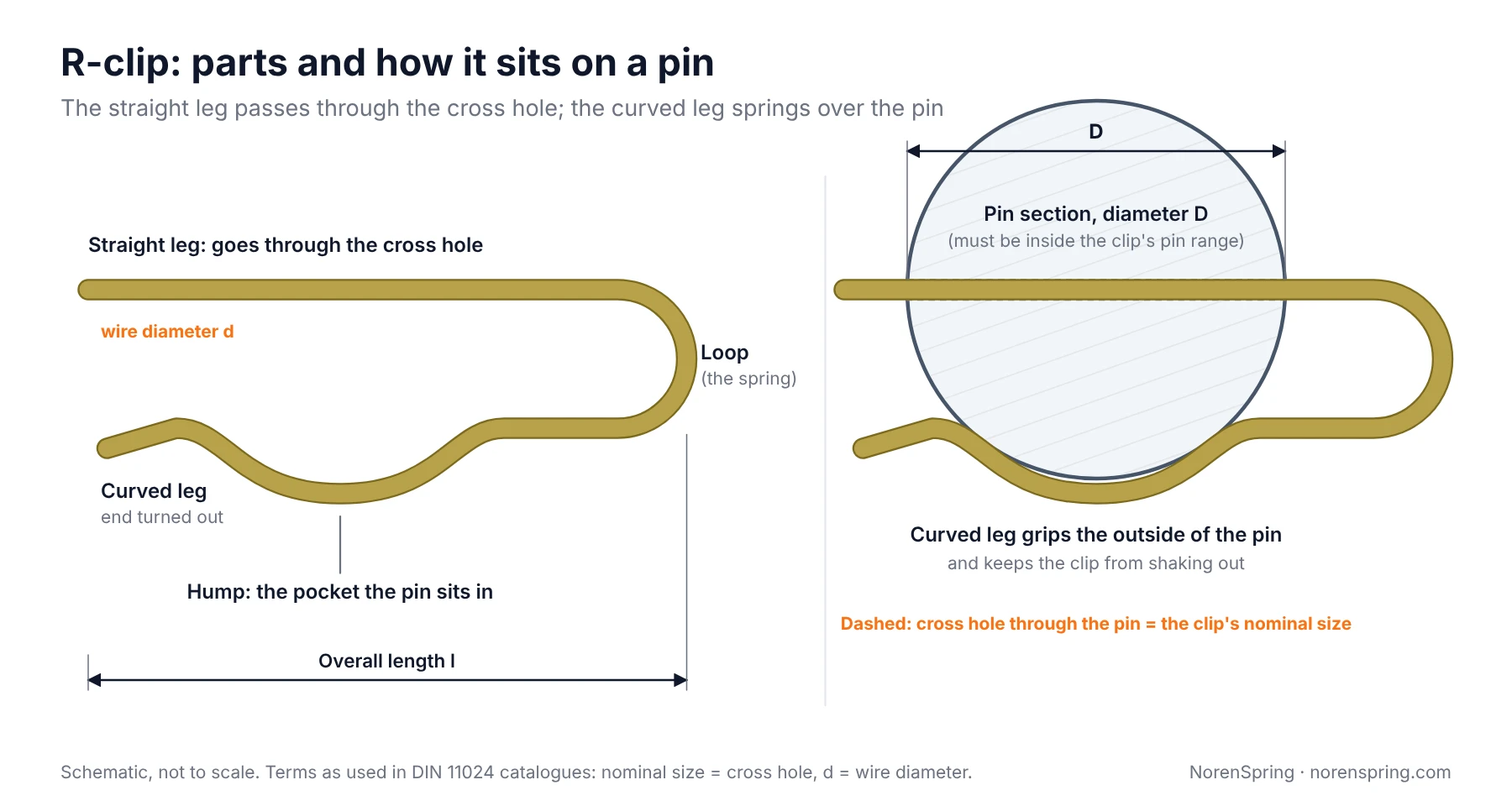
An R-clip is a wire form with four features. Looking at Figure 1:
- The straight leg goes through the cross hole in the pin.
- The curved leg lies along the outside of the pin. It is bent with a wave or hump that sits over the pin and springs back once the clip is pushed home.
- The loop joins the two legs. It is the spring that makes the curved leg grip, and it gives you something to hold when fitting or removing the clip.
- The ends. The straight leg end is usually chamfered or rounded so it enters the hole easily. The curved leg end is turned out slightly so it rides up over the pin.
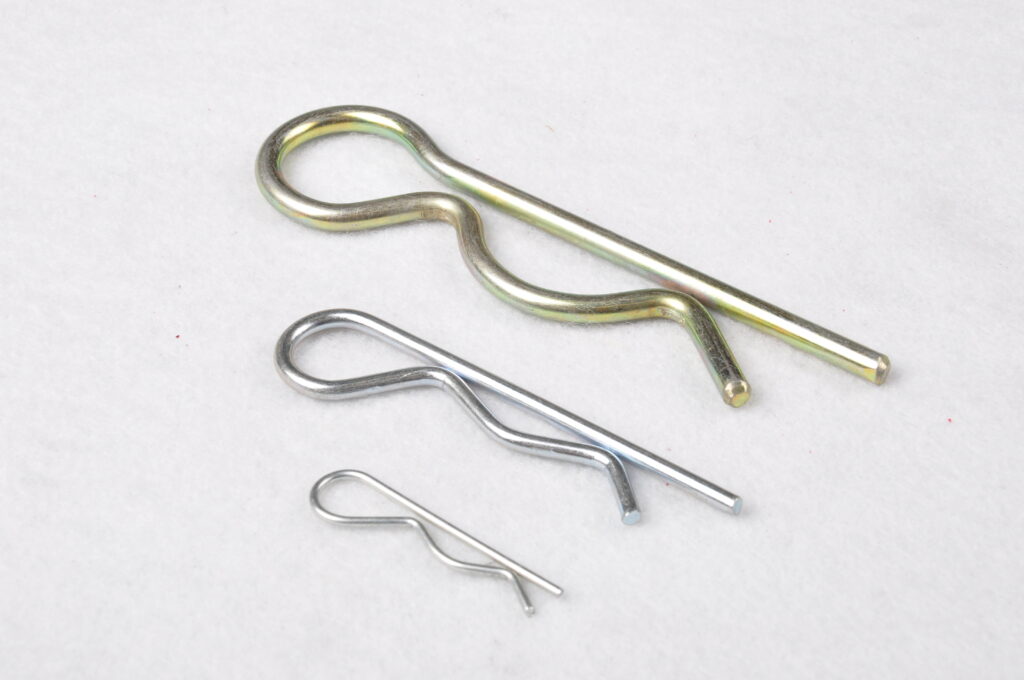
The names vary by industry and region. Farm and trailer suppliers say hitch pin clip, R-pin or R-pin clip. Hardware catalogues say hairpin cotter pin, hairpin clip or hairpin clip retainer. European standards and catalogues use spring cotter (German: Federstecker). Fastener catalogues list DIN 11024 clips as the “Beta” type [1], and in the UK they are often called beta pins. Catalogues offer both single-loop and double-loop versions [3]. They all describe the same part.
How does an R-clip hold a pin?
An R-clip holds by spring force and by shape. Once fitted, the straight leg in the cross hole stops the pin sliding back out of its bore. The curved leg wraps the pin with a preload from the loop, so the clip itself cannot shake out of the hole. To remove it, you pull on the loop until the curved leg rides back over the pin.
That gives R-clips their main advantage: they are quick to fit and remove by hand, with no tools, and they can be reused. Implement pins, trailer hitch pins and clevis pins that come out every day or every week are typical uses.
It also sets their limit. An R-clip does not carry the main load. The pin carries the shear, and the clip only keeps the pin from walking out. If a pin is pushed hard along its axis, by an implement that twists or a link that rubs against the clip, the load goes into the thin wire. In that case use a stronger retainer, as explained below.
How to size an R-clip: the DIN 11024 size chart
Choose the size in two steps. First find the pin diameter in the pin range column. Then check that the cross hole in your pin matches the nominal size. The table below gives the DIN 11024 dimensions as published in fastener references [1][2]. The wire diameter column shows what the clip is made from. If you need to claim compliance, check the current licensed edition of the standard.
| Nominal size, cross hole (mm) | For pin diameter (mm) | Pin diameter, inch (converted) | Wire diameter (mm) | Wire diameter, inch (converted) | Overall length (mm) |
|---|---|---|---|---|---|
| 2.5 | 9 to 11.2 | 0.35 to 0.44 in | 2.25 | 0.089 in | 42 |
| 3.2 | over 11.2 to 14 | over 0.44 to 0.55 in | 2.8 | 0.110 in | 48 |
| 4 | over 14 to 20 | over 0.55 to 0.79 in | 3.6 | 0.142 in | 64 |
| 5 | over 20 to 26 | over 0.79 to 1.02 in | 4.5 | 0.177 in | 80 |
| 6.3 | over 26 to 34 | over 1.02 to 1.34 in | 5.6 | 0.220 in | 97 |
| 7 | over 34 to 45 | over 1.34 to 1.77 in | 6.3 | 0.248 in | 125 |
| 8 | over 45 to 56 | over 1.77 to 2.20 in | 7 | 0.276 in | 150 |
Two details are easy to miss. First, the nominal size is the hole, not the wire. A distributor listing of a size 4 DIN 11024 clip gives a 4 mm hole diameter and a 3.6 mm nominal (wire) diameter, for a 14 to 20 mm grip range [3]. Ordering “4 mm R-clips” can therefore bring either size 4 or a clip made from 4 mm wire, depending on the seller. Second, catalogues also list single-loop clips “commonly used in the market” with different and overlapping ranges, for example a 4.5 size for pins over 16 to 20 mm [1]. These are not in the standard. If you mix suppliers, compare the full dimensions, not just the size number.
The inch columns are our conversions from the metric table, rounded, to help US readers compare; they are not part of the standard. Inch-sized clips are sold the same way, by wire diameter and pin diameter range. Ranges differ between catalogues, so state the range you need on the drawing.
Worked example: tractor three-point hitch pins
Three-point hitch pins are a common place to find R-clips, and their diameters are fixed by hitch category, which ISO 730 defines [6]. A European parts supplier lists these pin diameters [4]. Matching them to the DIN 11024 ranges gives the clip size:
| Hitch category | Top link pin | DIN 11024 size | Lower link pin | DIN 11024 size |
|---|---|---|---|---|
| 1 | 19 mm | 4 (14 to 20 mm) | 22.4 mm | 5 (20 to 26 mm) |
| 2 | 25.5 mm | 5 (20 to 26 mm) | 28.7 mm | 6.3 (26 to 34 mm) |
| 3 | 31.75 mm | 6.3 (26 to 34 mm) | 37.4 mm | 7 (34 to 45 mm) |
Lower link pins are often secured with linch pins instead; the sizes show which R-clip fits if one is used.
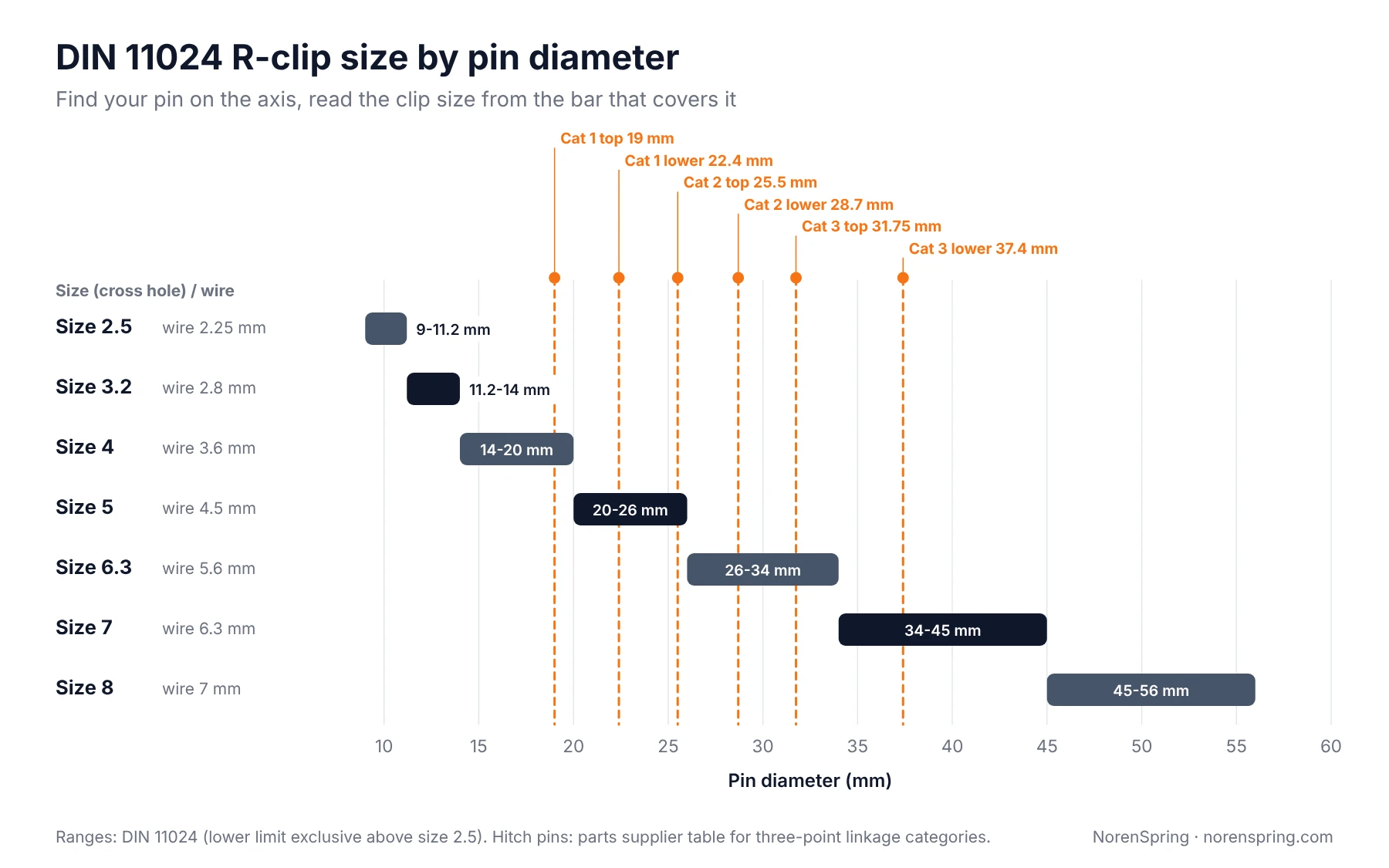
Two of these pins, and a common inch pin, sit close to the top of their range: the Category 1 top link pin (19 mm, size 4 goes to 20 mm), the Category 2 top link pin (25.5 mm, size 5 goes to 26 mm) and, for inch equipment, a 1-inch pin (25.4 mm, also size 5). Only about 0.5 to 1 mm is left before the clip is overstretched. Trial-fit the clip on a real pin, including any paint or wear, before you order in volume. The same check applies to any pin near a range limit.
Three more rules help when you design the pin rather than just buy a clip:
- Drill the cross hole to the nominal size. A hole much larger than the wire lets the clip rattle and wear. A hole close to the wire size makes fitting hard after painting or plating.
- Leave enough pin beyond the hole. The curved leg needs a length of plain pin to grip. If the hole is too close to the end, the hump sits off the end of the pin and the clip falls out.
- Keep the clip clear of moving parts. A link or yoke that rubs on the clip will bend the curved leg open over time.
Materials and finishes for R-clips
Most R-clips are made from high-carbon spring steel wire, which gives the curved leg enough spring to keep gripping after many fittings. Catalogues list DIN 11024 clips in zinc-plated steel and in A2 and A4 stainless steel [2][3]. The choice comes down to the environment:
| Service | Typical material and finish | Notes |
|---|---|---|
| Dry or indoor equipment | Spring steel, zinc plated (clear or yellow passivation) | The most common choice |
| Outdoor farm and trailer use | Spring steel, zinc plated; or a thicker coating where specified | Plating wears where the leg slides on the pin |
| Wet, salty or washdown service | Stainless steel, A2 (304) or A4 (316) | Lower spring force than hard spring steel at the same size; see our stainless steel springs guide |
| High visibility or colour coding | Spring steel, powder coated or painted | A thick coating can change the hole fit |
Zinc plating on spring steel carries one hidden risk: hydrogen embrittlement. Hydrogen absorbed during cleaning and plating can cause a clip to crack days after it is fitted. ASTM B850 is a guide to baking treatments after plating that reduce the risk [5]. We bake every zinc-plated spring part after plating to relieve hydrogen, following the applicable national standard. Ask any supplier to confirm how they handle it. Our spring finishes guide compares the coatings in more detail, and the spring wire material guide covers the wire grades.
R-clip vs cotter pin, linch (lynch) pin and lock pin
R-clips are one of several pin retainers. Each suits a different job:
| Retainer | How it holds | Removal | Best for |
|---|---|---|---|
| R-clip (hairpin cotter) | Straight leg in cross hole, curved leg grips pin | By hand, reusable | Pins removed often: implements, trailers, clevis pins |
| Split cotter pin (inch sizes in ASME B18.8.1 [7]) | Two legs pushed through a hole and bent apart | Pliers; usually replaced, not reused | Permanent or semi-permanent joints, castle nuts |
| Linch (lynch) pin | Pin with a sprung bow or ring that snaps over the pin end | By hand, reusable | Heavier axial loads, lower link and implement pins where the clip would be pushed out |
| Wire lock pin (safety pin with ring) | Pin through hole, wire bail snaps over the pin end | By hand, reusable, often kept on a lanyard | Pins that must not be lost and are fitted by feel |
| Circlip or retaining ring | Sits in a machined groove | Pliers or installation tool | Shafts and bores with a groove, not cross-drilled pins |
If an R-clip keeps bending open or walking out, the joint usually needs a linch pin or a lock pin, not a bigger R-clip. Our guide to wire spring clips covers how to judge retention and plan approval tests for clips in general.
Why R-clips fail
Most R-clip problems trace back to size, fit or environment. The common causes are:
- Wrong size for the pin. A clip for a larger pin will not grip a small one and shakes out. A clip for a smaller pin is stretched open, takes a set and then loses its grip.
- Curved leg bent open. Prying the clip off with a screwdriver, or a link rubbing on it, opens the leg. Once the hump no longer closes on the pin, the clip is scrap.
- Corrosion. Bare or thinly plated clips rust at the loop and on the leg where the plating wears. Rust reduces the wire section and can lead to a break.
- Delayed cracking after plating. High-strength plated clips that were not baked can crack without warning, as noted above.
- Fatigue from vibration. On a pin that moves in its hole, the straight leg can be worked back and forth until it cracks at the loop.
For the same failures in coil springs, see our article on why springs fail.
What to put on an R-clip drawing or RFQ
A short name like “R-clip 4 mm” leaves too much open. This table lists what a manufacturer needs to make the clip right the first time:
| Item | Example |
|---|---|
| Standard or drawing | DIN 11024 size 4; or your own drawing number and revision |
| Wire diameter | 3.6 mm |
| Pin diameter range | Over 14 mm to 20 mm; state the actual pin diameter if known |
| Cross hole diameter | 4.0 mm |
| Overall length and leg lengths | 64 mm overall; give the curved leg length if you need a specific grip |
| Loop | Single or double loop; lanyard hole if needed |
| Material | High-carbon spring steel (state the grade if specified), or stainless 304 / 316 |
| Finish | Zinc plated, clear or yellow passivation, baked for hydrogen relief; or plain stainless |
| Critical checks | Opening (gap) at the hump, fit on a gauge pin, removal force if specified |
| Documents and marking | Material certificate, inspection report, carton labels with part and batch number |
| Annual quantity and release pattern | For example, 200,000 pieces per year in monthly releases (example) |
The opening at the hump and the fit on the pin are the dimensions that decide whether the clip works. Give them a tolerance and agree a gauge pin for inspection. Our wire forms design guide shows an example R-clip drawing with the datum and the two critical sizes.
How we make R-clips
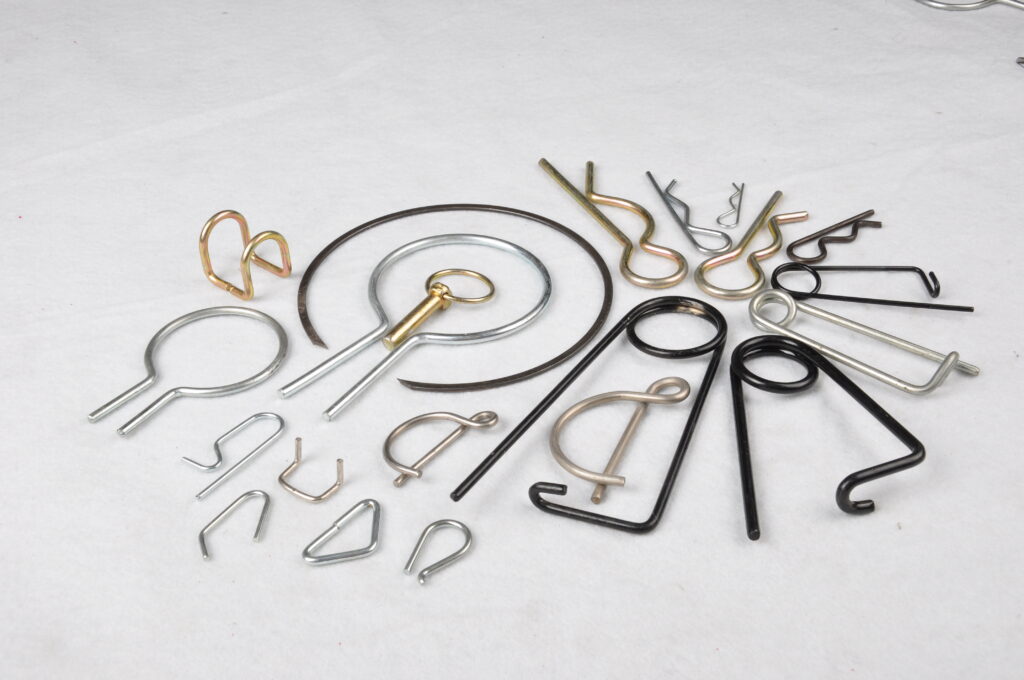
R-clips are part of our custom wire forms range, made on CNC wire forming machines to customer drawings or samples. In one example project, a buyer in Thailand needed white-zinc steel R-pin clips for agricultural machinery. Clips from their previous supplier varied in size and some did not fit during assembly. We tuned the forming parameters to control the opening size and tightened control of wire diameter and zinc plating quality. The clips are now in stable batch production, and the full case is on our wire forms case study page.
We confirm manufacturability and the wire grade before quoting, and agree the documents for each project, such as material certificates, inspection reports and dimensional records. R-clips are usually bought in volume as a running part, so we plan wire, forming, finishing and packing for repeat orders. Our agricultural spring solutions page lists the other farm machinery springs and wire forms we make, and our guide to cultivator and harrow springs covers the tines and trip springs that often sit next to these pins.
Frequently asked questions
What is the difference between an R-clip and a hairpin cotter pin?
There is no difference. R-clip, R-pin, hairpin cotter pin, hairpin clip, hitch pin clip and spring cotter are all names for the same bent-wire retainer. The name changes with the industry and region.
How do I measure an R-clip?
Measure the wire diameter with a micrometer or caliper, then the overall length and the length of each leg. Most important, note the diameter of the pin it fits and the cross hole it passes through. With those two numbers you can match it to a DIN 11024 size or a catalogue range. Our guide on how to measure a spring covers the tools and technique.
What size R-clip do I need for a 1-inch pin?
A 1-inch pin is 25.4 mm. In DIN 11024 that falls in size 5, which covers pins over 20 mm up to 26 mm (about 0.79 to 1.02 in) and uses 4.5 mm wire in a 5 mm cross hole [1]. That leaves only about 0.6 mm before the top of the range, so trial-fit a clip on the real pin. Check that your pin’s cross hole is about 5 mm. If it is drilled for an inch clip, compare the supplier’s range for that clip instead.
Are stainless steel R-clips as strong as spring steel ones?
Not quite. Stainless spring wire is generally less strong than high-carbon spring steel of the same size, so a stainless clip grips with less force. It is the better choice where corrosion is the main risk, such as marine trailers and washdown equipment. In dry service, zinc-plated spring steel is usually enough.
Can an R-clip be reused?
Yes. R-clips are designed to be fitted and removed by hand many times. Replace a clip when the curved leg no longer closes on the pin, the plating has worn through, or the wire shows rust or cracks at the loop.
About the authors
This guide was prepared by the NorenSpring engineering team, which designs and manufactures custom compression, extension and torsion springs and wire forms in Xuzhou, China. Technical review by Feng Yulin, General Manager and senior structural engineer, who has 15 years of spring R&D experience and more than 30 national patents. NorenSpring holds IATF 16949, ISO 9001, ISO 13485, ISO 14001 and ISO 45001 certifications. The photos of our R-clips and wire forms are of our own products; the cover is an AI illustration based on our own product photo. Sources were last checked on October 22, 2026.
Need R-clips made to your pin size and finish? Send us your drawing or a physical sample with the pin diameter, cross hole, finish and annual quantity. Our engineers give feedback within 24 hours and confirm the design with the quotation.
Sources
The numbers in square brackets in the text refer to this list.
- fasten.it, DIN 11024 standard dimensions for cotter pins, Beta type (DIN 11024 table for sizes 2.5 to 8: pin diameter range, wire diameter, ring diameter and overall length; plus a separate table of single-loop clips “commonly used in the market”). Retrieved 2026-10-22.
- Aspen Fasteners, Metric DIN 11024 Spring Cotter Pins / R Clips technical specification (PDF): the same DIN 11024 dimensions; stock clips in A4 stainless steel. Retrieved 2026-10-22.
- Würth, spring cotter pin DIN 11024 product listings (size 4 in A2 stainless steel: 4 mm hole diameter, 3.6 mm nominal diameter, 14 to 20 mm grip range; zinc-plated steel version with double loop). Retrieved 2026-10-22.
- Ersatzteilwelt, three-point linkage attachment table (top link and lower link pin diameters for categories 0 to 3). Retrieved 2026-10-22.
- ASTM International, ASTM B850, Standard Guide for Post-Coating Treatments of Steel for Reducing the Risk of Hydrogen Embrittlement. Retrieved 2026-10-22.
- ISO, ISO 730:2009, Agricultural wheeled tractors, Rear-mounted three-point linkage, Categories 1N, 1, 2N, 2, 3N, 3, 4N and 4 (current, confirmed 2023; amended 2014). Defines the linkage categories; pin diameters in the text are from source 4. Retrieved 2026-10-22.
- ASME, B18.8.1, Clevis Pins and Cotter Pins (Inch Series) (2014 edition, reaffirmed 2025; cotter pins 1/32 to 3/4 inch). Retrieved 2026-10-22.



