










In this article
- Key takeaways
- Spring natural frequency: the mass on the spring and the spring itself
- How to calculate spring surge frequency
- How much margin do you need?
- Spring natural frequency and surge calculator
- How to raise a spring’s surge frequency
- Damping: why springs ring, and why it cuts both ways
- Vibrating screen springs: isolation and surge together
- Valve springs and other cam-driven springs
- What to send with an RFQ for a dynamic spring
- Frequently asked questions
- About the authors
- Sources
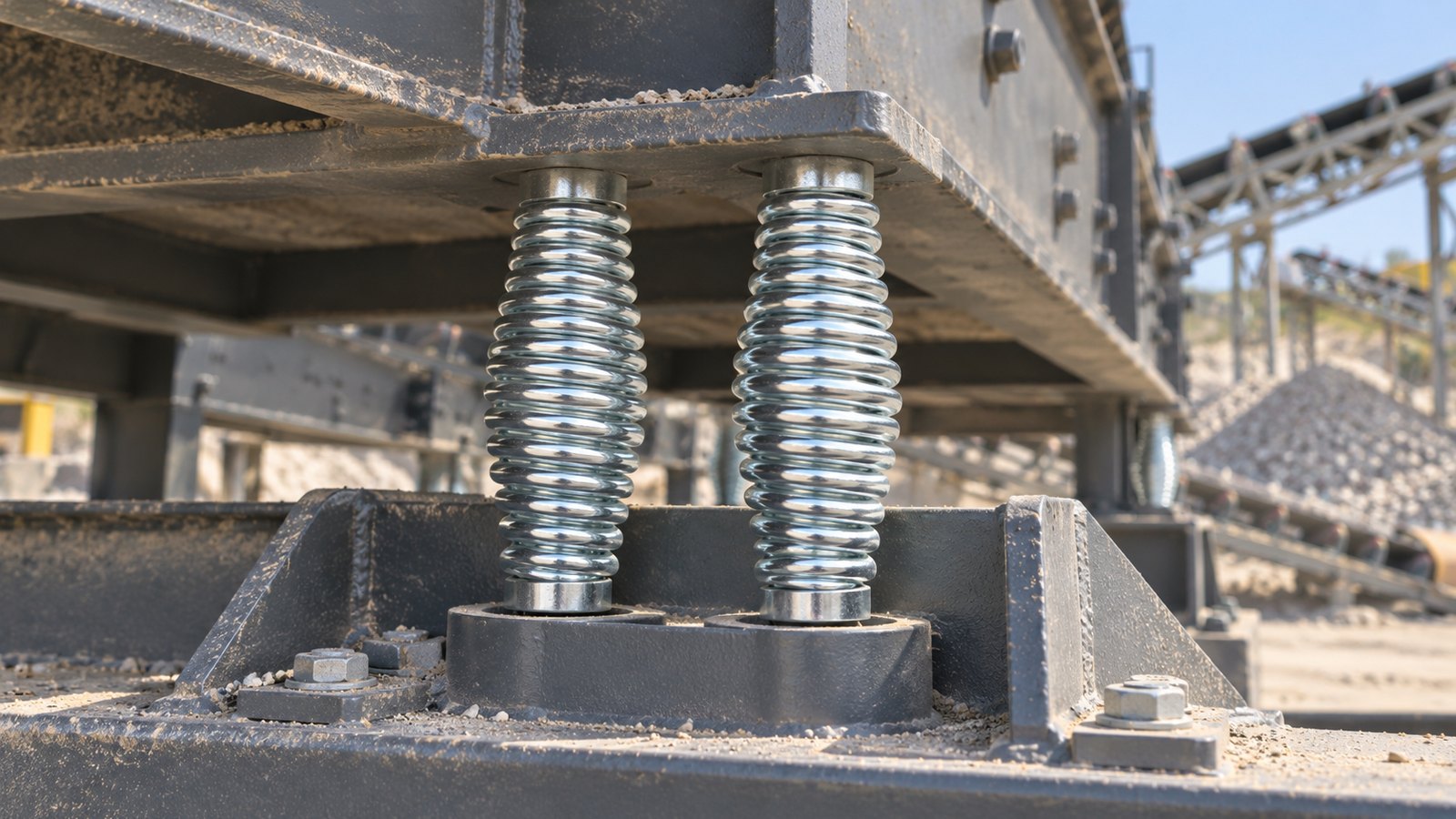
Cover image: an AI illustration based on a photograph of our vibrator springs, shown installed in a new setting.
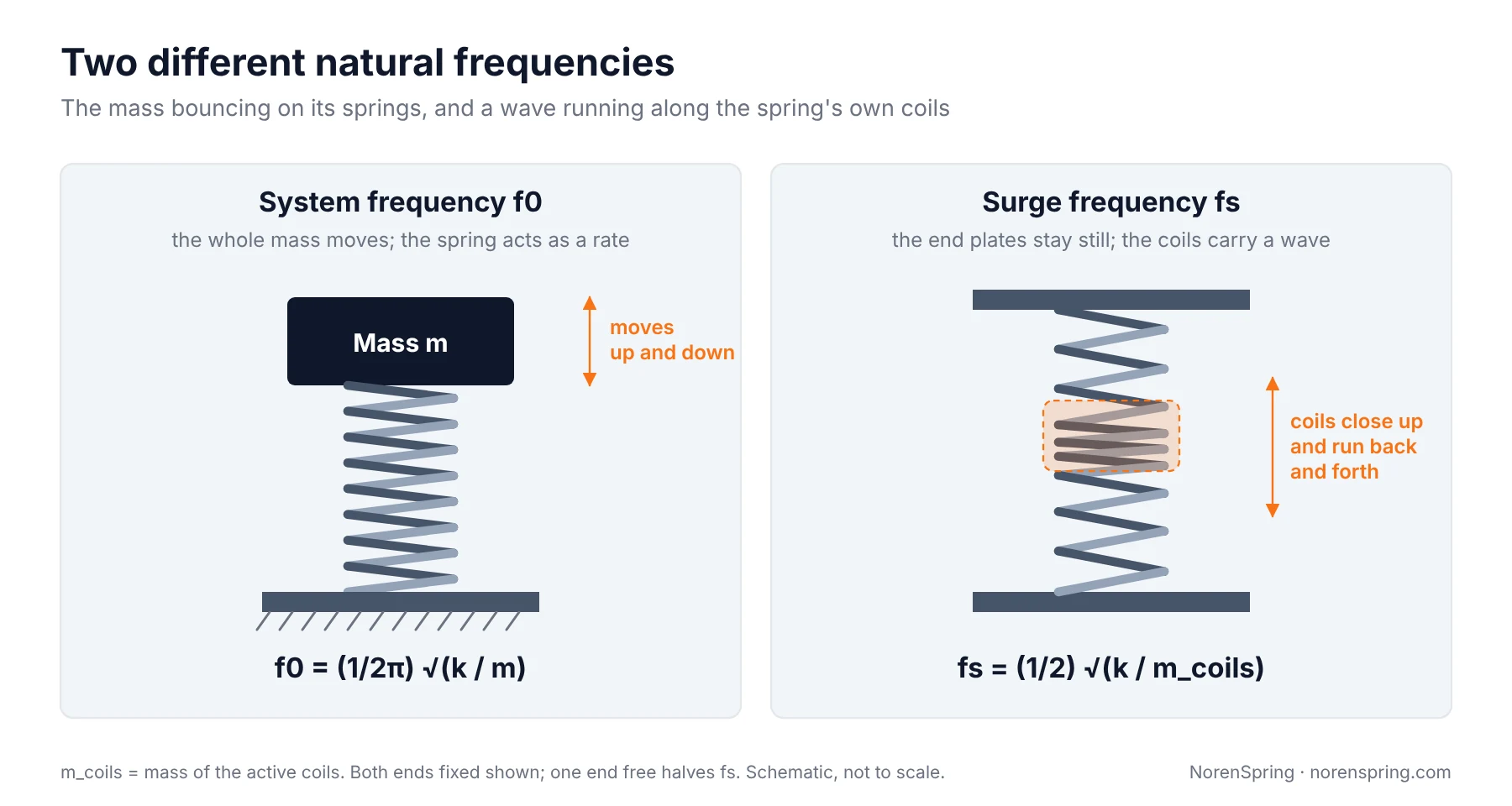
Spring natural frequency is the frequency at which a spring, or a mass on a spring, vibrates freely after it is disturbed. The term can mean two different things, and they are easy to mix up. The first is the frequency of the mass bouncing on the spring, f0 = (1/2π)√(k/m), which decides whether a spring-mounted machine is isolated from its base. The second is the spring’s own surge frequency, the rate at which a wave runs up and down the coils, fs = ½√(k/m_coils) with both ends held against plates. A steel compression spring with 2 mm (0.079 in) wire, a 16 mm (0.63 in) mean diameter and 6 active coils surges at about 470 Hz. Driven by a cam turning at 1,500 rpm (25 Hz), that is about 19 times the running frequency, which is enough. Driven at 2,000 strokes a minute, the margin falls to about 14 times, and the design needs a second look.
This guide explains both frequencies, how to calculate them in metric and inch units, how much margin to keep, how to raise a spring’s surge frequency, and what it all means for vibrating screen springs and valve springs. A calculator further down does the arithmetic.
Key takeaways
- Two frequencies, two jobs. The mass-spring frequency f0 should sit well below the running speed for isolation. The spring’s surge frequency fs should sit well above it.
- Surge frequency depends on d / (n D²). For a given D and n, a thicker wire raises it; fewer active coils or a smaller coil diameter also raise it. At a fixed rate, it rises with D / d³, in step with the stress. For steel, fs ≈ 358,000 × d / (n D²) Hz with d and D in mm, or about 14,000 × d / (n D²) Hz in inches.
- Keep a 13 to 20 times margin. Norton suggests a surge frequency at least about 13 times any forcing frequency; Shigley gives 15 to 20 times, to stay clear of the harmonics of the load cycle [1][2].
- Isolation starts above √2 · f0. Below that ratio the springs amplify the vibration instead of isolating it [6]. Vibrating screens are typically set to run at 3 to 5 times f0 [8].
- Give your spring maker the running speed. Without it, nobody can check surge. Add the shape of the load cycle, the supported mass and the number of springs.
Spring natural frequency: the mass on the spring and the spring itself
Every object with mass and elasticity has natural frequencies. With springs, two different ones come up.
| Mass-spring frequency f0 | Spring surge frequency fs | |
|---|---|---|
| What moves | The supported mass, as one body | The coils, as a wave between the ends |
| Formula | f0 = (1/2π) √(k / m) | fs = ½ √(k / m_coils), both ends fixed |
| Mass used | The mass the spring carries | The mass of the spring’s active coils |
| Typical size | A few hertz for spring-mounted machines | Tens to hundreds of hertz |
| Where you want it | Well below the running speed (isolation) | Well above the running speed |
| What goes wrong | The machine shakes its base, or rocks at start-up | Coils clash, stress jumps, the spring breaks early |
Natural frequency of a spring-mass system (f0)
The natural frequency of a spring-mass system, for a mass m on a spring of rate k, is f0 = (1/2π)√(k/m) in hertz, with k in N/m and m in kg. With several identical springs sharing the load, use the total rate. A handy shortcut comes from the static deflection δ the mass causes: f0 = (1/2π)√(g/δ), which is about 15.8 / √δ Hz with δ in mm, or 3.13 / √δ Hz with δ in inches. A machine that sits 16 mm (0.63 in) down on its springs has an f0 of about 4 Hz, whatever the mass.
The spring’s surge frequency fs
A helical spring is not a massless rate. When one end is moved quickly, a compression wave runs along the coils and reflects at the ends. If the spring is driven near the frequency of that wave, the wave grows: coils close up and clash, the stress at the closed section is far above the static calculation, and the spring can even jump off its seat [3]. This is spring surge. Norton notes that the large forces from the coil deflections and impacts will fail the spring [2], and our article on why springs fail lists surge among the causes of early fatigue breaks in dynamic springs.
How to calculate spring surge frequency
For a round-wire helical compression spring with both ends held against plates or seats, the fundamental surge frequency is [2][5]:
fs = ½ √(k / m_a)
where k is the spring rate and m_a is the mass of the active coils. Substituting the usual spring rate, k = G d⁴ / (8 D³ n), and the active-coil mass, m_a = ρ π² d² D n / 4, gives a formula in the dimensions alone:
fs = (d / (π n D²)) × √(G / (8ρ))
with d the wire diameter, D the mean coil diameter, n the number of active coils, G the shear modulus and ρ the density, all in consistent SI units. Two consequences stand out. The frequency depends on d / (n D²), so the coil diameter matters most. And it depends on G and ρ only through a square root, so changing between steels moves it by a few percent.
Shortcuts for steel springs
With ρ = 7,850 kg/m³, the formula reduces to fs ≈ C × d / (n D²) Hz with d and D in millimetres. C is about 353,000 for oil-tempered, chrome-vanadium and chrome-silicon wire (G = 77.2 GPa), about 362,000 for music wire (G = 81.0 GPa), and the UWA design notes round it to 358,000 [4]. In inch units, with G = 11.2 Mpsi and a weight density of 0.283 lb/in³, the constant is about 13,900, so fs ≈ 14,000 × d / (n D²) Hz with d and D in inches [5].
End conditions
The formula above is for the common case where both ends sit against plates or seats. A spring with one end fixed and the other free, for example one hanging from a moving part with nothing at the far end, has half that frequency, fs = ¼ √(k / m_a) [2]. Fixing both ends is the better arrangement where you have the choice.
Worked example
Take the spring from the introduction: music wire, d = 2 mm (0.079 in), D = 16 mm (0.63 in), 6 active coils.
| Step | Result |
|---|---|
| Spring rate k = G d⁴ / (8 D³ n) | 6.59 N/mm (37.6 lbf/in) |
| Active-coil mass m_a = ρ π² d² D n / 4 | 7.4 g (0.016 lb) |
| Surge frequency fs = ½ √(k / m_a) | about 471 Hz (28,200 cycles/min) |
| Inch shortcut check: 14,000 × 0.079 / (6 × 0.63²) | about 464 Hz |
| Ratio at 1,500 rpm (25 Hz) | 18.8 times: within Shigley’s 15 to 20 |
| Ratio at 2,000 rpm (33.3 Hz) | 14.1 times: above Norton’s 13, below Shigley’s 15 |
Two published examples give a feel for the range. Irvine’s isolation-mount spring with 12 mm (0.47 in) wire, a 75 mm (2.95 in) mean diameter and 6 coils surges at about 127 Hz [5], which the 358,000 shortcut reproduces (358,000 × 12 / (6 × 75²) = 127 Hz). A small, stiff valve spring surges in the high hundreds of hertz (see below). The rate and the spring index drive most of the difference; the spring rate guide shows how d, D and n set k.
How much margin do you need?
The load on a spring in a machine is rarely a pure sine wave. A cam, a crank or an impact produces a fundamental at the running speed plus harmonics at two, three, four times the running speed and so on. Surge can be excited by any of them, so the rules of thumb compare the surge frequency with the running frequency and ask for a large ratio:
| Source | Guidance |
|---|---|
| Norton, Machine Design [2] | Surge frequency greater than about 13 times any forcing frequency |
| Shigley / NPTEL [1][3] | Fundamental critical frequency 15 to 20 times the frequency of the force, to avoid resonance with harmonics |
| UWA design notes [4] | Surge frequency above the highest significant harmonic of the load cycle; around the 12th is a common assumption |
The ratio you need depends on how much harmonic content the load cycle has. A cam with sharp lift and dwell changes has a lot, which is why cam-driven springs need the larger margins. A smooth, nearly sinusoidal excitation, such as an unbalanced-mass exciter on a vibrating screen, has much less.
With a smooth excitation a lower ratio can work as long as the surge frequency does not land close to one of the harmonics that is present. If you cannot reach 13 times, the next best answer is to place the surge frequency between two harmonics rather than on one, and to confirm the design on the machine.
Spring natural frequency and surge calculator
Enter the spring dimensions and the running speed. The calculator gives the rate, the active-coil mass, the surge frequency, the ratio to the running speed and, when the ratio is below 15, the nearest whole multiple of the running speed. If you also enter the supported mass and the number of springs, it gives the mass-spring frequency f0, the static deflection and the isolation ratio. The defaults reproduce the worked example above; to check the vibrating screen example below, enter 16, 80, 8, the oil-tempered material, 960 rpm, 2,000 kg and 8 springs.
Spring surge and natural frequency calculator
Round-wire helical compression spring. Gives the spring’s own surge frequency, compares it with the machine’s running speed and, if you enter the supported mass, the natural frequency of the mass on its springs.
Optional: mass carried on the springs
k = G d⁴ / (8 D³ n); active-coil mass m = ρ π² d² D n / 4; surge frequency f = ½ √(k/m) with both ends fixed, half that with one end free. Margins: Norton suggests a surge frequency at least about 13 times the forcing frequency, Shigley 15 to 20 times. Below 15 times, the harmonic check flags a surge frequency within 5% of a whole multiple of the running speed. The mass-spring part treats the springs as massless and undamped; it ignores rocking modes and damping. Results are a first check, not a substitute for the machine builder’s dynamic analysis.
How to raise a spring’s surge frequency
From fs = ½ √(k / m_a), there are two levers: more rate or less moving mass. In a real design the rate is usually fixed by the job, so the practical question is how to carry the same load with less active wire.
- At a fixed rate, accept a higher stress. If k stays the same, fs varies with D / d³, exactly as the shear stress at a given load does. So the ways to raise fs at the same rate are a thinner wire with fewer coils, or a larger coil diameter with fewer coils, as far as the stress allows. Check the stress and the travel to solid in our compression spring design guide.
- If the rate may rise, stiffen the spring. For the same wire, fewer active coils or a smaller coil diameter raise both k and fs, because fs varies with d / (n D²).
- Use a higher-strength wire. This is what makes the higher stress acceptable. A wire that can work at a higher stress needs less material for the same rate and travel, so the spring is lighter and its surge frequency higher. The UWA notes make this point about springs that are preset or shot peened [4]. Our spring wire material guide compares the common grades, and music wire is the usual high-strength choice for small springs.
- Change the shape. Conical and beehive springs put less mass in the moving coils and are less prone to surge, which is why they are used in valve trains [7]. See our conical spring guide and our conical springs product page.
- Vary the pitch. In a progressive-pitch spring the closely spaced coils touch first, so the rate rises and the active mass falls during the stroke. The surge frequency is then not a single fixed value.
- Hold both ends. A spring with one free end surges at half the frequency of the same spring between two plates [2].
Damping: why springs ring, and why it cuts both ways
Steel wire has very little internal damping, which is why a surge, once started, is not damped out and can build to damaging amplitudes [3]. There is little a spring maker can add to the wire itself; the design answer is to keep the surge frequency out of reach of the excitation.
For the mass-spring system, damping is a trade-off. With a frequency ratio r = running frequency / f0, the undamped transmissibility is T = 1 / |1 − r²|. Isolation only begins when r is greater than √2, about 1.41. Below that the springs pass on more force than they receive. Our tractor seat springs guide applies the same rule to a suspension seat for 55 to 98 kg operators.
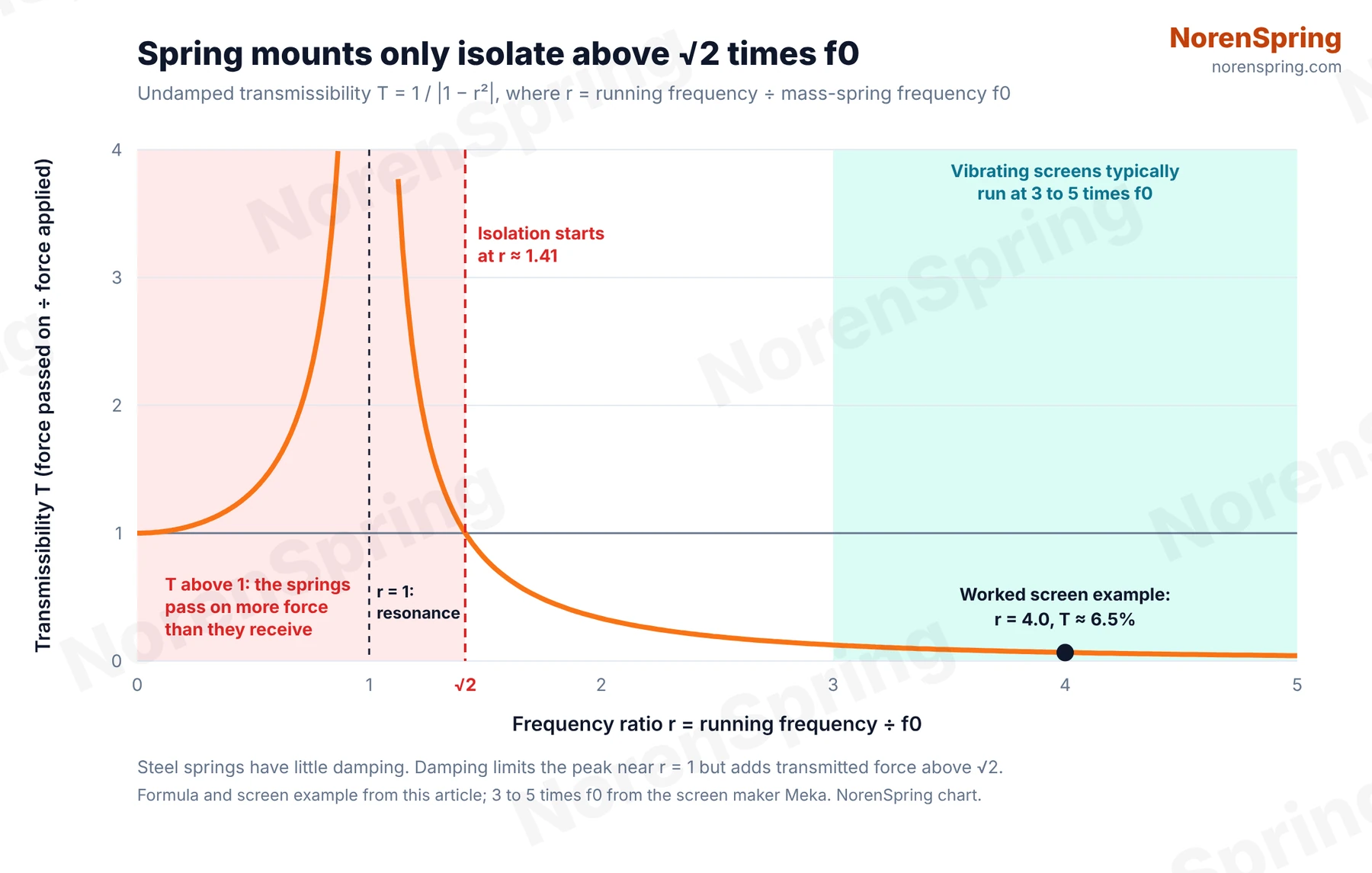
Above √2, adding damping actually increases the transmitted vibration, while near r = 1 it is the only thing that limits the response [6]. Steel springs give good isolation at the running speed and little help at resonance, which is why the start-up and run-down of a spring-mounted machine need attention. For fans, pumps and chillers on spring mounts, our guide to spring isolators covers static deflection classes and the stability and travel-to-solid rules that building specifications set.
Vibrating screen springs: isolation and surge together
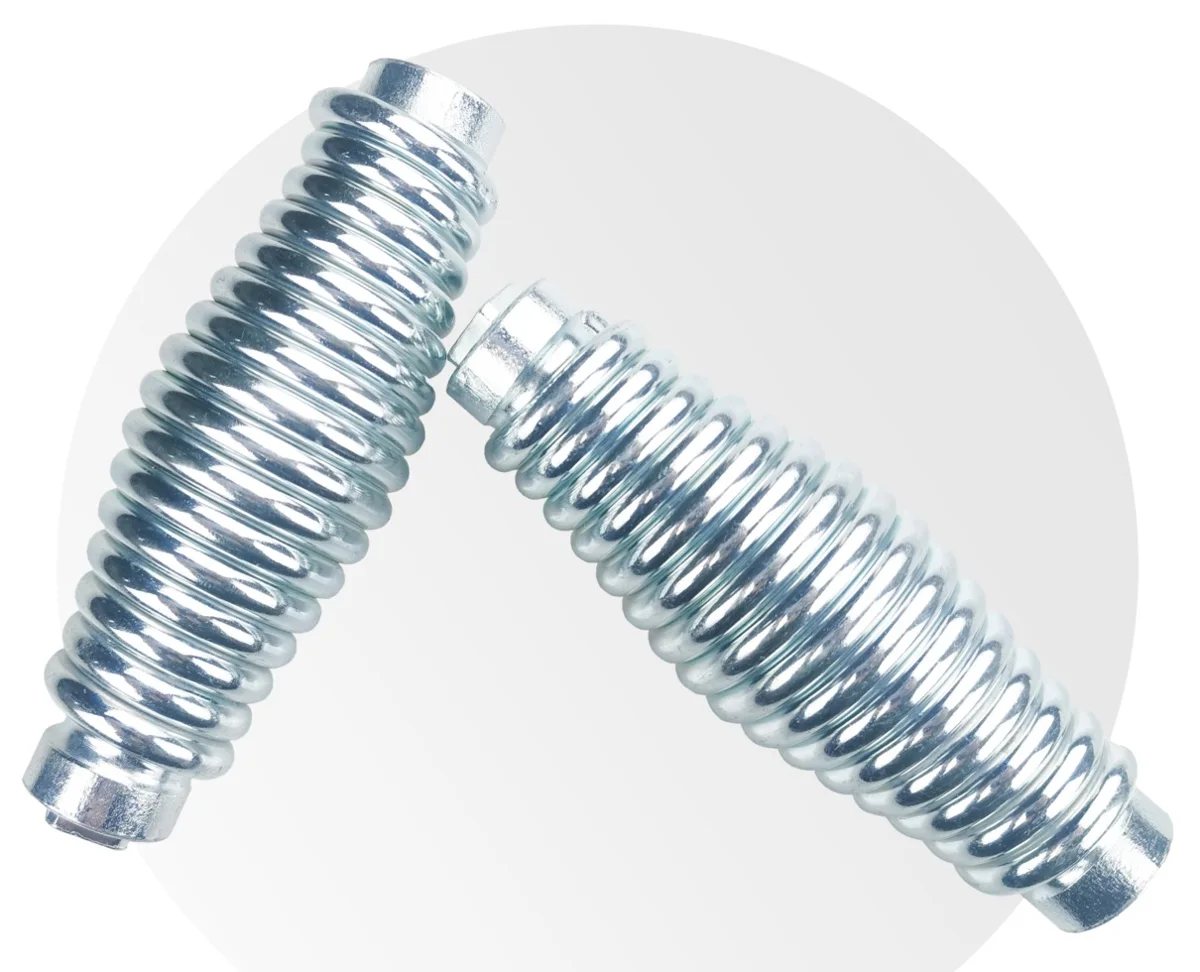
A vibrating screen or feeder is the case where both frequencies matter at once. The springs carry the weight of the vibrating body, let it move and keep the vibration out of the structure underneath. Our vibrator springs are compression springs whose end coils are wound to a smaller diameter so they grip the stud or spring seat, which keeps them in place while the machine shakes.
Isolation: set f0 well below the running speed
The screen designer chooses the spring rate so that f0 sits well below the exciter speed. Meka, a screen maker, says screens are designed to run at about 3 to 5 times the resonant frequency, and that the screen passes through resonance briefly as it starts and stops [8]. That is where the large start-up and run-down movements come from, and why the springs see their highest stress in those moments.
Surge: the spring’s own frequency still has to be checked
Isolation fixes the rate, so the surge frequency has to be checked at that rate. Here is an illustrative example worked through with the formulas above, not a rated design:
| Item | Value |
|---|---|
| Vibrating mass | 2,000 kg (4,409 lb) on 8 springs |
| Exciter speed | 960 rpm (16 Hz) |
| Spring | d = 16 mm (0.63 in), D = 80 mm (3.15 in), 8 active coils, oil-tempered or Cr-Si wire |
| Rate per spring / total | 154.4 N/mm (882 lbf/in) / 1,235 N/mm (7,053 lbf/in) |
| Static deflection | 15.9 mm (0.63 in) |
| Mass-spring frequency f0 | 3.96 Hz, so r = 4.0 and undamped T ≈ 6.5% |
| Surge frequency fs | 110 Hz, 6.9 times the running speed |
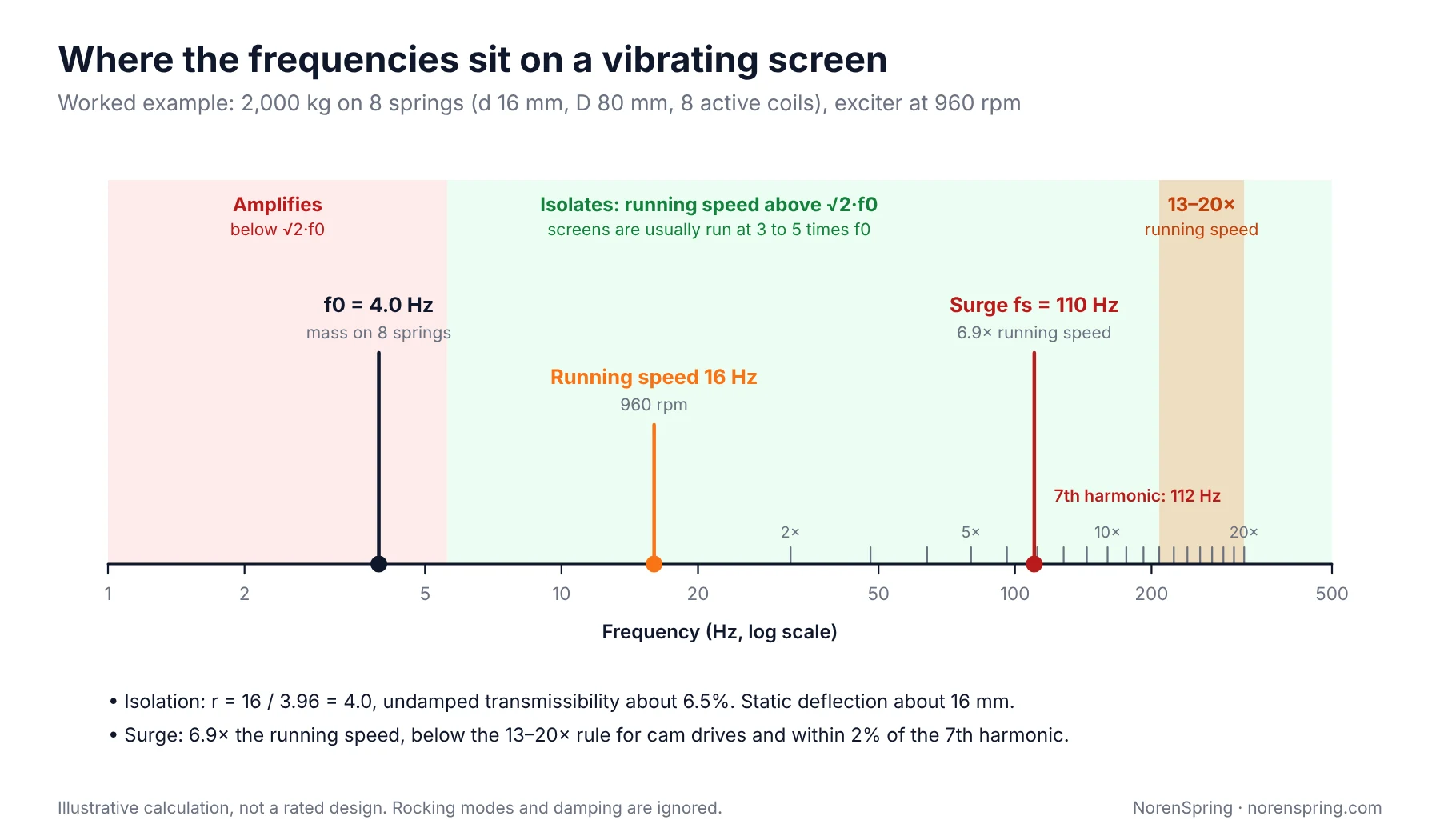
The isolation is good, but the surge frequency is only 6.9 times the running speed, and it sits within 2% of the 7th harmonic (112 Hz). A smooth unbalanced-mass exciter puts little energy into its 7th harmonic, so this may be acceptable; a machine with impacts, loose parts or a non-sinusoidal motion may not be.
Moving fs away from 112 Hz is cheap at the design stage and expensive after a field failure. At the same 154 N/mm, the coil diameter goes up and the coil count down: with D = 87 mm (3.43 in) and about 6.2 active coils, fs rises to about 120 Hz, midway between the 7th (112 Hz) and 8th (128 Hz) harmonics. The price is stress. At a given load the shear stress rises roughly in proportion to D, about 9% here, and the solid height and the fit on the seat change, so the fatigue check has to be redone.
What else decides vibrator spring life
- Fatigue around a static load. A vibrator spring carries the machine’s weight and is cycled around that load many thousands of times an hour, so wire quality, heat treatment and surface condition matter more than for a static spring. Our heavy-duty compression springs article covers large-wire springs of this kind.
- The end grip. Too loose and the spring rattles and wears; too tight and it is hard to fit or cracks at the end.
- Matched sets. If the springs under one screen differ in rate or free length, the body tilts and loads one corner, so springs for one machine should be made, checked and replaced as a set.
- Corrosion. Screens often run outdoors or in wet material, so zinc plating or another coating is usual; zinc-plated high-strength springs are baked after plating to drive out hydrogen.
Valve springs and other cam-driven springs
Engine valve springs are the classic example of surge. Irvine’s worked example of a valve spring with 0.185 in (4.7 mm) wire, a 1.05 in (26.7 mm) mean diameter and 4 active coils has a rate of 363.6 lbf/in (63.7 N/mm) and a surge frequency of 591 Hz calculated from k and m directly, or 583 Hz from the 13,900 shortcut [5].
Irvine then runs the engine at 8,000 rpm. In a four-stroke engine the camshaft turns at half the crank speed, so at 8,000 rpm on the crank the cam runs at 4,000 rpm (66.7 Hz). The surge frequency is then only 8.9 times the cam frequency and close to the 9th harmonic at 600 Hz, well short of the 13 times guideline. That is why high-speed valve springs use conical or beehive shapes and other ways of cutting moving mass [7].
The same reasoning applies to any spring that follows a cam or crank at speed: packaging machines, textile machinery, pumps, compressors and indexing mechanisms. Work out the highest running speed, look at how abrupt the cam profile is, and check the surge ratio before the drawing is released. A spring that only has to hold a static load, such as one setting a spring preload in a clamp, does not need this check.
What to send with an RFQ for a dynamic spring
| Information | Why it matters |
|---|---|
| Running speed (rpm, strokes/min or Hz), including the maximum | The basis of every surge and isolation check |
| How the spring is driven: cam, crank, unbalanced-mass exciter, impact | Sets how many harmonics are present and so what margin is needed |
| Supported mass and number of springs sharing it | Gives f0 and the static load for isolation springs |
| Installed length and working length, or the stroke | Sets the stress range for fatigue |
| End conditions and mounting: plates, seats, studs, reduced ends | Changes the surge frequency and the end design |
| Operating temperature and environment | Material, finish and corrosion protection |
| Annual quantity, and whether springs are replaced as sets | Production and matching |
If you already have a spring that works, send it or its drawing with the machine’s running speed; we can check the surge ratio before quoting a replacement or a modified design. Our compression springs page lists the size range we make, and our guide on how to specify a custom compression spring covers the rest of the drawing.
Frequently asked questions
What is the natural frequency of a spring-mass system?
For a mass m on a spring of rate k, it is f0 = (1/2π)√(k/m) Hz, with k in N/m and m in kg. A quicker way is from the static deflection under the mass: f0 ≈ 15.8 / √δ Hz with δ in mm, or 3.13 / √δ with δ in inches. This ignores the spring’s own mass, which is acceptable when the spring is much lighter than the mass it carries.
What is spring surge?
Spring surge is resonance of the spring’s own coils: a compression wave runs back and forth between the ends, and if the drive is near that frequency or one of its harmonics, the coils close up, clash and overstress. Wire springs have little internal damping, so a surge is not damped out once it starts [3].
How do you calculate the natural frequency of a compression spring?
With both ends against plates, fs = ½√(k / m_a), where m_a is the mass of the active coils. In dimensions, fs = d / (π n D²) × √(G / 8ρ). For steel this is about 358,000 × d / (n D²) Hz with d and D in mm, or about 14,000 × d / (n D²) Hz in inches. With one end free, halve the result.
How far should the natural frequency be from the operating frequency?
For the spring’s surge frequency, at least about 13 times the forcing frequency (Norton) and preferably 15 to 20 times (Shigley) when the load cycle has strong harmonics. For the mass-spring frequency of an isolation mount, the running speed must be above √2 times f0 for any isolation; vibrating screens typically run at 3 to 5 times f0.
Does adding mass to the spring change its surge frequency?
Barely, as long as the carried mass is much heavier than the spring. The carried mass changes the system frequency f0, but the surge frequency then stays close to the both-ends-fixed value, which depends on the spring’s own active coils [5]. That is why a vibrating screen can have an f0 of 4 Hz and springs that surge at over 100 Hz.
About the authors
This guide was prepared by the NorenSpring engineering team, which designs and manufactures custom compression springs, vibrator springs and other springs and wire forms in Xuzhou, China. Technical review by Feng Yulin, General Manager and senior structural engineer, who has 15 years of spring R&D experience and more than 30 national patents. NorenSpring holds IATF 16949, ISO 9001, ISO 13485, ISO 14001 and ISO 45001 certifications. The product photo is of our own vibrator springs; the cover is an AI illustration based on that photo. The worked examples are calculations to show the method, not rated parts. Sources were last checked on October 22, 2026.
Designing a vibrating screen, a feeder or a cam-driven mechanism? Send us your drawing or sample with the running speed, the supported mass, the number of springs and the installed and working lengths, and we will check the surge and isolation margins with the quotation.
Sources
The numbers in square brackets in the text refer to this list. Spring makers’ and equipment makers’ publications are cited by name without links.
- R. G. Budynas and J. K. Nisbett, Shigley’s Mechanical Engineering Design, 9th edition, McGraw-Hill, 2011, chapter 10 (Mechanical Springs). Source for the critical frequency of helical springs, the 15 to 20 times guideline and the shear moduli used in the calculator (Table 10-5).
- R. L. Norton, Machine Design: An Integrated Approach, 4th edition, Prentice Hall, 2011, chapter 14, section on compression-spring surge, p. 802. Source for the 13 times guideline, the fixed-fixed formula, the active-coil weight and the halving for one free end. Retrieved 2026-10-22.
- NPTEL, IIT Madras, Machine Design II, module 4, lesson 3: Design of helical springs for variable load. Source for the description of surge, the low internal damping of spring materials and the 15 to 20 times guideline. Retrieved 2026-10-22.
- University of Western Australia, Design and Analysis notes, Spring design. Source for the steel shortcut constant, the harmonic criterion and the higher natural frequency of lighter, more highly stressed springs. Retrieved 2026-10-22.
- T. Irvine, Spring surge, Vibrationdata. Source for the surge formulas in inch units, the 13,900 constant, and the isolation-mount and valve spring examples. Retrieved 2026-10-22.
- Purdue University, Vibration isolation. Source for transmissibility, the √2 frequency ratio and the effect of damping above it. Retrieved 2026-10-22.
- K. Siczek and K. Siczek, “Studies on the dynamics of the valve train with machined valve springs”, Combustion Engines, 2017, 168(1), 100–109, doi:10.19206/CE-2017-116. Source for conical and beehive valve springs and their lower moving mass. Retrieved 2026-10-22.
- Meka, “Elastic system for screeners and feeders” (screens designed to run at 3 to 5 times resonance; resonance during start-up and run-down). Retrieved 2026-10-22.



