










In this article
- Key takeaways
- What is a die spring?
- Die spring color chart: what the ISO 10243 colours mean
- How far can a die spring be compressed?
- Worked example: sizing die springs for a stripper plate
- Guiding, temperature and other installation rules
- Materials and finishes
- When to use custom die springs
- What to send for a die spring quote
- Frequently asked questions
- References
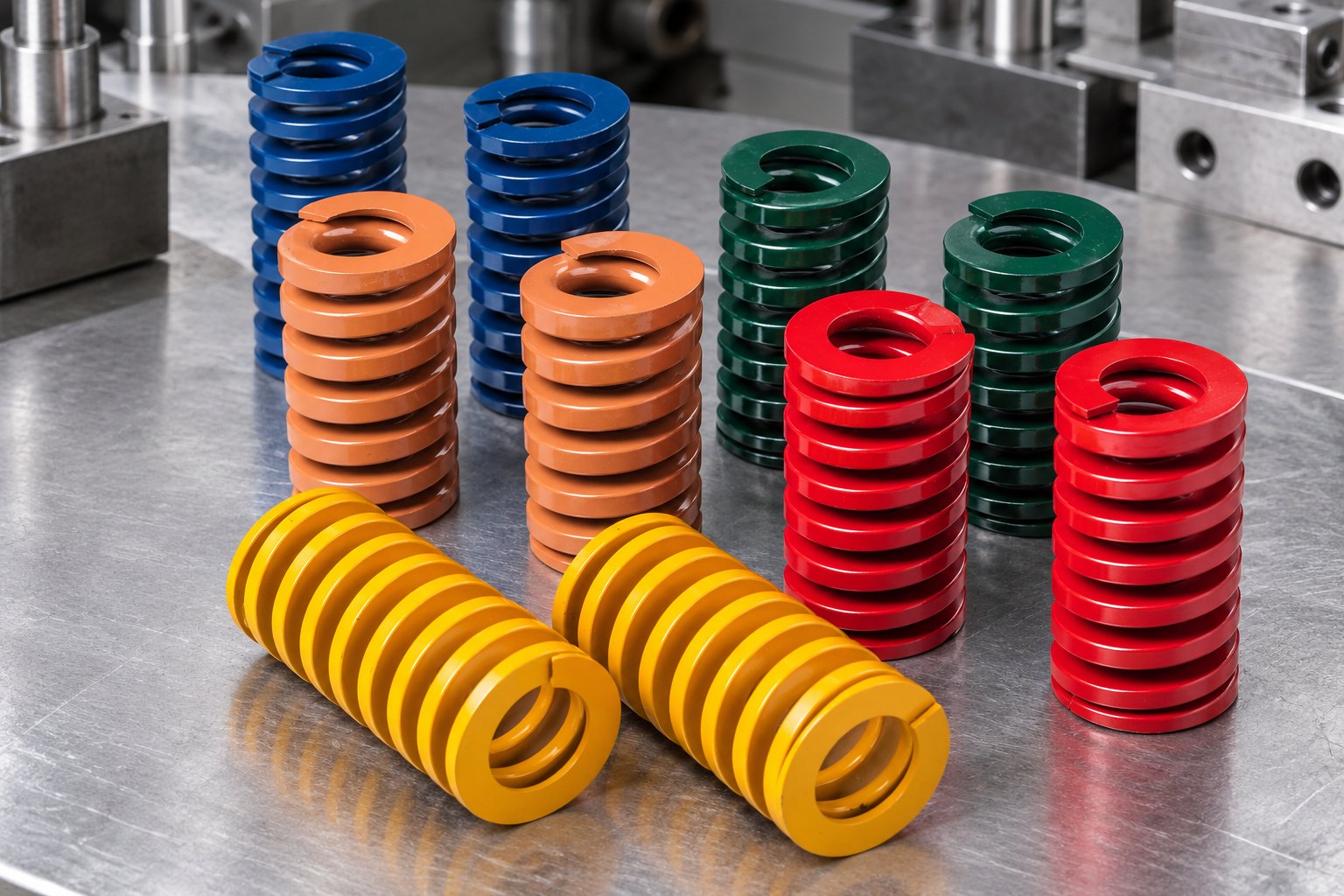
Cover image: an AI illustration based on a photograph of die springs we make, placed in a new setting.
A die spring is a heavy-duty compression spring wound from rectangular or flat-sided wire, built to give a high force in a small pocket and to survive millions of press strokes. Die springs strip parts off punches, return cams and lifters, hold pressure pads and push ejector plates back in injection moulds. They are also wear parts, and one tired spring in a set changes how the whole die behaves.
Buying them looks simple: pick a colour, a hole diameter and a length. In practice many early failures come from two gaps. The colour tells you the load class, not the force, and the free length tells you nothing about how far the spring may be compressed for the life you expect.
This guide is for tool designers, maintenance engineers and buyers at stamping plants, mould shops and machine builders. It explains what the ISO 10243 colour code actually fixes, how far each class may deflect, a worked sizing example for a stripper plate, how to install and replace die springs, and what to send when you need a custom die spring made to a drawing. If you are new to compression springs in general, start with our compression spring design guide.
Key takeaways
- ISO 10243 fixes the housing, not the spring’s quality. The standard sets the hole and rod diameters, free lengths, rate tolerance (±10%), colour and maximum deflection for each class. It does not specify material, cross-section or service life [1][2].
- The four ISO colours are green (light), blue (medium), red (strong) and yellow (extra strong). ISO 10243:2019 limits light springs to 40% of free length and medium springs to 37.5% [2]. Catalogues built to the standard list 30% for red and 25% for yellow [3][4].
- The maximum is a short-life figure. In catalogue life tables the maximum deflection corresponds to roughly 100,000 to 200,000 cycles. For 3 million cycles or more, the same catalogues drop to about 25% for green and blue, 20% for red and 17% for yellow [3][4].
- Count preload plus stroke, every time. Total deflection is the preload when the die is open plus the working stroke. In our worked example, four red springs that look fine on force reach 31% of free length and exceed the red maximum.
- Colour is not a universal language. JIS-series catalogues use yellow for extra light springs, the opposite end of the scale from ISO yellow [5]. Always name the standard, not just the colour.
What is a die spring?
A die spring is a rectangular-wire compression spring, preset and colour-coded by load class, designed for press tools and moulds where force must be high, space is tight and the spring cycles with every stroke. Three features set it apart from a general heavy duty compression spring:
- Rectangular wire. A flat-sided section packs more steel into each coil than round wire of the same height, so the spring carries more force for its size. Catalogue makers describe this as the main reason for the shape [4].
- Closed and ground ends. The ends sit square in a counterbore and on a flat plate, which keeps the spring upright under load.
- Set and colour-coded. Die springs are preset so they do not shorten in the first strokes, then painted in a colour that marks their load class. The ISO standard is written for springs “that are set” [2].
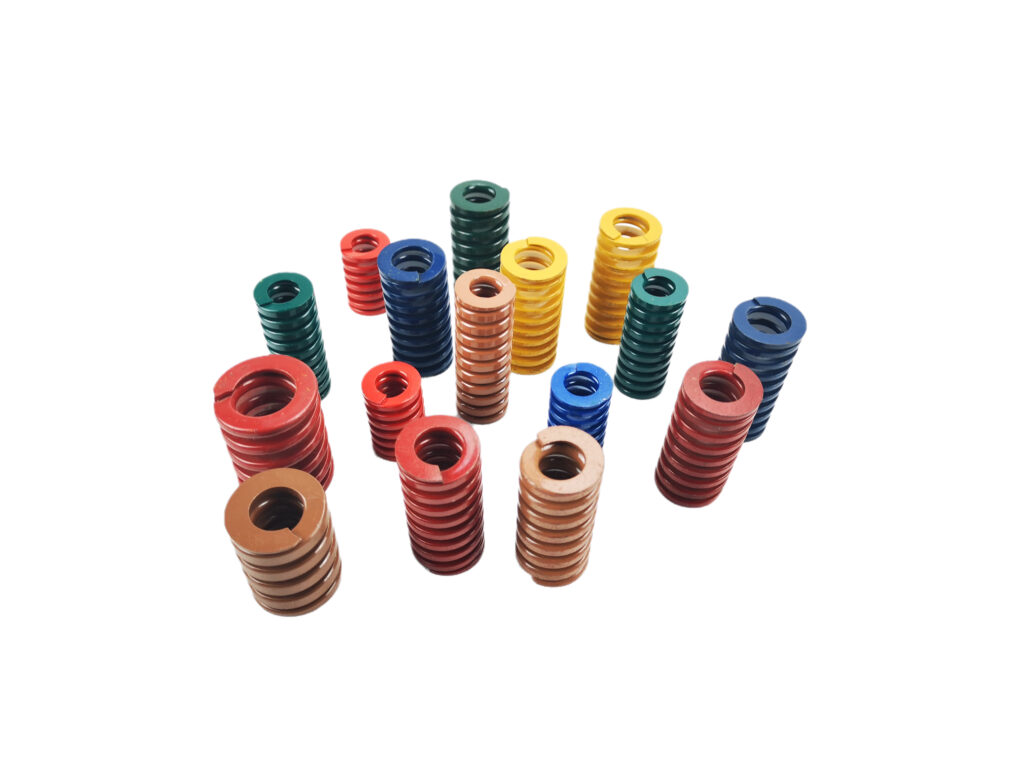
Where die springs are used
- Stamping and progressive dies. Stripper plates, pressure pads, cam returns and lifters.
- Injection and die-casting moulds. Ejector plate return and slide preload.
- Press and fixture equipment. Return springs in hydraulic presses, clamping fixtures and test rigs. We have supplied heavy-duty springs for the return systems of hydraulic stamping presses; see our hydraulics industry page.
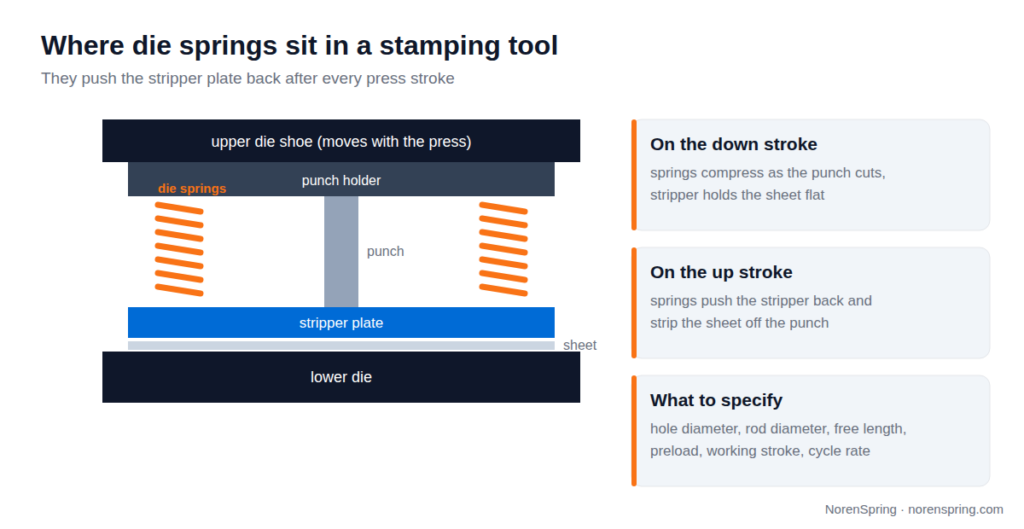
In a stamping die, the springs push the stripper plate down onto the sheet as the punch enters, then strip the part off the punch on the way up. The schematic below shows the layout.
Die spring color chart: what the ISO 10243 colours mean
ISO 10243 is the international standard for die springs. Its full title is Tools for pressing — Compression springs with rectangular section — Housing dimensions and colour coding. The current edition is ISO 10243:2019, which replaced the 2010 edition and its 2011 amendment [1][2]. It is maintained by the ISO committee for tools for pressing and moulding, ISO/TC 29/SC 8 [6].
The standard defines four load classes, each with its own colour. For every class it lists the hole diameter the spring fits (tolerance H15), the rod diameter it slides over (tolerance h15), the free length L0, the spring rate (±10%), the maximum operating deflection and the force at that deflection [2]. Free length tolerance is ±1 mm for the shorter lengths and ±1% of L0 from 115 to 305 mm [2].
The die spring color chart below summarizes the four ISO 10243 classes and how far each may be compressed.
| Colour | ISO load class | Maximum deflection, % of L0 | Long-life deflection (3 million+ cycles) |
|---|---|---|---|
| Green | Light | 40% (ISO 10243) | about 25% |
| Blue | Medium | 37.5% (ISO 10243) | about 25% |
| Red | Strong | 30% (catalogues to ISO 10243) | about 20% |
| Yellow | Extra strong | 25% (catalogues to ISO 10243) | about 17% |
Sources: maximum deflection for green and blue from ISO 10243:2019 [2]; red and yellow maximums and long-life values from die spring catalogues built to ISO 10243 (2010 edition) [3][4]. The public preview of ISO 10243:2019 shows the limit tables for the light and medium classes only. Treat long-life values as guidance, not guarantees.
Just as useful is what the standard leaves out. It “does not attempt to specify the quality of the springs themselves”, and it does not set material, cross-section or service life [2]. Two springs with the same colour and size from different makers will fit the same pocket and give about the same rate, but they can last very differently. That is why the life tables in a maker’s catalogue, and the maker’s testing, matter as much as the colour.
Why the colour alone is not enough
Colour codes differ between standards. ISO uses green, blue, red and yellow from light to extra strong. JIS-series die springs, common in Asian tooling, use their own scheme, and catalogues sell yellow JIS springs as extra light [5]. Several North American series use yet other colours and slightly different deflection limits [3]. A “yellow die spring” can therefore be the softest or the stiffest spring in the drawer.
“Heavy duty” and “extra heavy duty” are catalogue names, not ISO classes. ISO 10243 calls its two stiffest classes strong (red) and extra strong (yellow), and other series attach “heavy duty” to different colours [3], so ask which standard a heavy duty die spring was made to.
When you order replacements or write a drawing, state three things: the standard or series (for example ISO 10243), the load class, and the hole diameter and free length. Add the rate if the die was tuned to a specific force.
How far can a die spring be compressed?
A die spring should never be compressed past the maximum deflection for its class, and for long life it should work well below it. Catalogue life tables tie deflection to cycle life in steps. The chart below shows those steps for the four ISO colours.
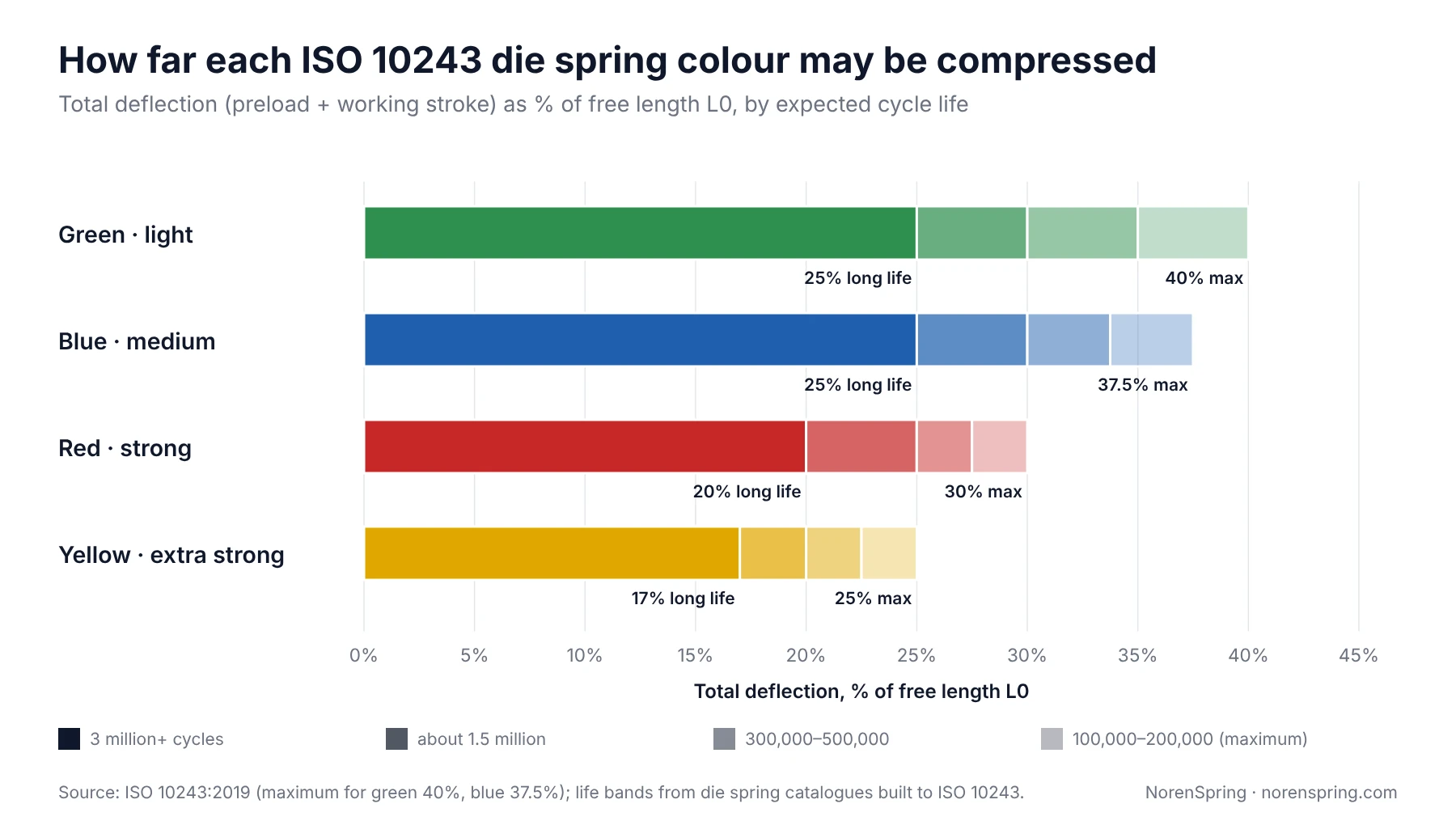
Read the chart from left to right. The darkest segment is the deflection you can use for about 3 million cycles or more. Each lighter step trades life for travel, down to roughly 100,000 to 200,000 cycles at the maximum [3]. One catalogue also notes that its life values come from internal testing and are not guaranteed [3], which is a fair warning for any table of this kind.
A die that runs 20 strokes a minute on two 8-hour shifts, about 250 days a year, makes about 4.8 million strokes a year (19,200 a day). If that die uses red springs at their 30% maximum, the springs are working in the 100,000 to 200,000 cycle band and will be due for replacement in about one to two weeks. The same red springs at 20% sit in the 3 million plus band. Deflection, not colour, decides how often you open the die.
Preload plus stroke: the number that matters
Total deflection is the preload when the die is open plus the working stroke as it closes. A common mistake is to check only the stroke.
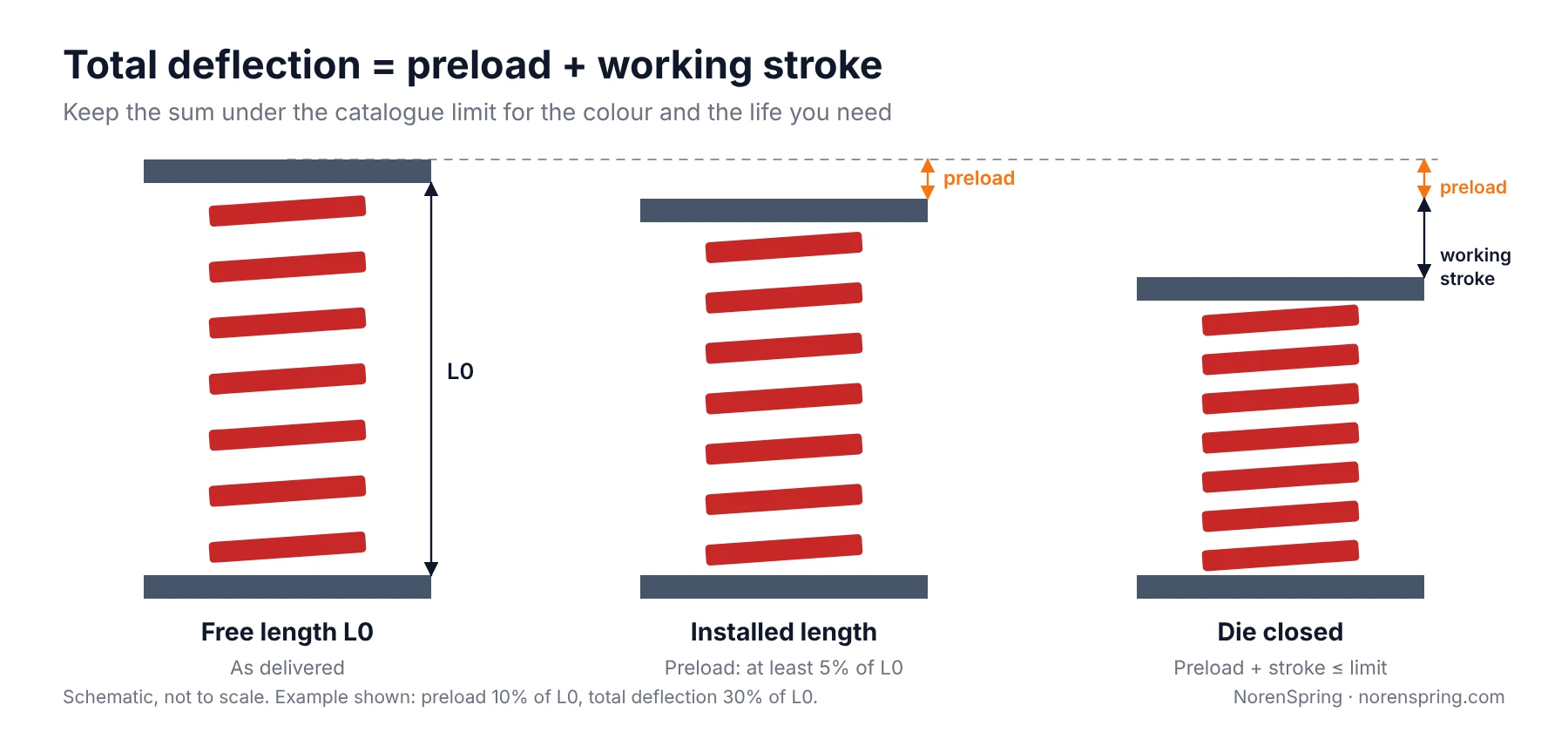
Catalogues recommend a preload of at least 5% of free length, because a spring that rattles loose in its pocket wears its ends and can shift sideways [3][4]. A larger preload also gives more force at the start of the stroke, which is often what a stripper plate needs. But every millimetre of preload is a millimetre less stroke within the limit. Our spring preload guide covers the trade-off in more detail.
Worked example: sizing die springs for a stripper plate
Suppose a stripper plate needs 3,600 N to strip the part off the punches with the die open, the working stroke is 10 mm, and the pocket layout allows four springs. The tool designer picks red (strong) springs. The rates below are illustrative values chosen for the example, not catalogue data, so use the real rate from your catalogue or drawing.
Option A: four red springs, L0 64 mm, rate 90 N/mm.
Each spring must give 900 N with the die open, so preload = 900 ÷ 90 = 10 mm. Total deflection = 10 + 10 = 20 mm, which is 31.2% of 64 mm. That is over the 30% red maximum before the die has made a single stroke.
Option B: four red springs, L0 76 mm. For the same wire and coil size, a longer spring has a lower rate, here 90 × 64 ÷ 76 ≈ 75.8 N/mm. Preload = 900 ÷ 75.8 ≈ 11.9 mm. Total = 21.9 mm, or 28.8% of L0. Within the 30% red maximum, but above 27.5%, which puts it in the 100,000 to 200,000 cycle band, the same short-life band as the maximum.
Option C: six red springs, L0 64 mm. Each spring now needs 600 N, so preload = 6.7 mm and total = 16.7 mm, or 26.0% of L0. Better, but still above the 25% line, in the 300,000 to 500,000 cycle band.
Option D: six red springs, L0 76 mm. Preload = 600 ÷ 75.8 ≈ 7.9 mm, total = 17.9 mm, or 23.6% of L0. This is below the 25% step, good for about 1.5 million cycles.
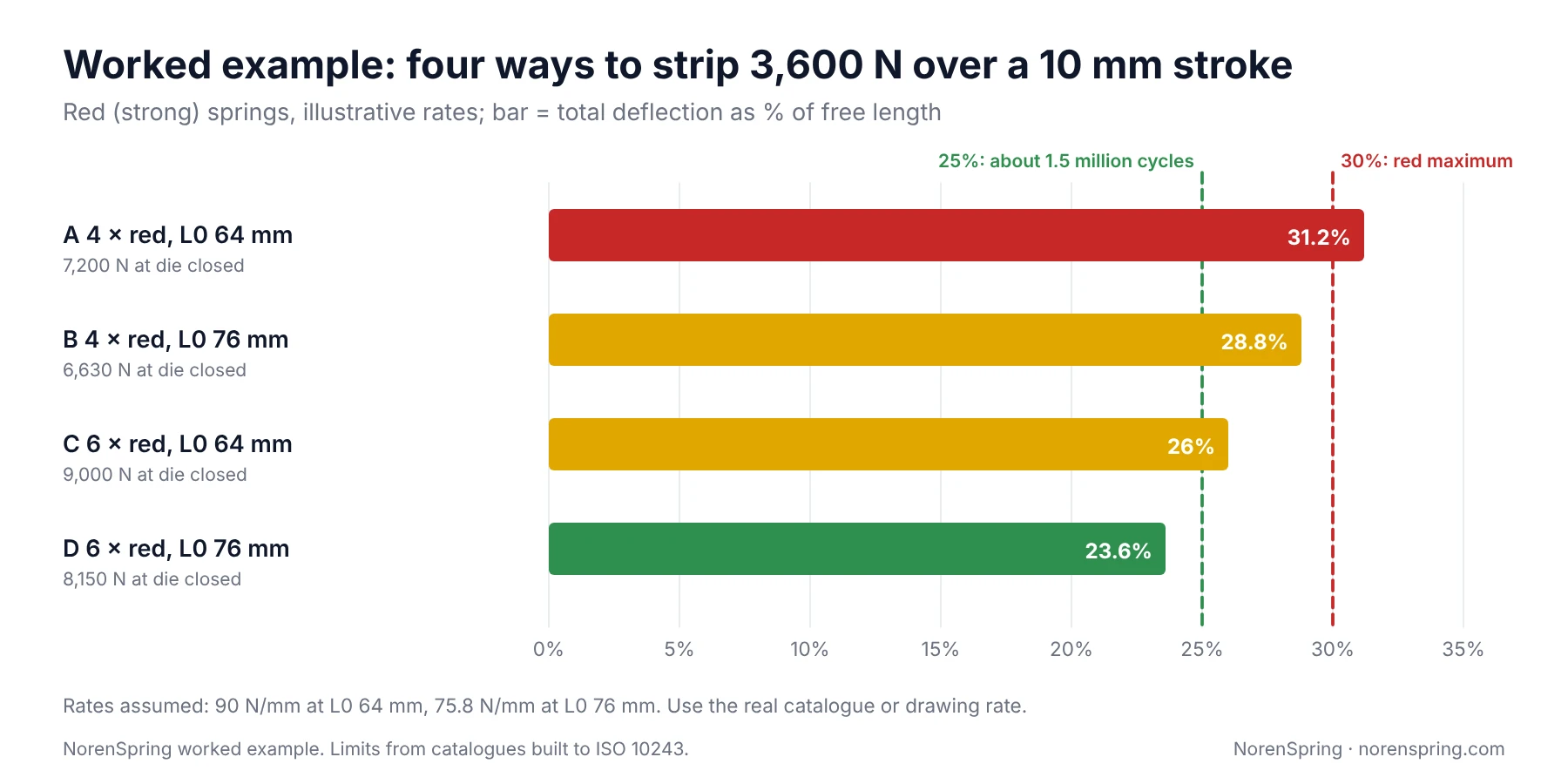
Two points come out of the example.
- In this example, spreading the load over more springs was the stronger lever. Going from four to six springs cut total deflection from 31.2% to 26.0% of free length; adding 12 mm of length only brought it to 28.8% (and in millimetres it actually rose, from 20 to 21.9 mm).
- More springs push back harder on the press. With the die closed, option D puts about 8,150 N into the press, against 7,200 N for option A. Check press capacity and the force on the part or sheet when you add springs. A more detailed treatment of rate and force is in our spring rate guide.
If neither more springs nor longer springs fit, move up a load class (fewer, stiffer springs with a lower deflection limit) or consider a nitrogen gas spring, which gives an almost constant force over its stroke but costs more and needs its own maintenance.
Guiding, temperature and other installation rules
Die springs fail early for reasons the sizing calculation does not show. These are the rules die spring catalogues repeat.
- Guide every long spring. Catalogues call for a guide rod or a deep pocket on any die spring whose free length is more than about 3.5 times its diameter [3]. An unguided long spring bows sideways, rubs the bore and breaks at the rubbed coil.
- Keep the springs square. Mount them as close to perpendicular to the plates as possible, and keep the pocket floor flat [3].
- Watch the temperature. One catalogue gives a best working range of −30 °C to +120 °C, with about 1% loss of rate for every 40 °C from 120 °C up to 250 °C [3]. Springs near heated moulds or hot-forming dies need that allowance, or a different material.
- Keep the coils clean. Slugs and scrap caught between coils shorten the stroke, overload the spring and can damage the tool [3].
- Don’t store die springs compressed for long periods [3].
- Remeasure the stroke after the die is reground. Grinding the punch or die face changes the working height, and with it the deflection. Recheck the real total deflection after maintenance [3].
- Replace springs as a set. When one spring in a stripper set breaks, the others carry its load and the plate tilts. Replace the whole set, ideally on a schedule based on the life table rather than waiting for a failure [3].
Surface damage also matters. Nicks, grinding marks and deep scratches act as fatigue crack starters, and a damaged die spring should be replaced, not refitted [3]. For more on how springs crack and lose load, see our guide to why springs fail.
Materials and finishes
Standard die springs are made from chrome-vanadium spring steel such as 50CrV4 (SAE 6150) [4], and chrome-silicon spring steel is another common choice for highly stressed springs. A typical route is coiling, heat treatment, grinding the ends, presetting and painting, and many makers shot peen the springs as well. Shot peening adds compressive stress at the surface, which slows fatigue cracking; our shot peening guide explains how it works.
Stainless steel die springs exist for wet, food or corrosive environments, but stainless spring wire is less stiff and generally weaker in fatigue than chrome-vanadium, so expect a larger spring for the same duty. Our stainless steel spring guide compares the grades. Polyurethane (urethane) die springs are a different product: elastomer cylinders that suit short strokes and high force in very small spaces, and that do not mark soft workpieces.
When to use custom die springs
Standard ISO die springs cover most press tools. A custom die spring makes sense when:
- the pocket is a legacy or non-standard size and remachining the die costs more than a special spring;
- the force or stroke falls between two standard classes, and you need a specific rate rather than the nearest colour;
- the spring sees heat, corrosion or a medium that standard painted chrome-vanadium will not handle;
- you need a matched set with a tight rate tolerance for a balanced stripper plate;
- you are replacing springs in imported machinery and only have a sample.
NorenSpring makes compression springs, including die springs and heavy-duty springs, from wire 0.1 to 80 mm in diameter, to customer drawings or samples.
What to send for a die spring quote
The fastest quotes come with the data below. If you have only a sample, send photos with a rule in the shot and the details you know. We measure free height and working height on a digital height gauge (Mitutoyo LH-600 series) and can make prototypes before a production order.
| Item | Why it matters |
|---|---|
| Standard or series (for example ISO 10243) and load class | Colour alone is ambiguous between standards |
| Hole diameter and rod diameter | Sets the outer and inner diameter limits |
| Free length L0 | Sets rate and allowable deflection |
| Installed length (die open) and closed length (die closed) | Gives preload and total deflection |
| Force needed at installed length, or the rate | The actual job the spring has to do |
| Strokes per minute and target life | Decides which deflection band to design to |
| Temperature and environment | Material and finish choice |
| Quantity per set and annual volume | Matching, packaging and pricing |
| Colour or marking required | Matches your maintenance system |
Not sure how to take the dimensions from an old spring? Our guide on how to measure a spring shows the method. When the data is ready, send it to our engineers for a quote.
Frequently asked questions
What do the colours on die springs mean?
On ISO 10243 die springs, the colour shows the load class: green is light, blue is medium, red is strong and yellow is extra strong [2]. Other standards use other colours, so a JIS yellow spring is extra light [5]. Always check which standard the spring was made to.
How much can you compress a die spring?
Under ISO 10243, light (green) springs may be compressed up to 40% of their free length and medium (blue) springs up to 37.5% [2]. Catalogues built to the standard give 30% for red and 25% for yellow [3][4]. Those are short-life maximums; for 3 million cycles or more, keep total deflection to about 25% for green and blue, 20% for red and 17% for yellow [3][4].
What colour is a heavy duty die spring?
It depends on the standard. In ISO 10243 the heaviest classes are red (strong) and yellow (extra strong) [2]; “heavy duty” is a catalogue term, and other series use other colours for it [3]. Check the standard before matching a replacement by colour.
What is ISO 10243?
ISO 10243 is the international standard for die springs. The current edition, ISO 10243:2019, sets housing dimensions, free lengths, rate tolerance (±10%), colour coding and maximum deflection for four load classes. It does not cover material or service life [1][2].
Should die springs be preloaded?
Yes. Catalogues recommend a preload of at least 5% of free length so the spring stays seated and square in its pocket [3][4]. Count the preload as part of the total deflection.
Are die springs interchangeable between makers?
ISO 10243 springs of the same class, hole diameter and free length fit the same pocket and have the same nominal rate within ±10% [2]. Life and quality are not covered by the standard, so performance can differ between makers.
What is the difference between a die spring and a normal compression spring?
A die spring uses rectangular or flat-sided wire, has closed and ground ends, is preset and is colour-coded by load class. That gives more force in a small pocket and a longer, more predictable life under repeated press strokes than a round-wire spring of the same size.
References
- ISO. ISO 10243:2019 Tools for pressing — Compression springs with rectangular section — Housing dimensions and colour coding. Retrieved 2026-10-28.
- ISO 10243:2019, third edition, 2019-05, preview of the standard text (scope, clauses 3–4, Table 1 free length tolerances, Tables 2–3 light and medium classes). Retrieved 2026-10-28.
- Special Springs, “Die springs to ISO 10243:2010 and oval wire die springs to US standard”, product catalogue, deflection and life tables and usage notes. Retrieved 2026-10-28.
- Alcomex Springs, “Die springs”, product information page, deflection table, preload and material notes. Retrieved 2026-10-28.
- Dieco, “JIS Series Yellow Extra Light Duty” die spring catalogue category. Retrieved 2026-10-28.
- ISO technical committee ISO/TC 29/SC 8, Tools for pressing and moulding, which maintains ISO 10243. Retrieved 2026-10-28.



