In this article
- Key takeaways
- The main spring wire families
- Spring wire grade cross-reference: China, Japan, US and Europe
- How the families compare: temperature, strength and corrosion
- How to choose: five questions in order
- What we actually use: 36 case parts by material
- Material and finish go together
- How we check the wire you specified
- What to put on your drawing or RFQ
- Have a drawing that lists a material you cannot source?
- Frequently asked questions
- About the authors
- Sources
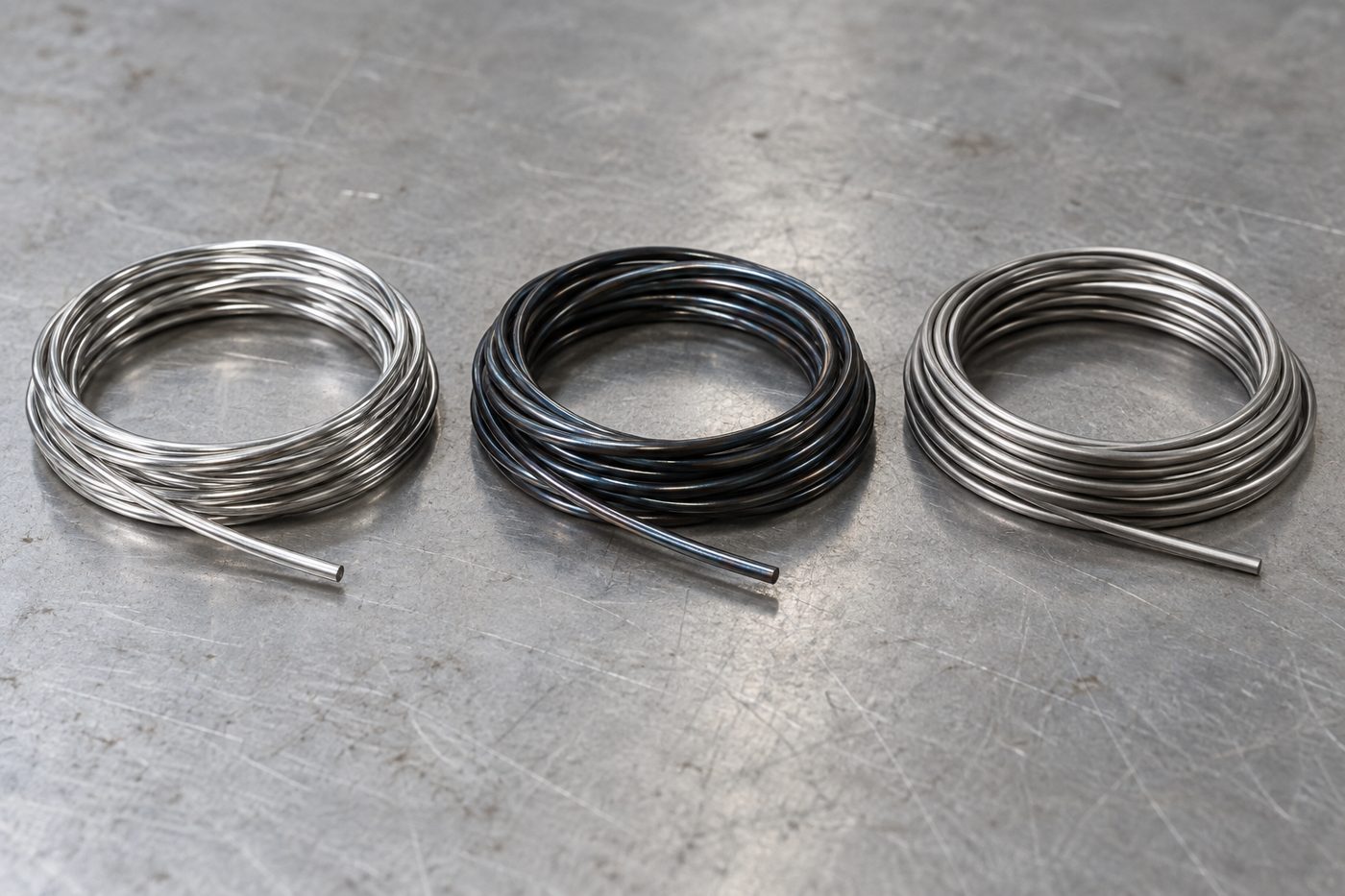
Cover image: an illustration of three spring wire types, not a photograph of our products.
The right spring wire material comes from four facts about the job: the highest temperature the spring will see, what it touches (water, salt, oil, skin, medication), how hard and how often it is loaded, and how much you can spend. Those four facts narrow the choice to one family: carbon wire, chrome alloy wire or stainless steel. Only then does the exact grade matter.
The grade name is where international orders go wrong. The same chrome-silicon valve spring wire is called SWOSC-V in Japan, ASTM A877 or SAE 9254 in the United States, VDSiCr in Europe and 55SiCr in China. Meanwhile, a drawing that only says “spring steel” tells the manufacturer almost nothing. This guide lines up the common grades across GB, JIS, ASTM/SAE and EN, shows where the look-alikes differ, and ends with what to write on your drawing. For the rest of a compression spring RFQ, see our compression spring specification guide.
Key takeaways
- Pick the family before the grade. Temperature, environment and loading decide between carbon, chrome alloy and stainless wire.
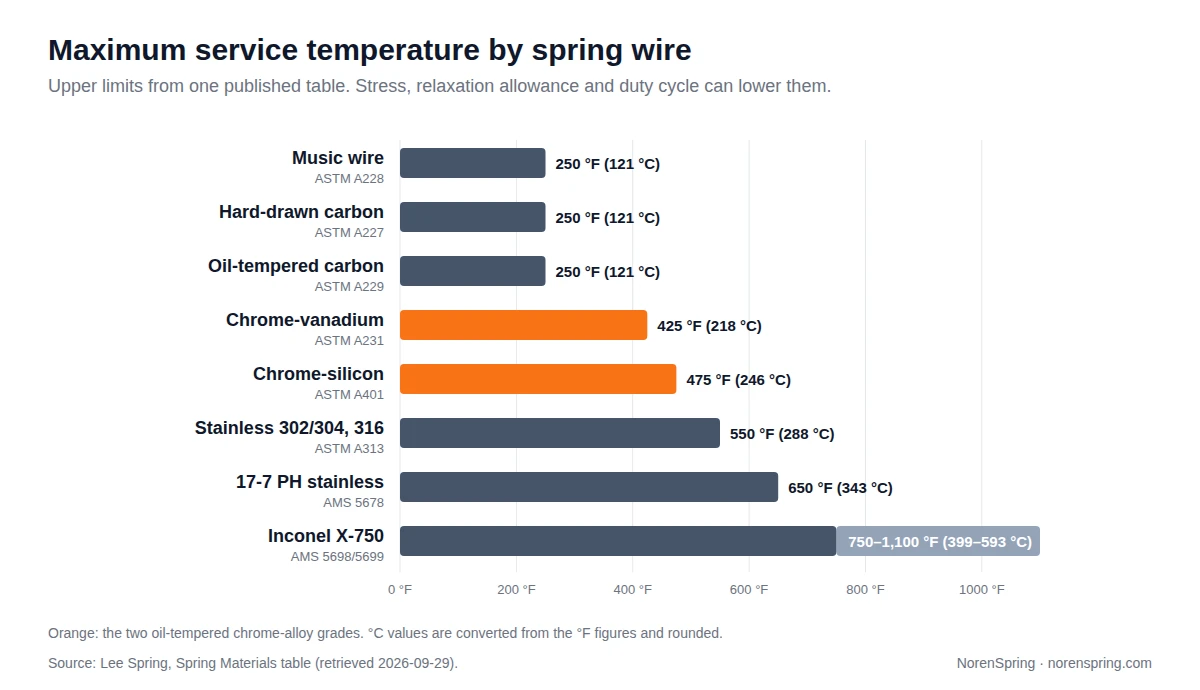
- Carbon wire has a low temperature ceiling. Lee Spring’s material table lists 250 °F (121 °C) for music, hard-drawn and oil-tempered carbon wire, against 425 °F for chrome-vanadium and 475 °F for chrome-silicon.
- Equivalents are close, not identical. 50CrVA lines up with SAE 6150 and JIS SUP10. SWOSC-V lines up with SAE 9254 and 55SiCr. 60Si2Mn is not SWOSC-V: it is a silicon-manganese steel with no specified chromium.
- Stainless springs are softer. The same geometry in 302/304 stainless gives about 13% less rate than carbon steel, because its shear modulus is lower.
- Write grade plus standard. “SWOSC-V to JIS G3561” or “ASTM A228” is a specification. “Spring steel” is not.
The main spring wire families
Most springs are made from one of six families of wire. Lee Spring’s material table describes them like this:
- Hard-drawn carbon wire (ASTM A227, JIS SWC): “general purpose spring wire for low to average stress applications”. It is cold drawn and usually the lowest-cost choice.
- Music wire (ASTM A228, JIS SWP): a high-quality cold-drawn carbon wire with a good surface finish and “generally good fatigue life due to high tensile strength”. It is the usual choice for small, highly stressed springs.
- Oil-tempered carbon wire (ASTM A229, JIS SWO): general purpose wire for average stress, “often used for larger wire sizes when Music Wire is not available”.
- Oil-tempered chrome-vanadium and chrome-silicon (ASTM A231/A232 and A401/A877): alloy wire “used for shock loads and moderately elevated temperatures”.
- Silicon-manganese steel (GB 60Si2Mn, JIS SUP6, SAE 9260): a common Chinese spring steel for heavier springs. It sits in GB/T 1222 with the other hot-rolled spring steels.
- Stainless steel (ASTM A313: 302/304, 316, 17-7 PH): chosen for corrosion and heat resistance. Lee Spring notes that 316 has “better corrosion resistance than Type 302/304” and “resists chloride attack”.
Beyond these, springs are also made from copper alloys (phosphor bronze, beryllium copper) for electrical contacts, and nickel or titanium alloys for high temperature or special corrosion. Those are specified case by case.
Spring wire grade cross-reference: China, Japan, US and Europe
The table below lines up the grades that appear most often on spring drawings. Treat each row as a list of close equivalents. Chemistry ranges, tensile classes and testing rules differ from standard to standard, so a substitution should always be confirmed in writing for your part.
| Family | China (GB) | Japan (JIS) | US (ASTM / SAE) | Europe (EN) |
|---|---|---|---|---|
| Hard-drawn carbon | GB/T 4357 carbon spring steel wire | G3521 SWC (SW-B, SW-C) | A227, SAE J113 | EN 10270-1 |
| Music wire | Our own records use the JIS name, SWP-B | G3522 SWP-A, SWP-B | A228, SAE J178 | EN 10270-1 |
| Oil-tempered carbon | — | G3560 SWO-A, SWO-B | A229, SAE 1065 | EN 10270-2 |
| Chrome-silicon (valve) | 55SiCr | G3561 SWOSC-V | A877 (A401 commercial), SAE 9254 | EN 10270-2 VDSiCr; EN 10089 54SiCr6 |
| Chrome-vanadium | 50CrV (formerly 50CrVA) | G3561 SWOCV-V (wire); G4801 SUP10 (bar) | A232 valve, A231 commercial; SAE 6150 | EN 10270-2 |
| Silicon-manganese | 60Si2Mn | G4801 SUP6 | SAE 9260 (closest) | No direct equivalent listed |
| Manganese carbon | 65Mn | No equivalent listed | SAE 1566 (closest by chemistry) | No equivalent listed |
| Stainless | Our own records use SUS304, SUS316 | G4314 (SUS304, SUS316) | A313: 302, 304, 316 | EN 10270-3 |
Sources: Gibbs Wire & Steel specification cross-reference; GB/T 1222-2016 Annex C; GB/T 4357-2022; JIS and SAE chemistries as tabulated by Kobe Steel. Rows marked “closest” are our reading of the published chemistry, not an official equivalence.
Common mix-ups
60Si2Mn and SWOSC-V are different steels. They are often listed together because both contain silicon. But SWOSC-V is a chrome-silicon wire with 0.50–0.80% chromium, the same range as China’s 55SiCr, and the Gibbs Wire cross-reference lists it alongside SAE 9254 and ASTM A877. 60Si2Mn has 1.50–2.00% silicon and no specified chromium. GB/T 1222 maps it to JIS SUP6, not SWOSC-V. The chemistry here is from the 2016 edition. GB/T 1222-2025 changed the silicon range and mechanical properties for 60Si2Mn, but did not turn it into a chromium steel.
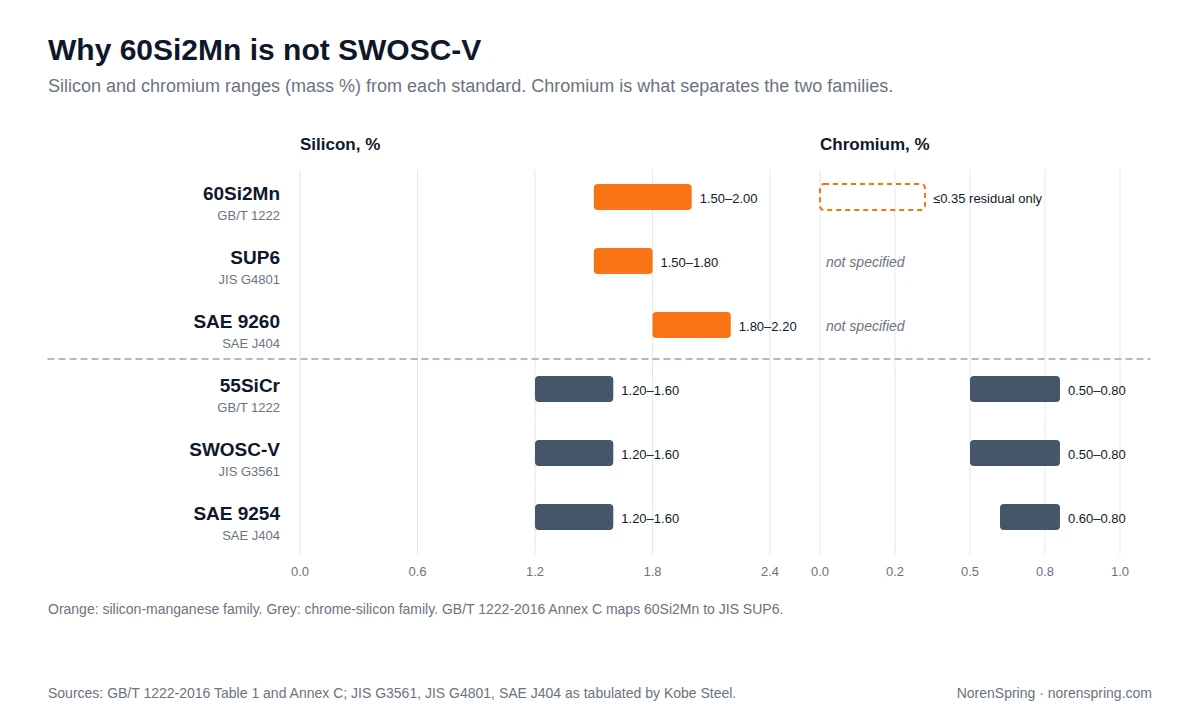
50CrVA and 50CrV. GB/T 1222-2016 names the grade 50CrV. “50CrVA” is the older name and is still common on drawings. The standard’s own comparison table maps it to JIS SUP10. SAE 6150 has the same chromium range, 0.80–1.10%.
SK5 is not a spring wire standard. SK5, renamed SK85 in JIS G4401, is a carbon tool steel. It turns up on drawings for circlips and flat spring parts. It is a valid choice, but it is not a substitute for a spring wire grade.
How the families compare: temperature, strength and corrosion
Temperature is usually the first limit you hit. Carbon wire relaxes, meaning it loses load, as it gets hot. Lee Spring’s table gives these maximum operating temperatures:
Three other differences matter when you compare quotes:
- Rate. All the carbon and chrome alloy wires share a shear modulus of about 11.5 × 10⁶ psi. Stainless 302/304 is 10 × 10⁶ psi. The same geometry in stainless therefore gives about 13% less force, so a stainless version of a carbon spring needs a redesign, not just a material swap. Our spring rate guide lists the shear modulus of each grade and includes a calculator for comparing materials.
- Corrosion. Carbon and chrome alloy wire need a finish if they will see moisture. Stainless 304 handles most wet and washdown service. Choose 316 where chlorides are present, such as salt water.
- Magnetism. Lee Spring describes carbon and chrome alloy wire as highly magnetic and 300-series stainless as slightly magnetic. This matters for sensors and some electronic assemblies.
How to choose: five questions in order
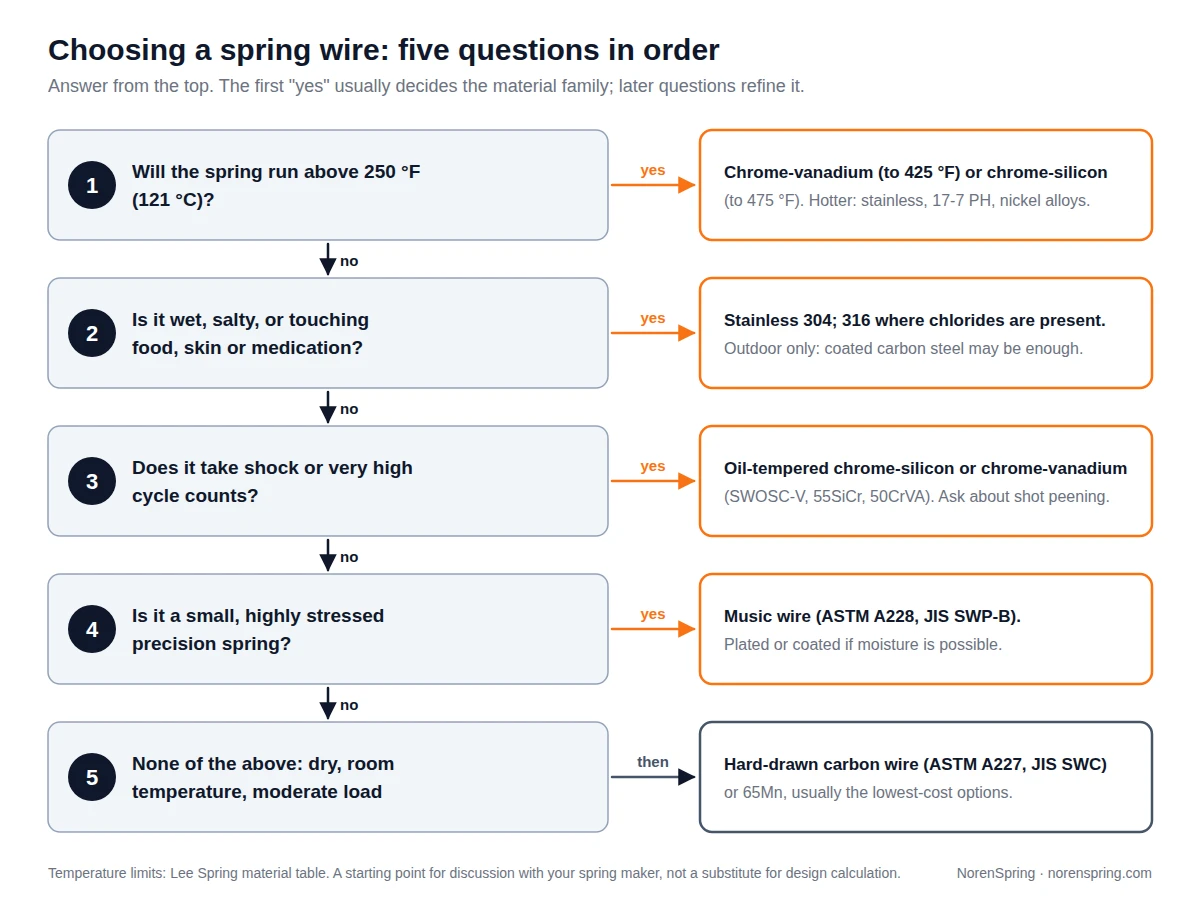
- Temperature. Above 250 °F (121 °C), move from carbon wire to chrome-vanadium or chrome-silicon. Above 475 °F, look at stainless steel, 17-7 PH or nickel alloys.
- Environment. Stainless 304 is the default for wet service and for contact with food, skin or medication. Use 316 for chlorides. For outdoor equipment that only sees rain, a coated carbon or alloy spring is often enough and costs less.
- Loading. Shock loads and very high cycle counts favour oil-tempered chrome-silicon or chrome-vanadium. Shot peening improves fatigue life further, so ask about it for heavily cycled parts.
- Size and stress. Small springs with high stress are usually music wire. Larger, heavier springs usually use oil-tempered or hot-rolled alloy steels such as 50CrVA or 60Si2Mn.
- Cost. When none of the above applies, hard-drawn carbon wire (SWC, ASTM A227) or 65Mn is the most economical choice.
If you are not sure, describe the operating conditions and let the manufacturer propose a grade. That is better than naming a grade that does not fit the job.
What we actually use: 36 case parts by material
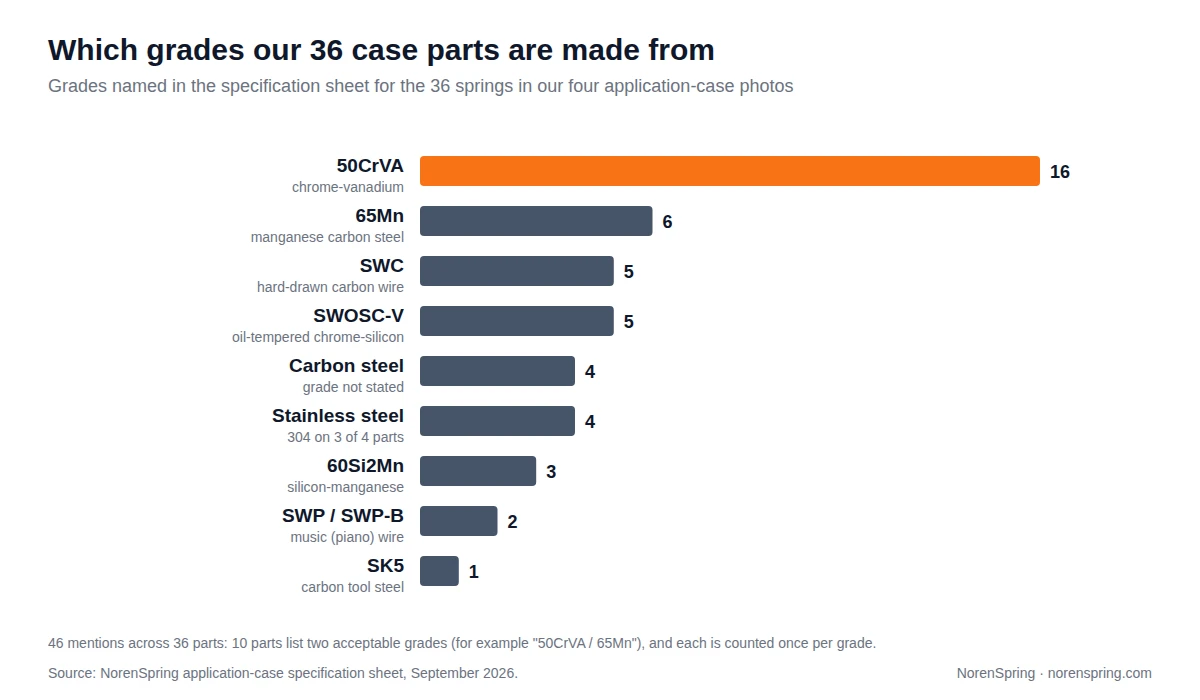
The four application-case photos on our case pages show 36 real springs and wire forms. When we listed the specified material for each part, 50CrVA came out far ahead of every other grade.
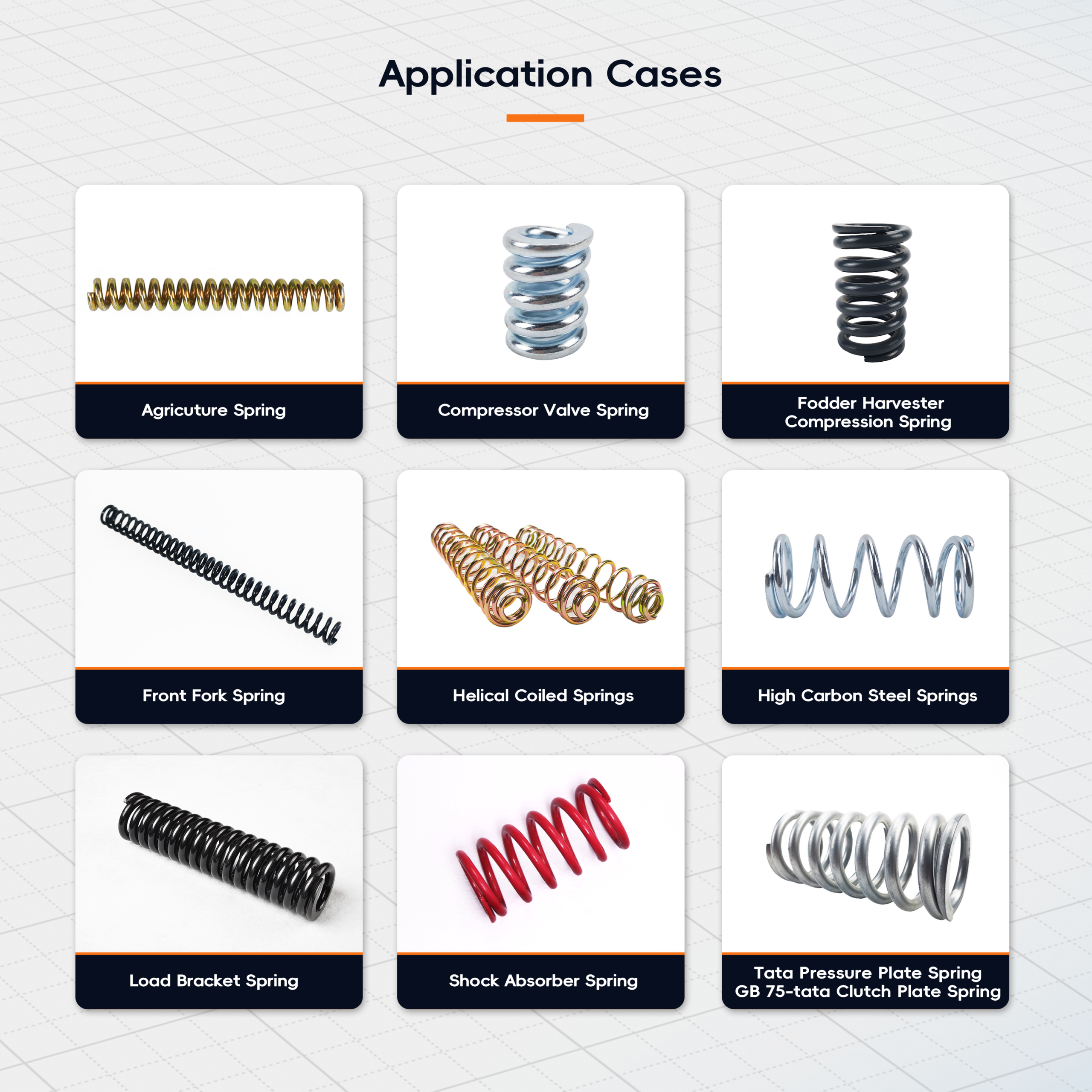
Why agricultural tines are mostly 50CrVA
Thirteen of the 16 parts that list 50CrVA are agricultural: reel tines, baler tines, harrow and cultivator tines, and harvester compression springs. Their wire diameters run from 3 to 12 mm. These tines and springs take repeated shock loads in the field, which is the use Lee Spring describes for chrome-vanadium wire. The finishes are phosphate, black oxide, paint or powder coating. Most are custom torsion springs and wire forms. You can see the parts on our torsion spring and wire form case pages, and read more about the sector on our agricultural machinery spring page. Our spring tines guide explains how to measure and specify a replacement tine.
Where the other grades go
- SWOSC-V appears on the compressor valve spring, the front fork spring, the shock absorber spring and general torsion springs. These parts cycle constantly, which is the job chrome-silicon valve wire was developed for.
- SWC and 65Mn appear on tractor pedal return springs, general extension springs and circlips, which are moderate-stress parts where cost matters.
- Stainless 304 appears on the exhaust pipe spring, the gym equipment spring and a chain tensioner spring. Stainless is typically chosen for heat, moisture or appearance. The finish is passivation or polishing.
- Music wire (SWP-B) appears on a cable reel extension spring with 1–4 mm wire.
For coil springs in any of these grades, see our custom compression springs range. For hooked springs, see our guide to specifying a custom extension spring.
Material and finish go together
The finish should follow the material and the environment. Across our 36 case parts, the finishes are black oxide, phosphate, zinc or nickel plating, paint and powder coating on carbon and alloy steels, and passivation or polishing on stainless steel. Our spring finishes and coatings guide compares each of these finishes and what to put on the drawing. Stainless springs for insulin pens, lancets and other devices are covered on our springs for medical devices page.
One rule matters more than the rest. Electroplating can put hydrogen into high-strength spring steel and make it brittle. Lee Spring’s coatings guide says: “To relieve embrittlement, the springs must be baked immediately after plating to drive the hydrogen out of the material”. It adds that the risk rises with high stress concentration, high hardness and high carbon content. ASTM B850 is the standard guide for these post-coating treatments. If you specify zinc or nickel plating on a chrome alloy spring, make sure the quote includes baking.
How we check the wire you specified
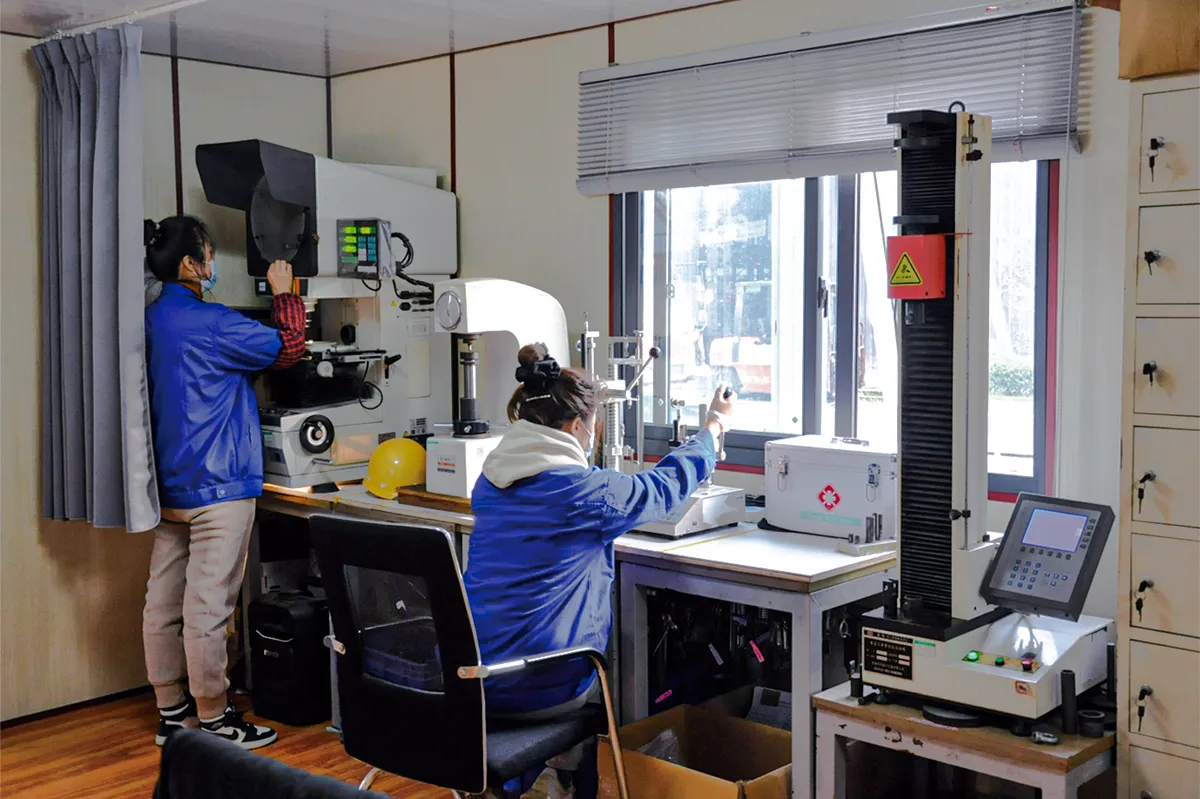
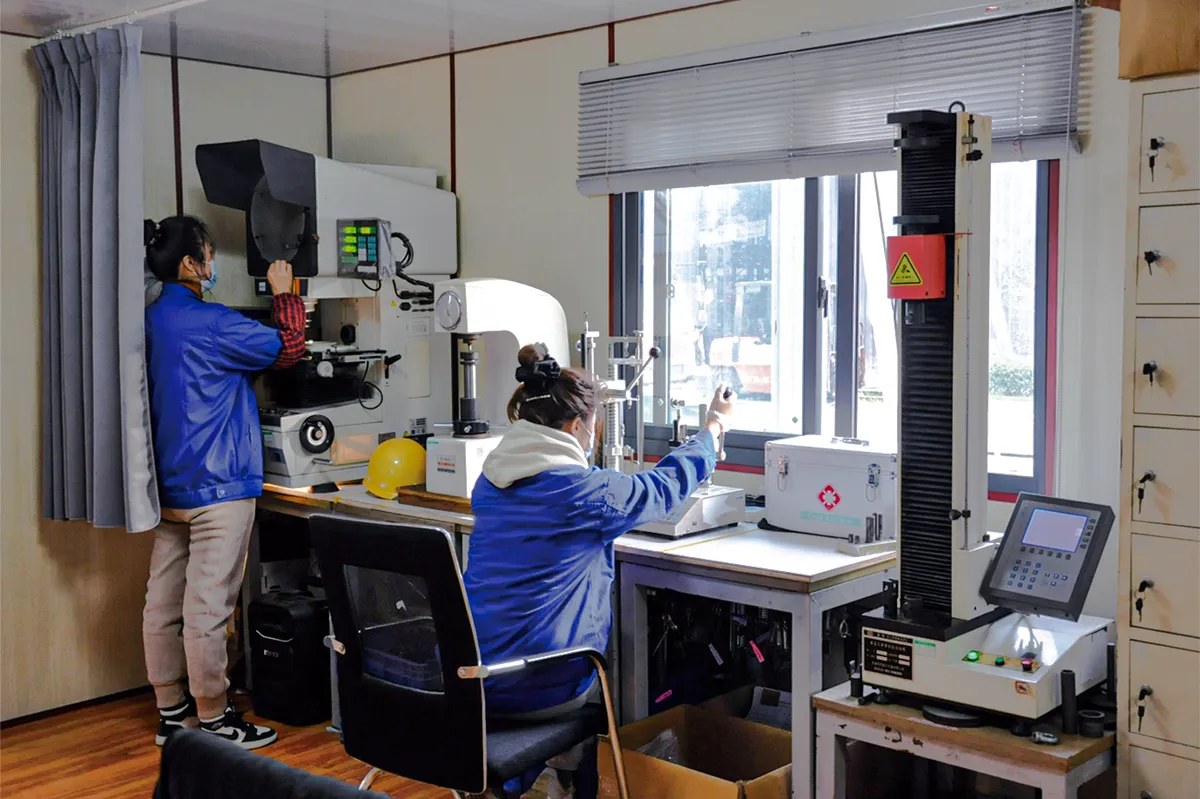
A grade on a drawing is only useful if the incoming wire matches it. Material certificates are part of the documentation we agree at project setup. Our in-house lab also has equipment to check the steel itself:
- Material analysis: material analysers (Thermo Scientific Niton XL2 series and OES) to confirm steel grades and to tell SUS304 from SUS316.
- Hardness: Mitutoyo Rockwell testers (HR-530 and HR-150A series) for 50CrVA, 65Mn and SWOSC-V parts, and a Mitutoyo HM-200 micro-Vickers tester for surface hardness and heat-treatment checks.
- Microstructure: an Olympus GX53 metallographic microscope for heat-treatment structure and crack analysis.
- Corrosion: a Q-Fog CCT1100 and neutral salt-spray testers for zinc, nickel and e-coat finishes.
Which of these checks your part receives is agreed in the control plan. See our capabilities page for the full equipment list.
What to put on your drawing or RFQ
Copy this into your RFQ and fill in what you know:
| Item | Example |
|---|---|
| Grade and standard | SWOSC-V to JIS G3561; or ASTM A228; or 50CrV (50CrVA) to GB/T 1222-2025 |
| Acceptable alternatives | “SAE 9254 or 55SiCr acceptable with written approval” |
| Operating temperature | Continuous and peak, for example 100 °C continuous, 140 °C peak |
| Environment | Indoor dry / outdoor / washdown / salt spray / oil / skin or medication contact |
| Loading | Static, cyclic (state cycles if known) or shock |
| Finish | Black oxide, phosphate, zinc (with baking), powder coat, passivation |
| Documents | Material certificate, hardness report, salt-spray report if required |
No grade in mind? Send the environment, temperature and loading, plus the wire diameter d, outside diameter and free length, and our engineers will propose a grade. We work with wire from 0.1 mm to 80 mm and reply to inquiries within 24 hours. Our torsion spring specification guide covers the inputs for torsion springs. For how China’s spring steel standard changed in 2025, see our GB/T 1222-2025 overview.
Have a drawing that lists a material you cannot source?
Send it to us with the grade as written. We will tell you which Chinese, Japanese, US or European grade we would use, how close it is, and what, if anything, changes in the design. Contact our engineering team.
Frequently asked questions
Is 50CrVA the same as SAE 6150?
They are close equivalents. Both are chrome-vanadium spring steels with 0.80–1.10% chromium, and GB/T 1222 maps 50CrV to JIS SUP10. The carbon and vanadium ranges differ slightly, so confirm the substitution for fatigue-critical parts.
Is 60Si2Mn the same as SWOSC-V?
No. SWOSC-V is a chrome-silicon wire with 0.50–0.80% chromium, equivalent to SAE 9254 and China’s 55SiCr. 60Si2Mn is a silicon-manganese steel with no specified chromium. Its closest matches are JIS SUP6 and SAE 9260.
Should I use music wire or oil-tempered wire?
Music wire is the usual choice for small, highly stressed springs because of its high tensile strength and good surface finish. Oil-tempered wire is common for larger wire sizes. Both are carbon steels with the same 250 °F (121 °C) limit in Lee Spring’s table, so neither suits hot service.
Stainless 304 or zinc-plated carbon steel for outdoor use?
Zinc-plated or coated carbon steel is often enough for equipment that sees rain and dries out. Choose stainless 304 for constant moisture or washdown, and 316 for salt water. Remember that the stainless spring will be about 13% softer at the same geometry.
What happens if my drawing only says “spring steel”?
The manufacturer has to choose for you, and two suppliers may quote different grades for the same part. That makes quotes hard to compare and replacement parts inconsistent. State the grade and the standard, or at least the temperature, environment and loading.
About the authors
This guide was prepared by the NorenSpring engineering team, which designs and manufactures custom compression, extension and torsion springs and wire forms in Xuzhou, China. Technical review by Feng Yulin, General Manager and senior structural engineer, who has 15 years of spring R&D experience and more than 30 national patents. NorenSpring holds IATF 16949, ISO 9001, ISO 13485, ISO 14001 and ISO 45001 certifications. More about NorenSpring.
Sources
- Gibbs Wire & Steel, Specification Cross-Reference of Spring Materials: Wire and Strip (dated 2012-11-27). Source for the ASTM, SAE, EN and JIS cross-references. Retrieved 2026-09-29.
- SAC, GB/T 1222-2016 Spring steels, Table 1 (chemical composition) and Annex C (comparison of grades), English edition. Retrieved 2026-09-29.
- Kobe Steel, Wire Rods and Bars Specification Tables. Source for JIS G3561, G4801 and G4401 and SAE J403 and J404 chemistries. Retrieved 2026-09-29.
- Lee Spring, Spring Materials. Source for maximum operating temperatures, moduli and material descriptions. Retrieved 2026-09-29.
- Lee Spring, Spring Coatings and Surface Treatments. Source for the hydrogen embrittlement quotation. Retrieved 2026-09-29.
- Suzuki Garphyttan, SWOSC-V. Source for SWOSC-V conformity with EN 10270-2 VDSiCr and ASTM A877. Retrieved 2026-09-29.
- SAC, GB/T 4357-2022 Carbon spring steel wire (national standard record in the SAMR standards catalogue, std.samr.gov.cn). Retrieved 2026-09-29.
- ASTM International, ASTM B850, Standard Guide for Post-Coating Treatments of Steel for Reducing the Risk of Hydrogen Embrittlement. Retrieved 2026-09-29.
- NorenSpring application-case specification sheet (36 parts), September 2026. Internal data.