In this article
- Key takeaways
- What dimensions define a compression spring?
- 1. Start with the space the spring has to fit
- 2. Define the working points, not just a spring rate
- 3. Why small dimension changes move the force so much
- 4. Check solid height and buckling before you commit
- 5. Choose the material for the environment, not the catalogue
- 6. Specify end type, squareness and surface finish
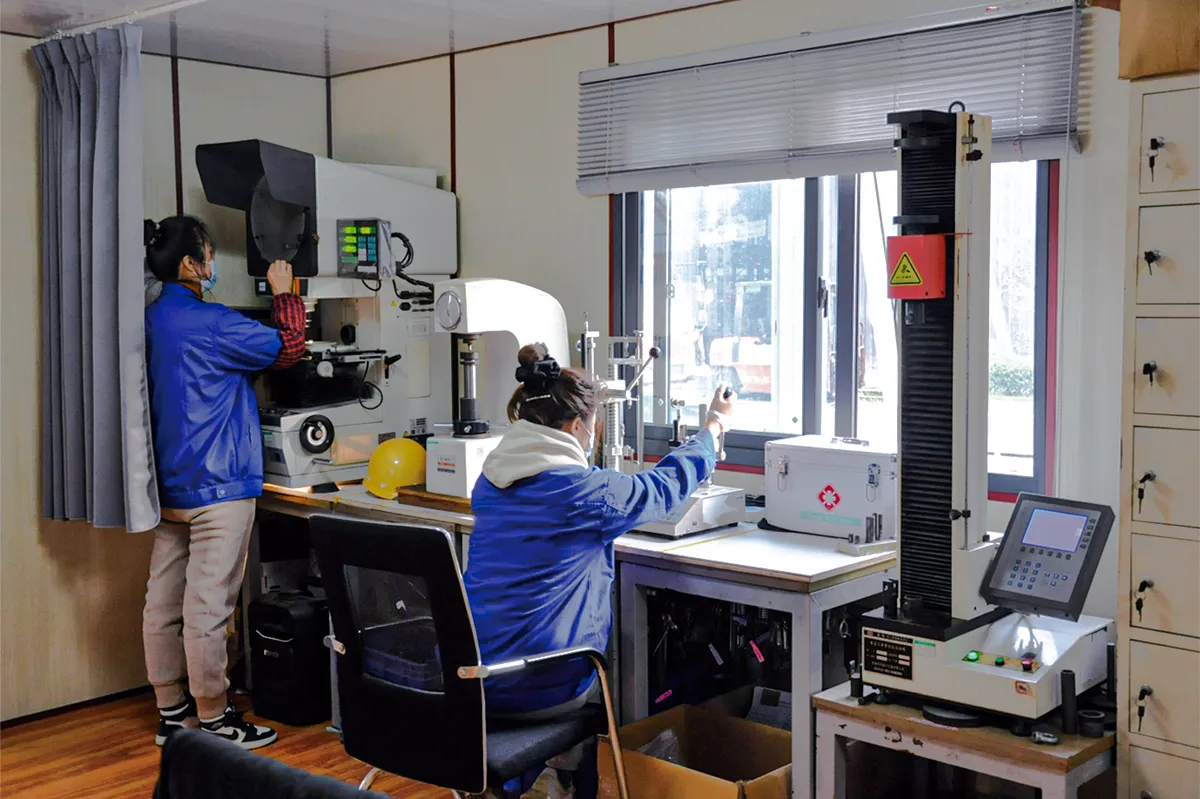
- 7. Set tolerances and inspection that match the risk
- 8. State the quantity, timeline and packaging
- Custom compression spring RFQ checklist
- What happens after you send the inquiry
- Have a drawing or a sample spring?
- Frequently asked questions
- About the authors
- Sources
To get an accurate quote for a custom compression spring, send your manufacturer three dimensions (wire diameter, outside diameter and free length), at least one working point (the load you need at a given compressed length), the material, the end type, the operating environment and the quantity. Everything else can be calculated, but these inputs cannot be guessed.
Most quote delays we see do not come from difficult springs. They come from incomplete drawings: a free length with no load, a load with no length, or an outside diameter that has to fit a bore nobody mentioned. This guide walks through each input in the order our engineers check it, explains why small changes matter more than buyers expect, and ends with a checklist you can paste straight into your RFQ. If your part is an extension or torsion spring, see our guides to custom extension springs and custom torsion springs.
Key takeaways
- Specify function, not just geometry. A load at a stated length is worth more than a spring rate plus a coil count.
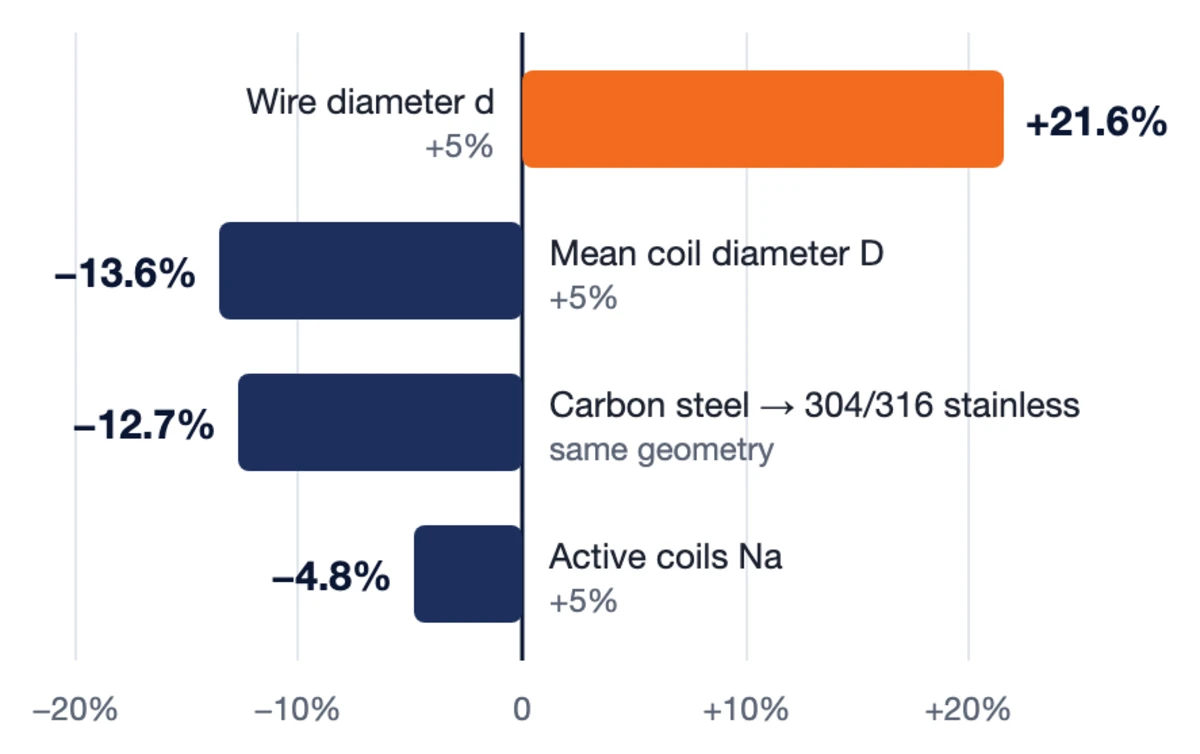
- Wire diameter dominates. Spring rate scales with the fourth power of wire diameter, so a 5% increase in wire size raises the rate by about 22% (a 5% decrease cuts it by about 19%).
- Check the space before the spring. Confirm solid height, bore or rod clearance and buckling risk. Springs longer than about four times their mean diameter may buckle.
- Material changes the rate. For the same geometry, 304/316 stainless gives roughly 13% less force than carbon spring steel.
- Tolerance only what matters. Commercial tolerances keep cost down. Tighten only the characteristics that affect your assembly.
What dimensions define a compression spring?
A helical compression spring is defined by a few dimensions you can measure with a caliper, plus the lengths and loads that describe how it works in your assembly. The diagram below shows the names used on most spring drawings and in our engineering review form.
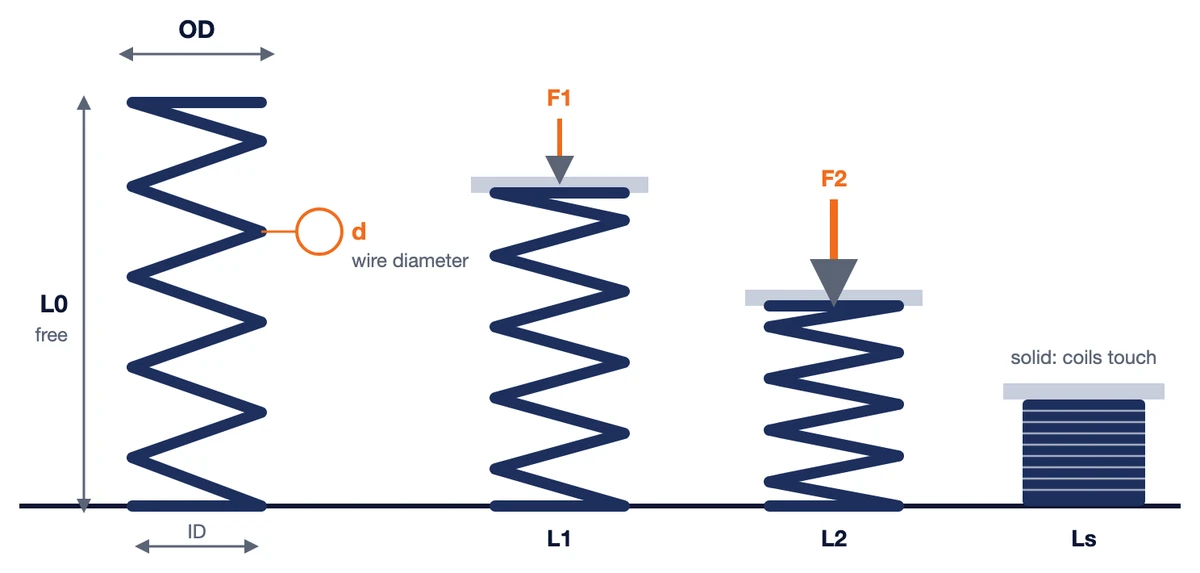
| Symbol | Name | Why it matters |
|---|---|---|
| d | Wire diameter | Largest single effect on stiffness and stress. |
| OD / ID | Outside / inside diameter | OD must clear the bore. ID must clear the rod. Mean diameter D = OD − d. |
| L0 | Free length | Unloaded length. Sets preload at the installed height. |
| L1, F1 / L2, F2 | Working points | The force the spring must deliver at each length. This is the function you are paying for. |
| Ls | Solid height | Length with all coils touching. Your shortest working length must stay above it. |
| Na / Nt | Active / total coils | Normally derived by the manufacturer from the working points. Rarely needs to be fixed on the drawing. |
1. Start with the space the spring has to fit
Before any load calculation, tell the manufacturer about the physical envelope: the bore the spring sits in, the rod or pin it slides over, and the shortest distance it will be compressed to. Those limits decide which designs are possible at all.
- Working in a bore? Give the bore diameter, not only the spring OD. A compression spring’s outside diameter grows as it is compressed. Lee Spring’s design guidance recommends checking that expansion against the hole using the high side of the OD tolerance.
- Working over a rod? Give the rod diameter. The same guidance says to check the ID using the low side of the tolerance.
- Only one diameter is critical. Put the tolerance on the OD or the ID, whichever touches your part, and leave the other as a reference dimension.
If the space is too short for a coil spring, a flat-wire wave spring may fit; our guide to specifying a custom wave spring covers when it does. If the problem is solid height rather than free length, a conical spring whose coils telescope can close to about one or two wire diameters; see our conical spring guide.
2. Define the working points, not just a spring rate
A spring rate (N/mm) says how stiff the spring is. It does not say how much force you get at your installed height. The most useful line on a spring drawing is a load at a length, for example “F1 = 25 N ± 10% at L1 = 22 mm.”
Give one working point if the spring does one job, such as holding a valve closed. Give two if both the start and end of the stroke matter, such as a return spring that must overcome friction at full travel. With two points, the manufacturer can derive the rate, free length and active coils for you.
Tip: Do not fix every value at once. If you specify free length, wire diameter, OD, coil count and a load, the design is over-constrained, and normal material variation makes it impossible to hold all five. Lee Spring’s guidance recommends putting the tolerance on spring rate or load rather than on the number of coils, because coil count is what the coiler adjusts to hit the load.
3. Why small dimension changes move the force so much
The stiffness of a helical compression spring comes from a standard formula found in every machine design textbook:
k = G · d⁴ / (8 · D³ · Na)
k = spring rate (N/mm) · G = shear modulus of the wire (N/mm²) · d = wire diameter · D = mean coil diameter (OD − d) · Na = number of active coils
The exponents are the important part. Wire diameter is raised to the fourth power and mean diameter to the third, so modest changes in either have large effects. The chart shows what a +5% change in each input does to the rate. We calculated the numbers directly from the formula, and the material bar uses the shear modulus values Tokai Spring publishes for its design calculations. Our spring rate guide has a free calculator for this formula and explains why a measured rate can differ from it.
A worked example
Take a music-wire spring with d = 1.0 mm, OD = 10 mm (so D = 9 mm) and 8 active coils. Using G = 78,500 N/mm², the rate is 78,500 ÷ (8 × 729 × 8) ≈ 1.68 N/mm. Make the identical spring in 304 stainless (G = 68,500 N/mm²) and the rate drops to about 1.47 N/mm. If your drawing only says “OD 10, d 1.0, 8 coils, stainless,” you will get a spring that is 13% weaker than the carbon-steel sample it replaces. That is why we ask for the load, not just the dimensions.
The same example shows the spring index, C = D/d = 9. Shigley’s Mechanical Engineering Design gives a preferred index range of about 4 to 12. Below that, the wire is hard to coil tightly enough. Above it, springs become unstable to form and tend to tangle in bulk packing. If your space forces an index outside this range, flag it early so the manufacturer can suggest another geometry.
4. Check solid height and buckling before you commit
Solid height
For a spring with closed and ground ends, solid height is roughly the total number of coils multiplied by the wire diameter. Lee Spring’s design procedure adds a 5% allowance to that nominal figure to get the maximum solid height. In the example above, 8 active coils plus 2 closed end coils gives 10 total coils, so Ls ≈ 10 mm nominal, or up to about 10.5 mm. Your shortest working length L2 has to stay clearly above that value. If the space is too short for a cylindrical design, a conical spring can nest its coils to reach a lower solid height.
The same procedure flags stress at solid height. If the spring can be compressed solid in service and the stress there exceeds about 40% of the material’s tensile strength, the spring should be pre-set or designed with set in mind. Above about 60%, it needs redesigning. You don’t need to run that calculation yourself. Just tell the manufacturer whether the spring can ever go solid in your assembly.
Buckling
A long, thin compression spring behaves like a column. Norton’s Machine Design: An Integrated Approach uses the ratio of free length to mean coil diameter (L0/D) as the slenderness measure and notes that above 4, the spring may buckle. End conditions matter too. A spring held between parallel plates is more stable than one with an end that can tip.
If your design needs a slender spring, say whether it runs in a bore or over a rod. Guiding it prevents gross buckling. The same textbook points out that coils rubbing on the guide lose some force to friction, so the delivered load will be slightly lower.
5. Choose the material for the environment, not the catalogue
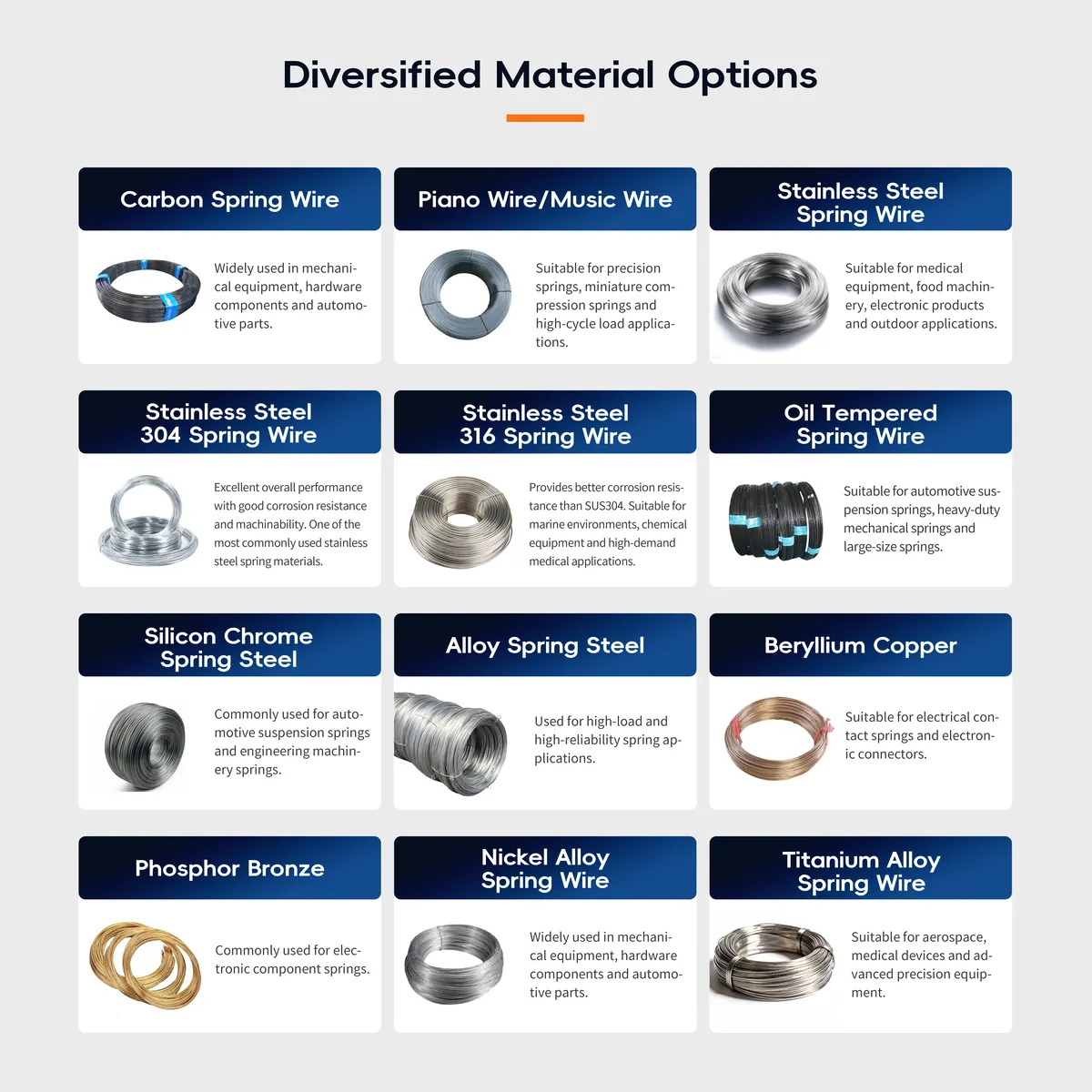
Material choice decides three things: how much stress the spring can take, how it behaves at temperature, and how it resists corrosion. Tell your supplier the operating temperature range and what the spring will touch (water, oil, cleaning chemicals, salt spray, skin or medication), and let them propose a grade. The table covers the materials our engineers specify most often for compression springs. Our spring wire material guide compares the common grades in more detail.
| Material | Typical use | Things to tell your supplier |
|---|---|---|
| Music wire / piano wire | Precision and miniature springs, high-cycle loads | Needs plating or coating if exposed to moisture. |
| Carbon spring wire | General machinery, hardware, automotive parts | Most economical option for dry, room-temperature service. |
| Oil-tempered wire | Heavy-duty and large-size springs, suspension | Good choice for larger wire diameters. For very high loads in tooling, see die springs. |
| Silicon-chrome spring steel | Automotive suspension, engineering machinery | Specify shock or fatigue loading and temperature. |
| Stainless 304 | Food machinery, electronics, outdoor use | About 13% lower rate than carbon steel at the same geometry. |
| Stainless 316 | Marine, chemical and demanding medical applications | Better corrosion resistance than 304. Mention chloride exposure. |
| Beryllium copper / phosphor bronze | Electrical contacts and connectors | State conductivity or non-magnetic requirements. |
| Nickel and titanium alloys | Aerospace, medical and high-temperature equipment | Give the exact temperature and any certification needs. |
6. Specify end type, squareness and surface finish
End type changes solid height, how squarely the spring sits and how much it costs.
- Closed and ground: the flattest, most stable seat. Best for loads above light duty and for slender springs. Grinding adds an operation.
- Closed, not ground: lower cost and common on small wire diameters, where grinding is hard to do and adds little.
- Open ends: rarely the right choice unless the spring sits over a locating feature.
Squareness describes how upright the spring stands. Lee Spring lists 3° maximum as its standard squareness tolerance and notes that tighter values add coiling and grinding setup cost. Only ask for tighter squareness if the spring pushes against a precision face.
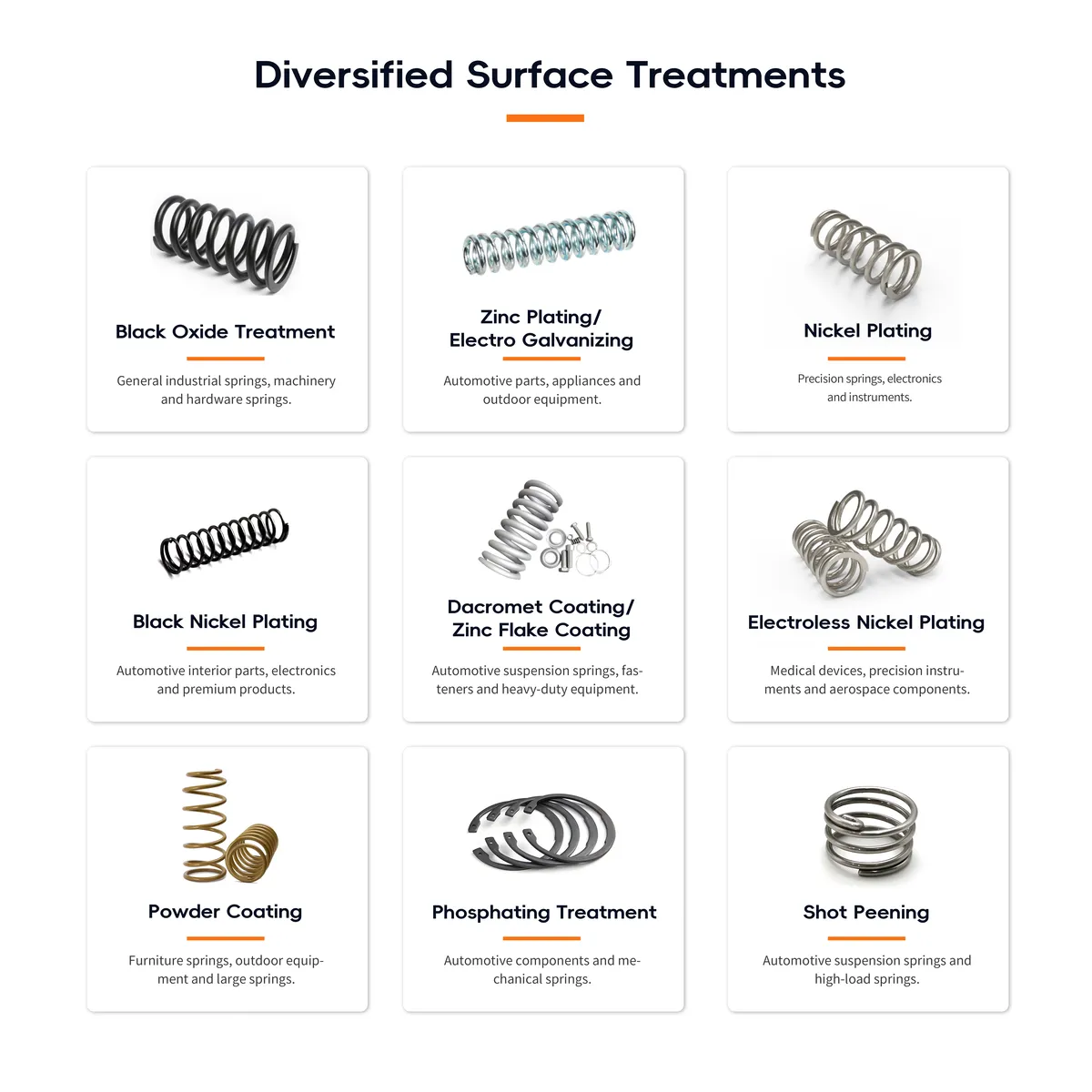
Surface finish should follow the environment you described in step 5. Common options include black oxide, zinc or electro-galvanising, nickel plating, Dacromet or zinc-flake coating, powder coating, phosphating and, for stainless steel, passivation. Shot peening is a fatigue-life treatment, not a corrosion one, so mention it separately if the spring is cycled heavily.
7. Set tolerances and inspection that match the risk
Every tight tolerance adds inspection time, scrap risk or both. Lee Spring’s guidance recommends commercial tolerances wherever possible and checking tighter ones against the process capability first. A practical way to decide:
- Mark the one or two characteristics that affect your assembly, usually a load at length and the OD or ID.
- Leave everything else as a reference dimension or commercial tolerance.
- State what records you need with delivery: dimensional report, load test results, material certificate or first-article inspection. For aerospace equipment springs, that usually means a FAIR.
- Say whether the part falls under a quality system such as IATF 16949 for automotive or ISO 13485 for medical devices, so the right controls are applied from the first sample.
8. State the quantity, timeline and packaging
Quantity changes the process. A few prototypes can be coiled on a setup that would be wasteful for 100,000 pieces, and a high-volume run can justify dedicated tooling or automated inspection. Give your prototype quantity, expected annual volume and target date together.
For reference, NorenSpring produces prototypes from a single piece, ships standard stock items in about 3 days and custom-developed springs in 7 to 14 days, depending on material availability and secondary processes. Tell us if springs must be separated or tray-packed. Springs with a high index tangle easily in bulk bags.
Custom compression spring RFQ checklist
Copy this list into your inquiry. If you can fill in the first seven lines, an engineer can usually return a design proposal or quote without further questions. The example column describes one consistent design: the stainless version of the worked example above.
| # | Item | Example |
|---|---|---|
| 1 | Wire diameter d | 1.0 mm (or “open, engineer to propose”) |
| 2 | OD or ID + the bore or rod it fits | OD 10 mm max, works in Ø11 mm bore |
| 3 | Free length L0 | 30 mm |
| 4 | Working point(s) | F1 = 12 N ± 10% at 22 mm; F2 ≈ 21 N at 16 mm |
| 5 | Material or environment | 304 stainless, washdown, 20–60 °C |
| 6 | End type | Closed and ground both ends |
| 7 | Quantity and timing | 50 prototypes, then 20k/year |
| 8 | Surface finish | Passivated / zinc / none |
| 9 | Cycle life or duty | ~500,000 cycles, 1 Hz |
| 10 | Documentation | Material cert + load test report |
No drawing? A clear photo of the old spring next to a ruler, the measured d, OD and free length, and the force you need is enough to start. You can also enter these three dimensions directly in the engineering review form.
What happens after you send the inquiry
At NorenSpring, each inquiry goes through the same five steps. Our engineering team reviews your drawing, sample or operating requirements. They check geometry, material and tolerances for manufacturability. Next, samples are made and verified for dimensions and load. Approved parts move into controlled production on CNC coiling equipment with repeatable settings. Every batch is inspected before it is packed and shipped with the records you asked for. Most of the questions answered in this guide are the ones our engineers would otherwise have to ask you in step one.

Have a drawing or a sample spring?
Send the drawing, CAD file or sketch you already have, or just the three dimensions you know. An engineer will confirm the missing values, flag any buckling or solid-height risk, and quote from there. If you’re comparing suppliers, see what we make as a custom compression spring manufacturer.
Upload a drawing See custom compression springs
Frequently asked questions
What is the minimum information needed to quote a compression spring?
Wire diameter, outside diameter and free length describe the geometry. To be sure the spring works, also give one load at a stated length, the material or environment, and the quantity. With those, an engineer can check stress, solid height and buckling before quoting.
Should I specify spring rate or load at a length?
Load at a length, in most cases. It describes what the spring has to do in your assembly, and the manufacturer can adjust coil count to hold it despite normal wire variation. Specify a rate only when the force change across the stroke matters more than the absolute force.
Why does my replacement spring feel weaker than the original?
The usual causes are a different material or a slightly different wire diameter. Stainless steel has a lower shear modulus than carbon spring steel, which cuts the rate by roughly 13% at the same geometry. A wire just 5% thinner cuts the rate by about 19%, and slightly more once the larger mean diameter is counted. Measuring the original’s load at its installed length avoids both problems.
How do I stop a long compression spring from buckling?
Keep free length below about four times the mean coil diameter where you can. If you can’t, guide the spring in a bore or over a rod, or use closed and ground ends between parallel seats. If none of these fit, ask the manufacturer to review the geometry. A larger diameter or a conical spring may solve it.
What if I only have a sample and no drawing?
That is a common starting point. Send the sample, or photos with measurements, and describe where it is installed and what force it must give. We can reverse-engineer the geometry, load-test the sample and propose a drawing for your approval.
About the authors
This guide was prepared by the NorenSpring engineering team, which designs and manufactures custom compression, extension and torsion springs and wire forms in Xuzhou, China. Technical review by Feng Yulin, General Manager and senior structural engineer, who has 15 years of spring R&D experience and more than 30 national patents. NorenSpring holds IATF 16949, ISO 9001, ISO 13485, ISO 14001 and ISO 45001 certifications. More about NorenSpring.
Sources
- Lee Spring, “Compression Spring Design and General Considerations” (white paper). Source for OD expansion checks, solid height allowance, stress-at-solid thresholds, squareness and tolerancing practice.
- R. L. Norton, Machine Design: An Integrated Approach, Ch. 14, “Buckling of Compression Springs”. Source for the L0/D > 4 buckling guideline and guide friction.
- Tokai Spring Industries, “Compression Springs: Calculation Formulas”. Source for the shear modulus values used in Figure 2 and the worked example.
- R. G. Budynas and J. K. Nisbett, Shigley’s Mechanical Engineering Design, 11th ed., McGraw-Hill, Chapter 10 “Mechanical Springs”. Source for the spring rate equation and the preferred spring index range.